Who comes to your door in Long Beach, and what happens in the first hour
SOS Restoration of Long Beach is who you call while it is still happening: water, fire and smoke, mold, storm, sewage. We stop it spreading and dry out what got wet, in Long Beach and the Los Angeles County cities within about ten miles of it. Labor is billed by the hour, and (657) 660-4185 is answered at any hour of the night.
Who actually shows up when you call?
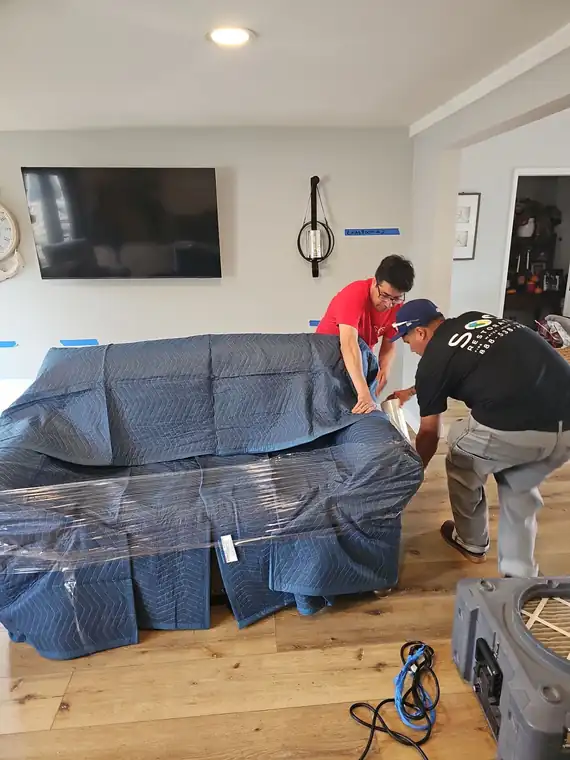
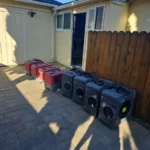
The tech who reads the meter in your hallway is the same one who drags the hose in and carries your soaked carpet pad out to the truck. What comes through the door with him is a moisture meter, an extractor, air movers and dehumidifiers, a roll of plastic and a camera. The extractor is a vacuum built to pull water back out of carpet; the air movers are those low flat fans you have seen aimed along a baseboard. Not a folder of packages to choose from.
No salesman sits at your table building a proposal while the floor is still wet.
What happens instead is a walk-through, and the useful half of it is the rooms that look fine. Water leaves the room you found it in. It goes under the door casing into the hall closet, up the back of a baseboard in the next bedroom, out along a seam in the flooring where nothing shows on the surface at all. The tech reads all of that with the meter and writes the numbers down before a single thing is moved or cut.
By the end of it you should know what is wet, how far it traveled, what has to come out tonight and what can stay. Where a piece of that answer is a guess, you should hear the word guess in the sentence.
Y si a las dos de la mañana explicar todo esto en inglés le va a costar tiempo que no tiene, no lo intente. Se habla español.
The number is (657) 660-4185, and it is written down on the contact page if you would rather not dial from memory at 3am.
What happens in the first hour on a job?
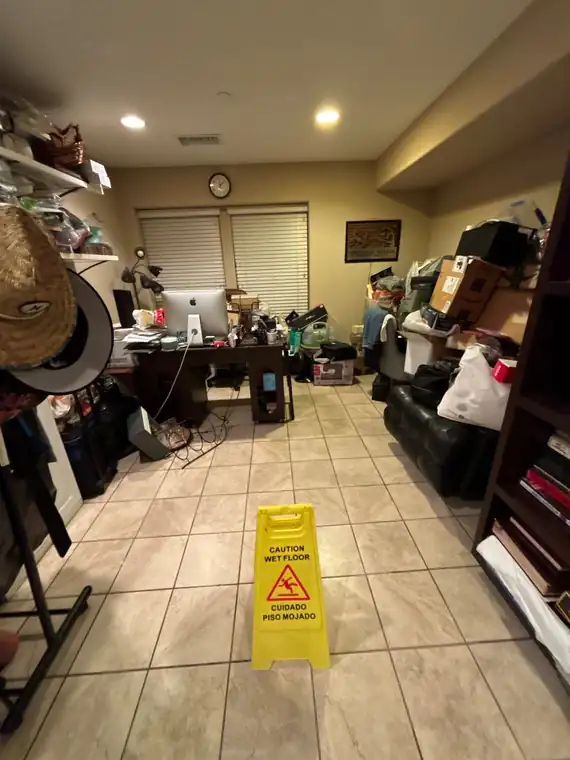
First thing is killing the source. That means the angle stop under the sink, the little oval valve on the wall behind the trap, or the main out by the sidewalk, or the breaker for a circuit with water running through it. Nothing that comes after counts for anything while the water is still arriving.
Then photographs of everything exactly as it sits, the failed washing machine hose and the split supply line included, because this is the only hour the loss will ever look like this.
Then the map. Meter readings room by room, plus one taken somewhere the water never reached, so the wet numbers have something to sit against. That untouched reading is the dry standard, and every number after it gets judged against that one. Then a decision about what leaves the building tonight. Carpet pad and soaked insulation are usually gone. Drywall depends on how high the water climbed and what is behind it. The toe kick, the flat strip at the floor under your base cabinets, comes off whether or not the kitchen looks dry, because the cavity behind it holds water for weeks. How the drying runs after that, day by day, is on the water damage page.
Extraction, then equipment, then the log starts.
Long Beach makes that equipment less optional than people expect. Air coming in off the water is already carrying a load, and a wet wall can only give up what the air around it still has room to take, so for most of the calendar here throwing the windows open is not a drying plan. The dehumidifier does the work. The air movers only feed it. What the moisture in this air does to the length of a job is on the water damage page.
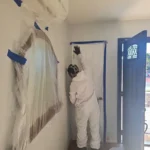
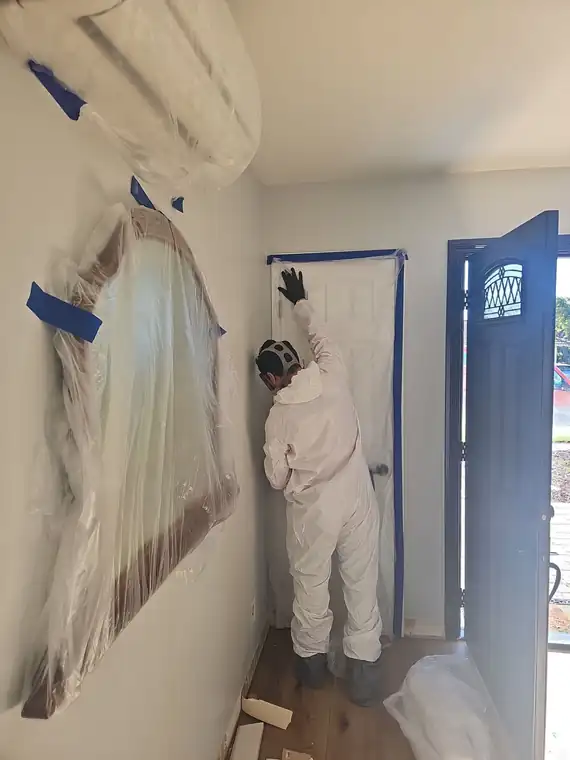
One thing gets settled before a saw comes out. If your house went up before 1980, and nearly four in five in this city did, the plastic goes up first, because the federal lead rule treats the paint in a house that old as lead paint until an inspector tests it and says otherwise. Containment before the cutting, not after.
What are the red flags when you are hiring someone after a loss?
Anybody who offers to cover your deductible, promises to handle your insurance claim, pushes paper at you with no cancellation notice on it, or leads with the word toxic has just told you how he does business, and that is enough to end the conversation at the door. Here is the rest of the list. It is worth exactly as much to you if you go on to hire somebody else.
- An offer to cover, waive, or absorb your deductible. Absorbing a deductible on an insurance repair is a fraud exposure in California, and the man offering it is showing you how he works generally.
- Anybody who will not read you the number he just took off the meter.
- A promise that the carrier will pay, or an offer to handle and negotiate the claim on your behalf. Adjusting a claim for compensation is work California licenses separately, and a cleanup company is not doing it.
- Listen to how a referral is worded. Your carrier can hand you a name. It cannot hand you an instruction, and California regulation is specific about that difference. If the referral arrived sounding mandatory, read the insurance claim page before you sign with anybody.
- Paper pushed at you on the hood of a truck. A contract to repair a home damaged in a disaster has to carry a notice, in bold type, saying you can cancel any time before midnight of the seventh business day. If the man holding the pen skips that paragraph, read the rest of it twice.
- A mold test sold as the thing that tells you whether the house is safe. The CDC does not recommend testing for mold, and since no federal or state limit for it exists, no lab result can pass or fail your house against one.
- Anyone whose first move is the word toxic. It is a selling word, not a finding, and this state’s own public health people have declined to single out one mold as more dangerous than another for a healthy household. What is actually worth knowing before you hire on that is on the mold removal page.
- A spray, a fog, or a sealer sold as the whole remedy. Dead mold still sets off allergies. Killing it was never the job. Getting it out of the house is.
Then the quieter ones. Equipment sitting in a house for days with no reading written down is equipment being billed. Ask to see the daily log, and if there is no log, ask why day four is on the bill. Get it on paper, room by room, before anybody cuts. And if the invoice comes back as one line, ask for it broken out by room and by piece of equipment; what actually belongs on one is on the cost page.
Before anybody does work in your house that needs a city permit, repiping or electrical or framing, ask for the state license number and check it yourself instead of taking the card at face value.
When are we not the right call?
We are the wrong call for a good half of what people phone us about. A dishwasher that let go onto vinyl and got mopped up the same afternoon. A small patch of mold on a hard surface with the leak already fixed. A pipe still running that needs a plumber first. A rental, where your landlord gets the first written notice. Anything more than about ten miles out from Long Beach.
That dishwasher does not need a truck at your curb. Mop it, take the toe kick off the cabinet beside it if it comes away with a screwdriver, and leave a fan running in the doorway overnight with the cabinet doors open. Two days on, press your thumb into the vinyl seam nearest the machine. If it feels cold and gives a little where the floor a yard away does not, that is the morning to call.
If water is still coming out of a pipe, the plumber goes first. Drying a wall against a live source is money spent on nothing. Same with a roof in the middle of a February storm. Stay off it in the dark, get the bucket down, get the rug and anything paper off the floor, and have a roofer up there in daylight.
Small mold is a homeowner job far more often than the internet lets on. The line the EPA draws for homeowners is about ten square feet: under that, on a hard surface, with the leak already fixed, you can clean it yourself. Fix the water first, though. Every piece of mold guidance a health agency has ever published comes back to the same sentence, which is dry it and keep it dry, or it returns.
If you rent, the first call is your landlord, in writing, with photographs and a date on them. If that goes nowhere, who hears the complaint depends on which side of a street you live on. A Long Beach rental stays with the city, which runs its own environmental health department. The identical complaint one block into Lakewood or Signal Hill goes to the County instead, different inspector, different clock.
Distance is the last one. Past about ten miles out, the drive stops being an emergency response and turns into a scheduling problem, and a company closer to you will serve you better. More of what people ask before they call is on the FAQ page.
What happens after you leave?
What you are left with is a dry structure, the carpet pad and the soaked insulation and the cut drywall already hauled out, the source identified, and a file.
The file is the plain working kind. What the meter read in the hall closet and the back bedroom, day by day, set against that dry reading from a part of your own house the water never touched. The rooms shot before anybody moved anything. A list on paper of every piece that came out of the building with the reason it could not stay written next to it. Wet framing does not look wet. Readings walking down toward that dry number, morning after morning, are the only honest way you or your carrier can tell the structure is finished.
Putting the house back together after that, meaning new drywall, texture, paint, flooring and cabinets, is a rebuild, and it belongs to a different contractor with a different scope. Hand that person the file. It is the fastest way to get an accurate number out of him, since he can see what was opened and why.
Ask him two things before he starts. The first is what he is pulling permits for. Long Beach wants a plumbing permit and an electrical permit before that work begins, with no dollar amount underneath either one, and neither of those gets waved through at the counter the way a simpler job can. That is where a rebuild quietly turns into weeks.
The second is asbestos. The air district wants the building looked at before anybody demolishes or renovates, and on a single-unit house the only job small enough to skip that is under 100 square feet of material.
One more if the property is a rental outside Long Beach. The county inspector wants to see the wall cavity while it is still open, so the new drywall cannot go up until he has been out.
Can't call right now? Send it and we call you.
Your phone number is the only thing we really need. Everything else helps us load the truck right.
If it is happening right now in Long Beach, call (657) 660-4185 and somebody will pick up, whatever hour of the night it is.