
Rain is getting into your Long Beach house tonight
Storm damage work in Long Beach means chasing the rain that got in through the roof, a window, or a wall: finding where the water traveled, pulling the soaked insulation and drywall, and drying the framing before it turns into a mold problem in March. SOS Restoration answers at (657) 660-4185, any hour, any night of the storm.
Water is coming through my ceiling during the storm. What do I do right now?
Get a bucket under it, then put a hole in the low point of the bulge with a screwdriver and let it drain. A ceiling that is holding water lets go all at once, and it brings the light fixture, the insulation, and thirty years of attic dust down with it. Draining it on purpose is the cheaper failure.
Kill the breaker for that room first if the water is running anywhere near a ceiling fan or a can light, one of those recessed cans sunk up into the drywall.
Then move what actually matters, which is almost never the furniture. It is the paperwork, the hard drives, the boxes of photographs on the closet shelf under the wet spot. Take pictures of all of it before you shift anything, from the doorway and then up close, because the record you make in the first ten minutes is the one nobody can argue with later. Our list of what to photograph takes about four minutes to work through.
One drip landing in a pot on a tile floor does not need a crew. Set the pot, go to bed, look at the ceiling in daylight, and check the same spot two days after the rain stops to see whether the ring has grown.
Water coming under a door rather than through a ceiling is a different night altogether. Long Beach keeps sandbags at neighborhood fire stations year-round and opens extra pickup points once storm season starts, ten bags per resident with an ID.
Should I put a tarp on the roof myself?
No. Not in the dark, and not on a wet roof.
A wet shingle roof is ice on a slope, and a low-slope apartment roof with an inch of standing water on it is worse, because you cannot see the soft spot before you put your weight through it. The wind that is driving the rain in is the same wind that turns a loose tarp into a sail.
The useful work is inside, and specifically in the attic if the house has one. Water rarely comes in above the stain. It hits the plywood deck under the shingles, runs down a rafter, and drops off wherever that rafter dips, so the hole is often several feet uphill of the wet spot on your ceiling. Follow the drip up with a flashlight, set a mop bucket directly under it, and pull the wet insulation out of the way.
A tarp goes on in daylight, on a dry roof, by somebody who is tied off. Covering the hole is not optional if you intend to make a claim, though. The California Department of Insurance tells people that making temporary repairs to prevent further damage is one of the most important things to do after a loss, and that the reasonable cost of protecting the property comes back to you as long as you keep the receipts.
If you would rather talk to a person at two in the morning than fill in the form on our contact page, call (657) 660-4185.


What happens after you leave?
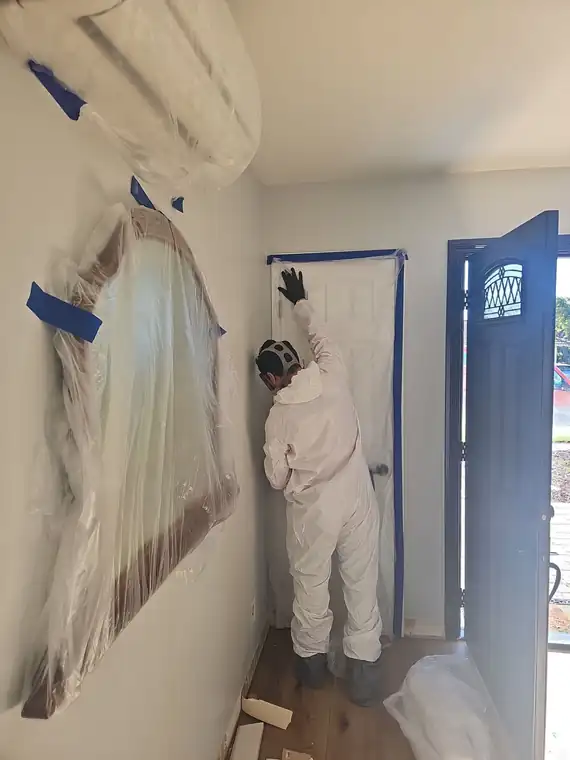
You get the file. Photographs from before anything was touched, a moisture map, which is a sketch of the rooms with the wet areas drawn onto it, the daily readings with dates on them, the equipment log, and a plain list of what was removed and why it came out. The readings are the part that matters most later, because they are what proves the cavity was dry on the day the next trade started and not just dry-looking.
The roof itself is the next call, and it belongs to a roofer. We dry the house and open what has to open; the roofer makes the water stop coming in. Ask where the water actually entered, which is often nowhere near your stain, and make them show you a photograph taken from the roof surface that day. Ask too whether what failed was the flashing, the metal that seals a joint or an edge, or a scupper, the drain hole cut through the low wall around a flat roof, and whether they are proposing a patch for this season or the real fix.
Drywall, texture, paint, and new insulation come after that, and nothing should be closed up while a reading is still climbing. Show the finish trade the log before they hang board.
Keep the file. It answers the smell in six months and the buyer’s inspector asking about the ceiling patch three years from now.
Storm work out here is almost never rising water. It is a roof, a window or a drain that gave up. In Manhattan Beach it is wind driving rain sideways into a wall that faces the water. In Rancho Palos Verdes it is runoff finding a way in from uphill, which is its own kind of problem on that peninsula. In Inglewood it is a flat roof that ponded because nobody cleared the drain in October. Same trade, three different ways in.
Why did my roof only start leaking this year?
Because a roof here only gets tested a handful of days a year, and this was one of the years it got tested properly. Measurable rain falls on about 35 days out of 365 at the airport gauge. The other 330 days your roof sits in the sun getting older, and nothing about how it looks up there tells you what it will do in February.
It also arrives in a heap. Four fifths of the year’s rain lands between December and March, so the roof sits untested for eight or nine months and then takes all of it at once.
Then February 2024 happened. That one month put 11.95 inches through the gauge at Long Beach Airport, within a tenth of an inch of what a normal entire year delivers, most of it in three days. Roofs that had never leaked leaked.
That storm did not sort by age or budget. Afterward the City of Long Beach said it was writing repair plans for at least 41 city-owned and leased buildings with known leaks and water damage. If the city’s own portfolio took water, the third layer of shingle on a 1954 house was never going to hold.
Age does the rest, and this is an old city. About half the homes in Long Beach were finished in 1959 or earlier. Nothing on a roof that age fails on a dry day. It fails on the fourth day of rain, at the one seam that was always marginal.
The kind of building matters as much as the year on it. Close to four in ten homes here sit in buildings of five units or more, and those mostly carry low-slope roofs, the near-flat kind where rain stands in a puddle instead of running off the edge. A pitched roof leaks where the water crosses it. A flat roof leaks where the water sits, which is why the stain on an apartment ceiling is so often nowhere near the actual hole.
The rain stopped and the ceiling looks dry. Is it?
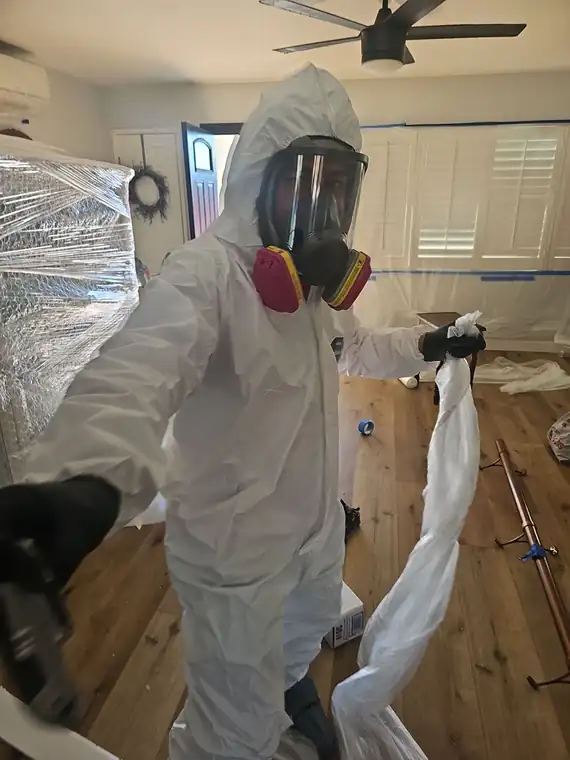
Probably not, and the ceiling is the least reliable thing in the room to judge by. Painted drywall gives up its surface moisture to the air in about a day, so it looks fine from the floor while the paper backing, the framing above it, and the insulation lying on top of all of it are still wet.
Insulation is the part nobody sees. Blown fiberglass over a bedroom ceiling holds water the way a sponge does, then hands it back into the cavity for weeks, into the top plate, the flat board that caps the wall framing, and into the ends of the joists above the drywall.
The weather works against you in exactly the months it rains. December here averages about 18 days with fog or mist, more than any month of summer, so the air you are trying to dry into is already carrying water. Opening the windows on a wet December morning does close to nothing.
The number to hold onto is 24 to 48 hours, which is the window the EPA gives for drying wet materials before mold gets started. Once you are past it the question stops being whether the ceiling looks dry and becomes what is still wet and where. A moisture meter, a probe that reads how wet a material is behind the paint, settles that in a minute.
Three weeks later is when the phone rings about a smell in the hallway, and that call is the same water. If a room was already dried and still smells wrong, the cause is usually water still trapped in the framing and insulation. By then it is mold work on a job that started as a roof leak, and it costs more than the drying would have.
What does storm damage cleanup include?
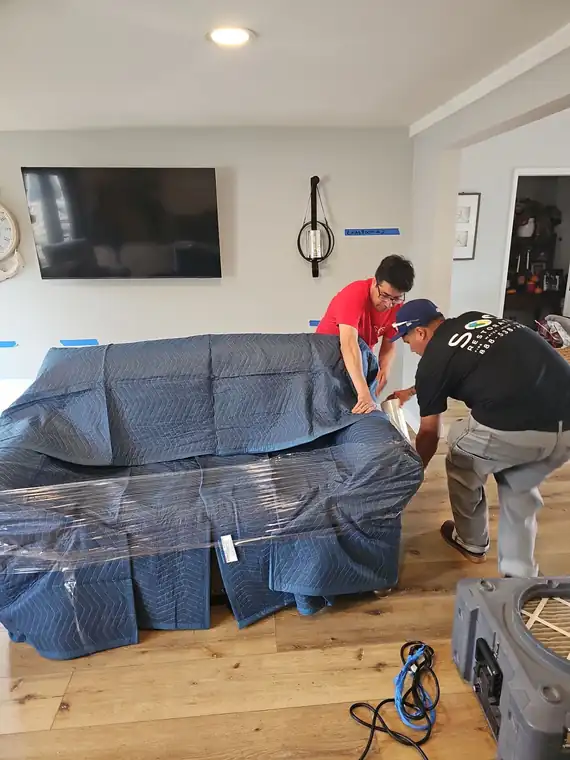
We pull the standing water first, then the wet insulation and the drywall that will not dry, then set fans and a dehumidifier and take readings on the same marked spots every day until they stop dropping. On a rain intrusion that usually means:
- Wet insulation pulled out of the ceiling or wall cavity. It does not dry in place, and while it sits there it holds water against the framing.
- Openings cut where the meter says the water stopped, not where the stain ends. Often that is a strip of drywall along the wet edge, or a two-foot square of ceiling.
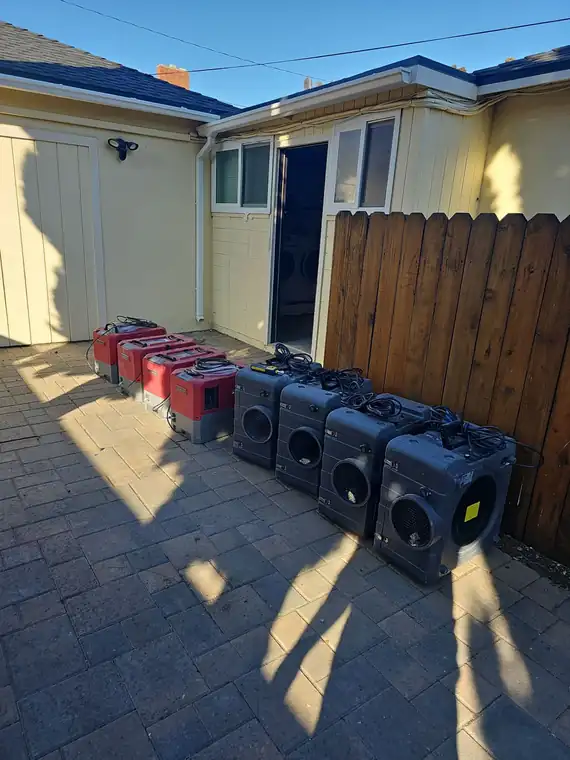
- Air movers, which are squat high-speed fans aimed along the wet surfaces, and a dehumidifier sized for the room rather than the kind you buy for a closet. A single wet bedroom ceiling is commonly three or four movers and one dehumidifier, running around the clock.
- Carpet lifted and the foam pad underneath thrown out where the water reached the floor. The pad is the part that holds it.
- Readings taken on the same marked spots at the same time each day and written down with the date, so the drying is on paper rather than on somebody’s word.
How long it runs depends on what got wet. Plaster and a soaked stud bay, the hollow gap between two wall studs, take longer than drywall and open framing in a dry week, and the honest answer on day one is a range with the reasons attached. From there it is the same drying as any water damage job in the city; only the way the water got in is different. The labor is billed by the hour, and an emergency call-out starts at $90 an hour whether it is a Tuesday afternoon or a Sunday at 3am; the rest depends on the job.
Will my insurance treat a roof leak differently from a burst pipe?
Yes, and the difference is usually the whole argument. A burst supply line is a cause the standard homeowners policy names outright. Rain coming in through the roof or a window is not, and that one turns on whether there was an opening in the building and how the opening got there.
The standard homeowners form, as the Insurance Information Institute publishes it, covers water that escapes by accident from a pipe or an appliance inside the house. That is your burst supply line. The same form excludes wear, deterioration, and dry rot, which is the language a carrier reaches for when the roof was already at the end of its life.
Your policy is the only document that answers your version of this, and your carrier is the only one who can confirm it.
Water that came off the street or out of a channel rather than through the roof is a different policy entirely. Flood is sold separately, and the state insurance department puts it plainly: homeowners policies do not cover flood damage, but they do cover other kinds of water damage.
That line gets drawn in real neighborhoods here. ZIP 90803, which is Belmont Shore, Naples, the Peninsula and Belmont Heights, carries 151 federal flood program claims filed between 1980 and 2024, close to three times any other Long Beach ZIP. If you are down there, which policy pays is not a theoretical question.
What travels well into a claim file is dated photographs, the moisture readings, a note of when the rain started and when you found it, and receipts for anything you bought to stop it getting worse. We put the readings and the photographs in writing and hand them to whoever is handling the claim; the filing is yours. The claim page goes through what a carrier asks for and in what order.
Worth knowing before you spend anything: what you are paid for temporary repairs comes out of the total settlement rather than sitting on top of it.
Water damage
Mold
Fire & smoke
Sewage cleanup
The cities we drive to for this work
Storm damage tends to arrive for a whole neighborhood at once. We work Long Beach first and the Los Angeles County cities around it; each city page says what its roofs and yards usually do in a wet winter.
Can't call right now? Send it and we call you.
Your phone number is the only thing we really need. Everything else helps us load the truck right.
If rain is coming through the ceiling right now, call (657) 660-4185 and talk to someone in Long Beach about it tonight, whatever time the clock says.