
In Inglewood the water that wrecks a home almost always starts inside the wall, not outside the window.
We handle water, sewage, fire and mold cleanup in Inglewood, most of it in homes and apartments where a supply line or a water heater let go overnight. Call (657) 660-4185 and tell us what floor the water started on. We answer at night, because that is when pipes break.
Why does the water that ruins an Inglewood home almost never come from the sky?
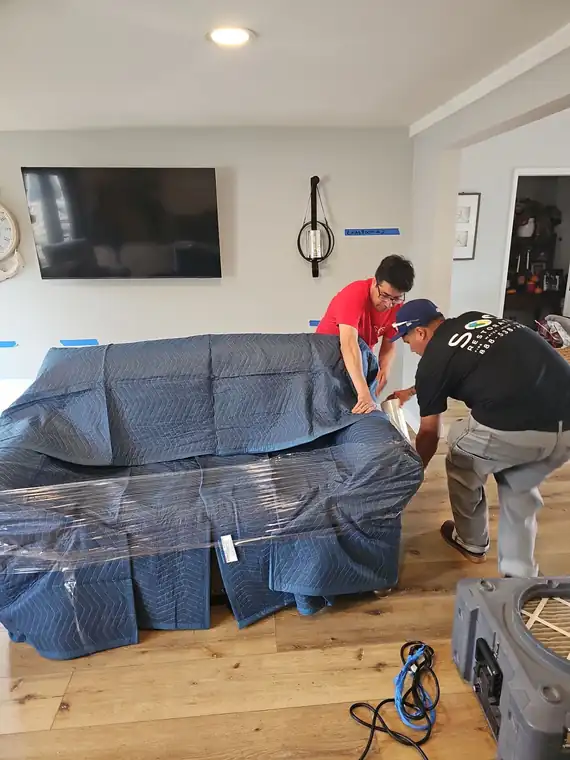
Start with the federal flood record. In the entire history of the National Flood Insurance Program, FEMA’s claim file holds twenty-three flood claims across all five Inglewood ZIP codes put together, 90301 through 90305, and not one since 2010. All but one sat outside the mapped floodplain. Twenty-three claims in five decades, in a city with forty thousand housing units, is not a flooding problem. It is a rounding error.
The water that takes a home apart here comes out of a pipe that belongs to the building. In the census the middle Inglewood home dates to 1960, with 12,637 homes already standing before 1950 and close to half the city finished before that decade turned. Half the plumbing here was laid before PVC, ABS and PEX were ordinary in houses. Behind the plaster is galvanized steel and early copper, and both fail from the inside, where nobody is looking.
Then there is the water itself. The city publishes its own numbers: the groundwater Inglewood pumps from its own wells averages 248 milligrams per liter of hardness and has come in as high as 328, close to double the 136 in the imported supply it gets blended with. Hard water is not dangerous. It is relentless. Scale coats the bottom of a heater until the steel above it runs hot, and it builds inside angle stops until the handle spins without closing anything. That second one costs people a whole floor.
Here is the free answer. Tonight, find the shutoff for your unit and turn it all the way. If it will not move, or it turns and the faucet keeps running, you just found the thing that turns a small leak into a large one. A plumber swapping a stuck angle stop on a Tuesday afternoon is the least expensive work anyone will ever do in your home.
What do you do when the leak started one floor above you and the building is not yours?
This is the normal call in Inglewood, not the odd one. Only 37.6 percent of the housing here is a detached single-family house. Nearly half of all units, 46.5 percent, sit in buildings holding five apartments or more, which in this city means the two and three story walk-ups built between the 1950s and the 1970s, parking underneath, bedrooms stacked over bedrooms. And 63.8 percent of occupied homes are rented. Put those census numbers together and you get the job: a supply line lets go upstairs, and the water is never a puddle. It runs the wall cavity, crosses the ceiling below and comes down through the light fixture into the hallway. Three households are wet, and whoever calls us usually owns none of them.
Call anyway. A tenant can let us in, and the sooner air moves, the less gets thrown away. While you chase the owner or the manager, somebody has to kill the water, and in Inglewood the answer depends on the address. The city’s own water department serves about 86 percent of homes and businesses through four wells and roughly 152 miles of main, while Golden State Water and Cal Am cover the rest, so one address in seven is not on city water at all. If yours is, Inglewood Public Works takes that call at 310-412-5333. If not, the number is on the bill in your kitchen drawer.
Sewage is a different animal with a different owner. The city’s own sewer plan describes about 145 miles of gravity pipe, mostly vitrified clay, roughly 95 percent of it only eight inches across, most of it laid before 1960. Inglewood owns no pumping stations. Nothing gets pushed anywhere; it all rolls downhill toward the county trunk lines and out to the plant in Carson. An eight inch clay line with joints older than the people living above it collects roots and grease, and when it blocks, the water does not spray. It rises, quietly, and leaves through the lowest opening it can find: the tub or floor drain of a ground floor unit. The lateral between the building and the main belongs to the owner, not the city, and the county sanitation districts that run the trunk lines answer at 562-699-7411.
Which of these five jobs does an Inglewood building actually need?
Five of them, and the right answer changes with what your floor sits on.
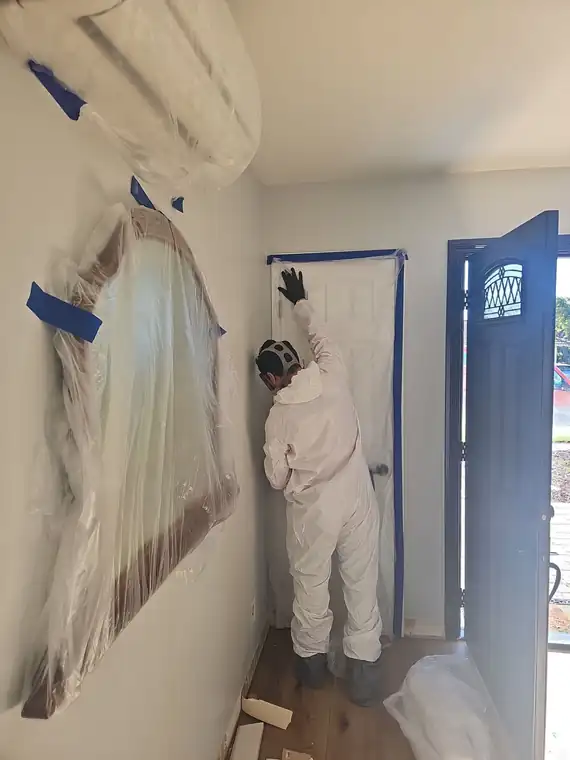
Water damage drying is most of what we do. In the older half of this city the floor is wood over a crawlspace, so the water leaves the room you can see and pools underneath, where it sits for weeks. In the newer walk-ups the slab holds it and it climbs the drywall and the baseboard instead. Same street, two different jobs. We open enough to find out which one you have before setting a single fan. Get that wrong and you dry the air in a room while the structure behind it stays soaked.
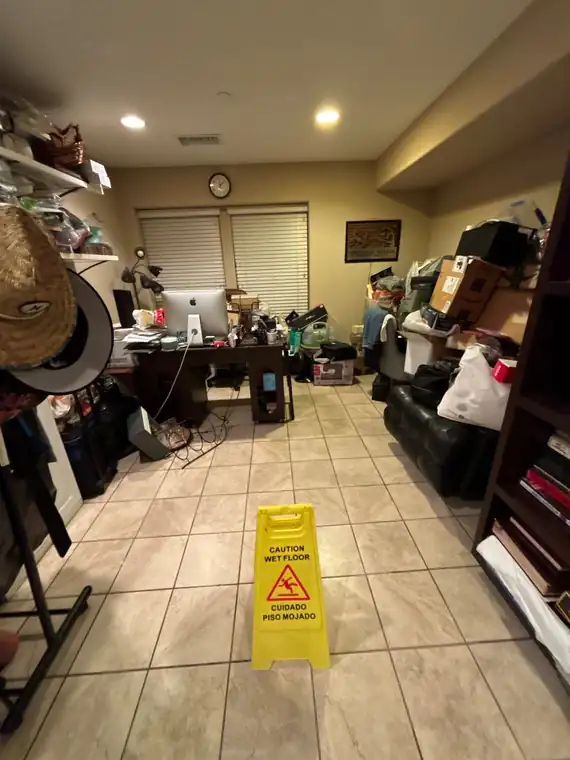
Sewage cleanup follows the clay pipe story above. In a stacked building the backup lands on whoever is lowest, and porous material that has touched it goes in a bag: carpet, pad, particle board, and the drywall up to the line the water reached. It is not a mopping job and nobody should treat it as one.
Mold cleanup has a twist that belongs to this city alone. Inglewood runs a permanent Residential Sound Insulation Department because of the airport next door, and the city publishes that the program sealed 2,075 homes in a single year and has about 3,700 more units identified under the 2020 noise contour map: double-pane windows, solid core doors, added insulation. My own read, from working inside those units and not from any study, is that a tighter envelope in a marine layer climate holds shower and kitchen humidity longer, so a slow leak under a sink has a friendlier room to grow in. Take that as a reason to run the bath fan, not as a statistic.
Fire and smoke cleanup in a walk-up is mostly a smoke problem for the neighbors. One kitchen fire, and the units beside and above it take the odor through shared cavities and return air with no flame ever reaching them. Tight windows keep the smoke in the building instead of letting it out.
Storm damage work here is wind and roof, not rising water. Given the flood file, if a storm gets you here it is because something above you opened up: a lifted shingle, failed flashing, or a clogged drain that turned a flat roof into a shallow pond.
What should you be doing before anybody knocks on your door?
Nobody on this phone is going to promise you a clock time at your door. Century and La Cienega at five, the knot where the 405 meets the 105, a crowd letting out on Prairie: the drive is whatever the hour makes it, and you would be guessing at it exactly as well as we would. What you get instead is an honest window, said out loud, and a call from the road the moment that window slips. We run this corridor daily, so if the address is actually in Gardena or Torrance, the answer barely changes. The rest of what we cover sits on the main page, and if typing is easier than talking, the form on our contact page lands on the same desk.
The hour before anyone arrives is yours to use. Kill the water at the unit shutoff, or at the building if the unit valve is the part that failed. If a ceiling is holding water in a bulge, that bulge weighs far more than it looks, so stay out from under it. Do not touch a breaker or a switch while standing in water; if the panel is dry and reachable, cut power to the wet rooms only. Then lift what you can: books, boxes off the closet floor, wood furniture legs onto foil or blocks so the finish does not print into the carpet.
Get pictures while nothing has been touched yet, wide first and then close, including the pipe or appliance that let go. Keep the failed part. Do not throw out the burst supply hose. After that, two rules depending on what the water is. Clean water from a supply line: open windows and move air. Water that backed into the room through a drain: stop, close the door to that room, keep kids and pets out, and run no fans, because a fan over contaminated water throws it into the rest of the home as mist.
Storm damage
Sewage cleanup
What is this going to cost you?
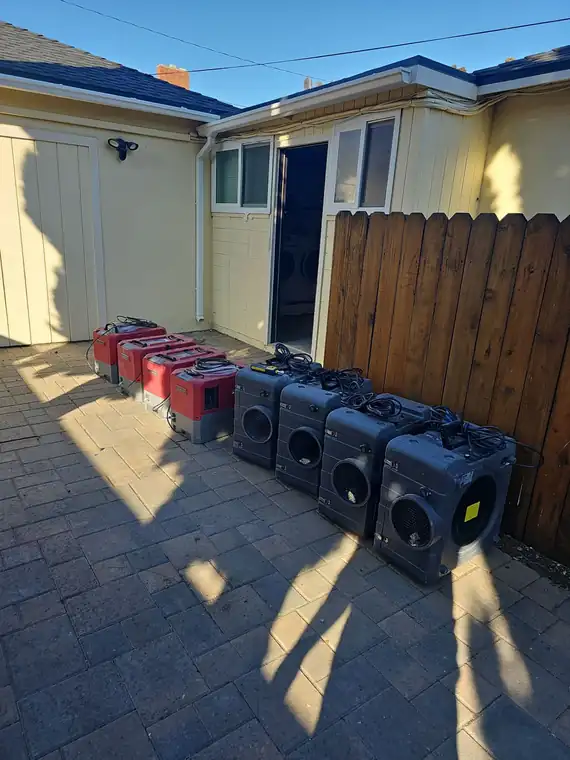
Straight numbers. Water damage work starts at $60 an hour. An emergency call, meaning nights, weekends and holidays, starts at $90 an hour. Those are labor rates, and the honest word in both is starts, because hours are the smaller half of most bills. The bigger half is equipment and time: how many air movers and dehumidifiers a room needs and how many days they stay, which depends on how much water there was, what it soaked into, and whether it sat for three days before anyone noticed. A one-room clean water loss caught the same night and a three-unit loss found on Monday morning are not the same invoice, and I would not pretend otherwise.
Ask for the count before anyone starts, get the equipment list in writing, and ask when that gear comes back out. We break the arithmetic down on the water damage cost page, and if you want to argue with a line on it, argue. Anyone who will not put the hours and the machine count on paper is telling you how the rest of the job will go.
What happens after you leave?
Here is the limit, and you should know it before you call rather than after. What we do is mitigation. We stop the spread, we take out what is soaked and cannot be dried, we clean what can be cleaned, we run equipment until a moisture meter says the framing and the subfloor are dry, and we write all of it down. The wall stays open where we opened it. Drywall, texture, paint, cabinets, baseboard and flooring belong to a different trade under a different contract, and that trade is not us.
What you should have in hand when we pull the last fan out: photos taken before anything moved, daily moisture readings with dates, a list of what we hauled away, and the equipment log. In a rented building, give the manager a copy and keep your own, because when three units are wet the paperwork is the only thing that keeps the story straight four months later. When you hire whoever puts the room back together, ask for their state contractor number in writing, and have them read the drying log before closing anything up. A wall closed over damp framing is the cheapest decision available this week and the most expensive one available this year.
Nearby
Inglewood is the far northwest corner of what we cover, straight up the 405; Gardena and Torrance are on the way, so one run can take in all three.
Can't call right now? Send it and we call you.
Your phone number is the only thing we really need. Everything else helps us load the truck right.
If the ceiling in the unit below is already sagging, call <a href="tel:+16576604185">(657) 660-4185</a> and start moving things out from under it while it rings.