
Almost every wet house we walk into in Gardena got that way from the inside.
If you are standing on wet carpet in Gardena right now, close the meter valve at the curb before you read another word, then call (657) 660-4185. SOS Restoration of Long Beach handles water, fire, smoke, mold and sewage cleanup here. The first hours decide how much of your floor survives.
Why does the water in a Gardena house almost never come from the sky?
Start with the federal record, because it settles the argument fast. FEMA’s national flood claim file, going back to the beginning of the program, shows eight paid claims across all three Gardena ZIP codes put together: three in 90247, none in 90248, five in 90249. The most recent loss is dated April 2013. Every one of them sat in a minimum risk zone, not a special flood hazard area. Cross the city line into Carson and the count nearly doubles. So when a Gardena kitchen is standing in water, the odds are overwhelming that it arrived from a line inside that same kitchen.
The reason sits under the slab. The Census Bureau puts the median Gardena home at 1964, with 6,192 houses built in the 1950s alone, and 43.7 percent of the whole housing stock already standing before 1960. Those houses went up on a drained freshwater marsh. The Dominguez Slough ran right through here, and the concrete channel that drained it was dug between 1949 and 1967, which means the ditch was still being cut while the tract houses were being framed. The last intact piece of that marsh is the 13.6 acres of the Gardena Willows Wetland Preserve. And the city’s own stormwater plan, the one filed with the regional water board, says the entire city, all 5.87 square miles of it, drains into the Dominguez Channel through five outfalls. No creek. No slope. Nothing else.
That is not trivia, it is the physics of your floor. Water in flat, filled marsh ground does not run downhill, because there is no downhill. On a slab it behaves the same way: a supply leak is not a puddle you can mop, it travels sideways under the floor and climbs the drywall by capillary action. What most people see first is a dark line low on the wall, just above the baseboard, days after the leak started. By then the sill plate and the bottom of the studs are wet too.
Nobody has knocked on your door yet, so what should you be doing?
We are not going to invent an arrival time for you. Anyone who does is guessing, and you will remember the guess. What is honest: call and ask where the truck is and what it is on right now, and you get a straight answer about tonight. The same crews run out to Torrance on one side and Carson on the other, and the differences are real, since Torrance runs its own municipal water system and Carson has an even higher share of manufactured homes than Gardena does. If you would rather type than talk, the contact form reaches the same phone.
While you wait, in this order:
- Shut the water off. The curb valve is the water company’s; the one you want is usually the house valve near the hose bib or the water heater.
- If the water is anywhere near outlets or a panel, kill the breakers to those rooms and stay out.
- Shoot the room on your phone before anything gets picked up. One wide frame from the door, one tight on the dark line the water left, one on whatever let go.
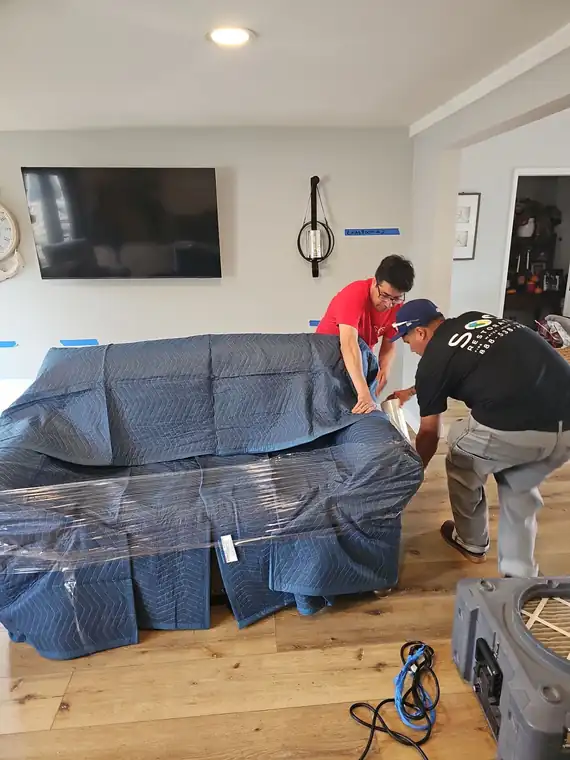
- Pull up area rugs and get furniture legs off wet carpet. Foil or wood blocks under the legs, or the finish bleeds into the pad and never comes out.
- If you rent, tell the manager in writing, in a text or an email with a time stamp on it. Verbal does not survive month three.
- If you are upstairs, knock on the downstairs door now. Do not wait for their ceiling to tell them.
- Leave the wet drywall alone. Punching holes in it before anyone has taken a reading destroys the map of where the water went.
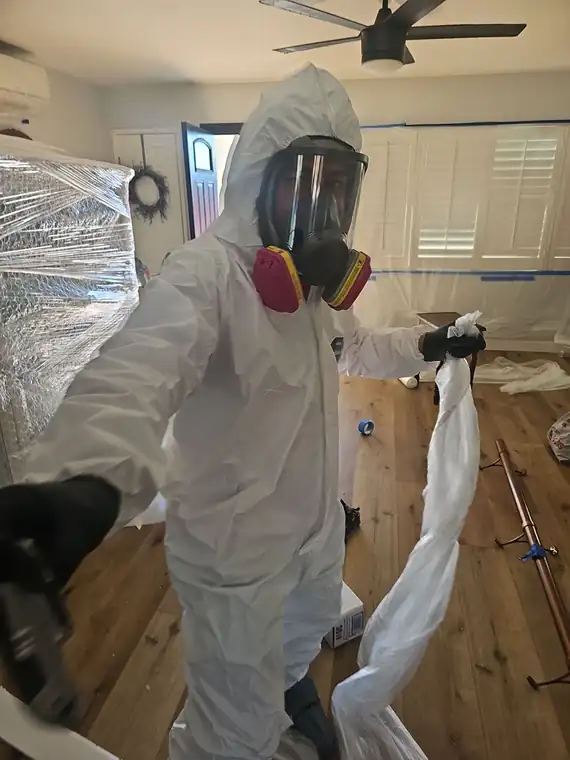
Shut the water off
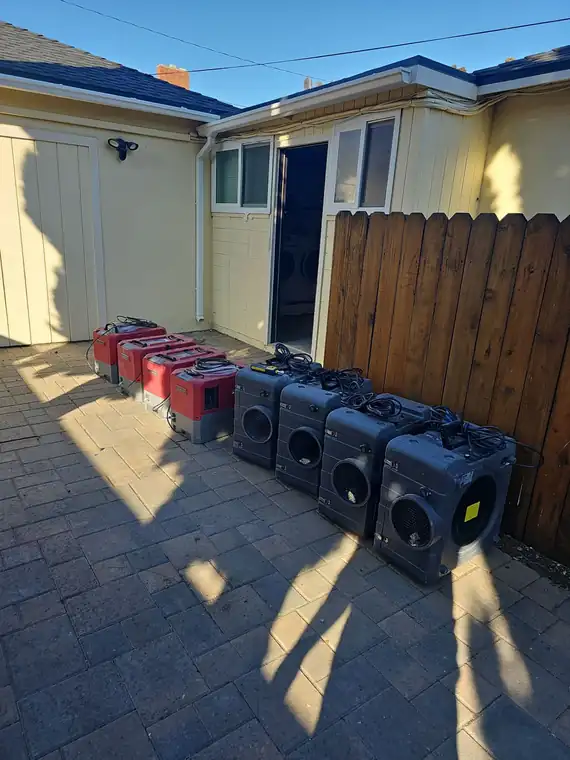
If the water is anywhere near outlets or a panel, kill the breakers to those rooms and stay out
Shoot the room on your phone before anything gets picked up
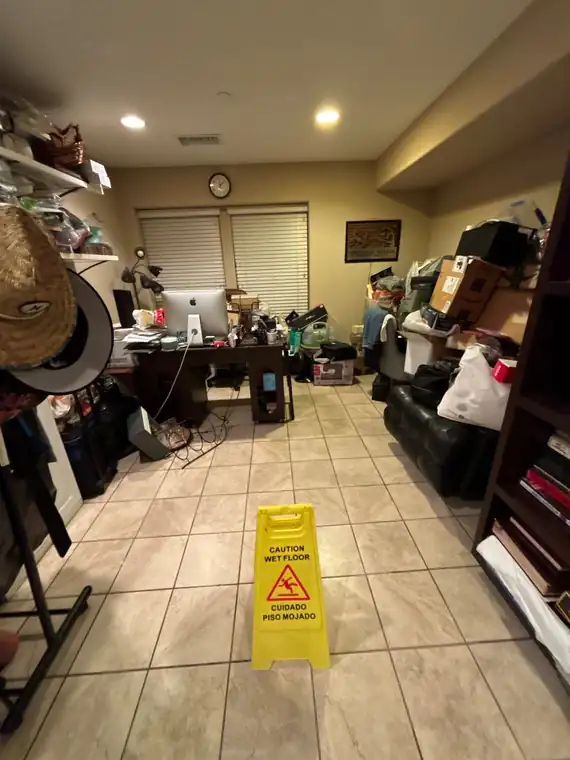
Pull up area rugs and get furniture legs off wet carpet
If you rent, tell the manager in writing, in a text or an email with a time stamp on it
What is eleven grain water doing to the copper in a 1964 house?
The city of Gardena does not sell you your water. Golden State Water Company does, through its Southwest system, and that matters at two in the morning, because the shutoff valve at your curb belongs to them and not to City Hall. Their own water quality report for that system puts hardness at an average of 180 milligrams per liter, which is 11 grains per gallon, running as high as 16 in some samples. That is genuinely hard water. It drops scale in the bottom of a water heater tank and on the inside of supply lines, and the same report names internal corrosion of household plumbing as the source of the copper it picks up at the tap. The utility is describing, in careful regulatory language, the single failure that fills our schedule.
Put that water through plumbing from the Eisenhower years and you get a short, repetitive list of what breaks in this town. A water heater that rusts through at the bottom seam and empties the whole tank onto the hallway floor while everyone is at work. A pinhole in a copper line inside a wall, dripping for weeks before anyone smells anything. A cast iron drain line gone thin, backing up at the lowest fixture in the house. Roots in the lateral, the private run of pipe between your foundation and the main under the street.
On that last one, know something before you agree to pay for anything. In most of California the lateral belongs to the property owner rather than the utility, but get that confirmed for your specific parcel instead of taking a contractor’s word for it. And if the backup is in the street rather than your yard, the sanitary mains inside Gardena are maintained by the city itself: the City of Gardena Public Works sanitation division takes backup reports at (310) 217-9568. That call is free. Make it before you pay anyone to snake a line that is not yours.
How do the five jobs actually go in a slab house on filled ground?
Five kinds of work, and each behaves differently here than in a hillside house with a crawlspace you can climb into.
Water. Most of what we do in this city is water damage cleanup, and on a slab the job is mostly about finding where the water traveled, which is almost never where it came in. We map it with a meter and open the wall where the moisture reading says it is wet, not where the stain looks worst.
Mold. The Census counts 1,247 manufactured homes in Gardena, about one in every eighteen, which is twelve times the rate in Hawthorne one city north. A manufactured home has no slab. It has a raised floor with a belly wrap underneath, and water that gets up into that cavity sits on top of the insulation, invisible, drying at its own pace over months. That is why mold removal in that kind of home is a different procedure with different equipment, and why almost nobody quotes it right over the phone. The 24 to 48 hour clock is the same everywhere.
Fire and smoke. Only 43.8 percent of homes here are detached houses. There are 8,345 units in buildings of three or more, and hardly any are towers, so Gardena is really garden apartments and dingbats of two and three stories. Smoke in that kind of building rides the shared framing into units that never saw flame, which is why fire and smoke cleanup in an older complex starts with mapping how far the smoke actually went before anyone opens a bucket.
Storm. Real wind damage is rare here and real flooding is rarer, but when those five outfalls are running full, street water has nowhere to be, and it sits. Storm damage work in Gardena is usually a roof that has been up since the Kennedy administration finally letting go at a valley or a flashing, plus whatever came in behind it.
Sewage. Thin cast iron and old roots make sewage cleanup a steady call here, and in a two story fourplex the upstairs backup lands in the downstairs neighbor’s ceiling within hours. Most of Gardena rents, 51.2 percent by the Census count, so this is usually two households, two policies and a property manager, all arguing about who calls while the clock runs.
What is this going to cost you, and what should you refuse to pay for?
Plain numbers. Water damage work starts at $60 an hour. An emergency call, the kind that comes in at two in the morning on a holiday weekend, starts at $90 an hour. Equipment and materials are separate, and any honest crew tells you on site how many air movers a room needs and why. If you want the arithmetic broken down before you call anyone, we wrote it out on the cost page.
What you should push back on: a flat number quoted over the phone, sight unseen, for a slab house. Nobody knows how far the water traveled without walking it. Push back on drying gear left running for days after the readings stop moving, and on tearing out cabinets on day one when a probe and two days of air would have saved them. On plenty of Gardena calls the honest answer is that a plumber fixes the pipe, a couple of fans and a dehumidifier finish the job, and you never needed a cleanup crew. We would rather say that on the phone than bill you for finding it out.
What happens after you leave?
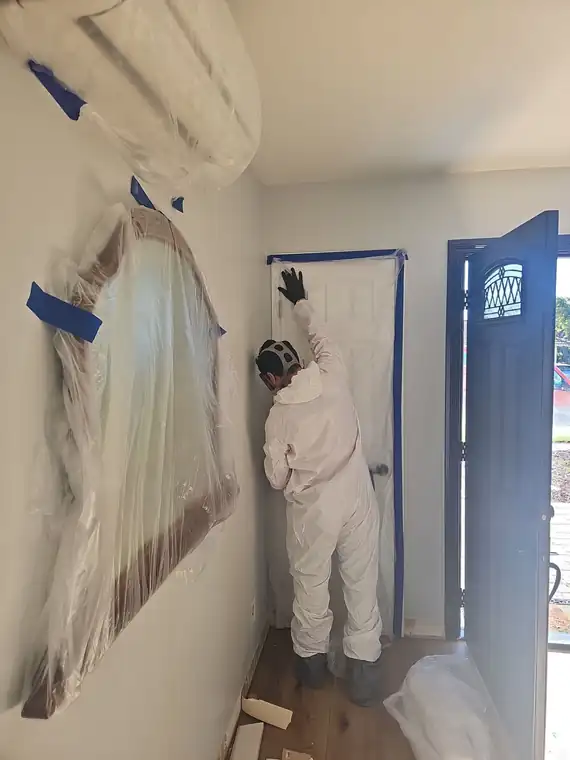
Here is the part most companies leave vague, so read it twice. What SOS Restoration of Long Beach does is mitigation. We stop the damage from spreading, dry the structure down to a stable moisture reading, remove the drywall, carpet, pad and insulation that cannot be saved, clean and treat what stays, and document all of it. We do not put your house back together afterward. The drywall, paint, flooring, cabinets and trim are a separate trade and a separate contract, and it is not ours.
People learn that at the worst moment, walls already open, having assumed one crew would carry it to the end. Plan for it on day one. Line up whoever does that next stage while we are still drying, ask them to put their state contractor registration number on the written estimate, and make sure their scope starts where our documentation stops.
When we pull the last fan out, you should be holding a moisture log with dated readings, photos from before and during, and a written list of every material we removed and from which room. Hand that stack to whoever does the drywall, paint and flooring, and they can bid off dated readings instead of guessing how far the water ran sideways under a 1964 slab. The same stack answers the questions that come up later about the claim, so nothing rests on what anyone still remembers three months out. Everything else this company handles across the South Bay is laid out on the main page. If the floor is wet while you are reading this, stop reading and call (657) 660-4185.
Nearby
Gardena sits between Long Beach and the beach cities, so a truck headed for Torrance or the coast passes it either way, and often stops here first.
Can't call right now? Send it and we call you.
Your phone number is the only thing we really need. Everything else helps us load the truck right.
Wet floor in Gardena tonight, call <a href="tel:+16576604185">(657) 660-4185</a> and we will tell you straight whether this is a crew job or a plumber and two fans.