
Here is how a Long Beach water damage claim works for the person who has to file it
If the water arrived all at once, your policy probably covers it. If it seeped for months, probably not. SOS Restoration does the emergency drying in Long Beach and writes down what it finds every day, so what you hand your carrier is a file instead of an argument. Call (657) 660-4185, 24 hours.
Does homeowners insurance cover water damage?
Usually yes if it arrived in one event, and usually no if it seeped. That one distinction decides more claims than every other clause in the policy put together.
The hose behind the washing machine lets go while you are at work. The ice maker line splits. The water heater in the garage gives up overnight. That is the shape of a covered loss on the standard homeowners form most California policies are built from: an accidental discharge or overflow of water from a plumbing system or from a household appliance. What it will not cover is flood, which the California Department of Insurance says plainly because it is the thing people get wrong most often.
Then the form takes part of it back, and this is the half people find out about later. A split supply line gets you a claim for the wet floor, not a new dishwasher, because the appliance or the system that actually failed is excluded. Surface water and sewer backup are cut out entirely.
Mold is excluded too, with one narrow opening for growth hidden inside a wall, a ceiling or under a floor that came from an accidental plumbing or appliance leak in the house. That is a different animal from visible mold in a room you use every day.
None of that tells you what your policy says. Your declarations page, the summary sheet at the front that lists your coverages and your deductible, and a phone call to your carrier are the only two places that answer lives.
Why do insurers deny claims for a slow leak?
Insurers deny slow-leak claims because the standard homeowners form does not read gradual damage as an accident. Wear and tear, deterioration, corrosion and dry rot are all excluded, and so is a part that simply broke from age.
A pinhole in a copper line wets a stud bay, the hollow framing space behind the drywall, for a year. The first sign anybody gets is a baseboard that will not hold paint. Nobody was careless. The policy still does not call it sudden, and that is the paragraph a carrier reads back to you.
People come out of this furious, and the fury makes sense. You reported the leak the day you found it, and the letter talks about how long it ran. How long it ran is the part you can put evidence against.
- The plumber’s invoice, if it names the actual failure: a cracked fitting, a split braided hose. The part has to be on the paper.
- Photographs taken before anything was moved, mopped or thrown out. What to shoot, and in what order.
- Moisture readings taken on day one, on named materials, so there is a starting number to argue from.
- The date, the time and the name of whoever you reported it to.
If you are in one of the early-1950s tracts in east Long Beach or over toward Lakewood, plenty of those houses still run their original supply lines. That is why the wear-and-tear paragraph gets read out loud so often around here.
Do you work directly with insurance companies?
No. You hire SOS Restoration, the invoice comes to you, and no carrier tells this crew what to charge or what to pull out of a wall.
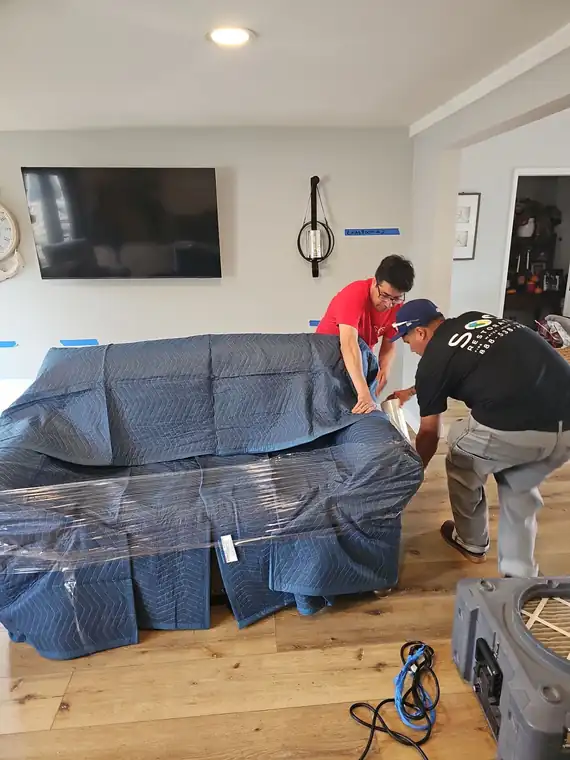
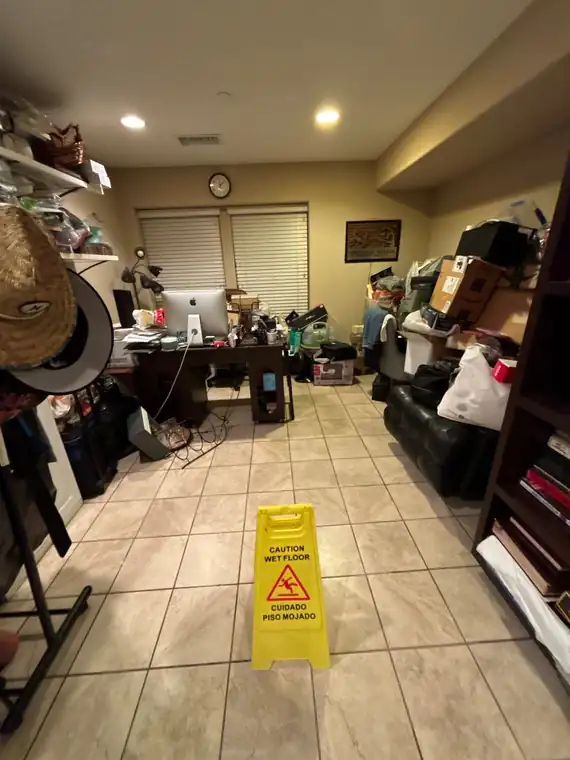
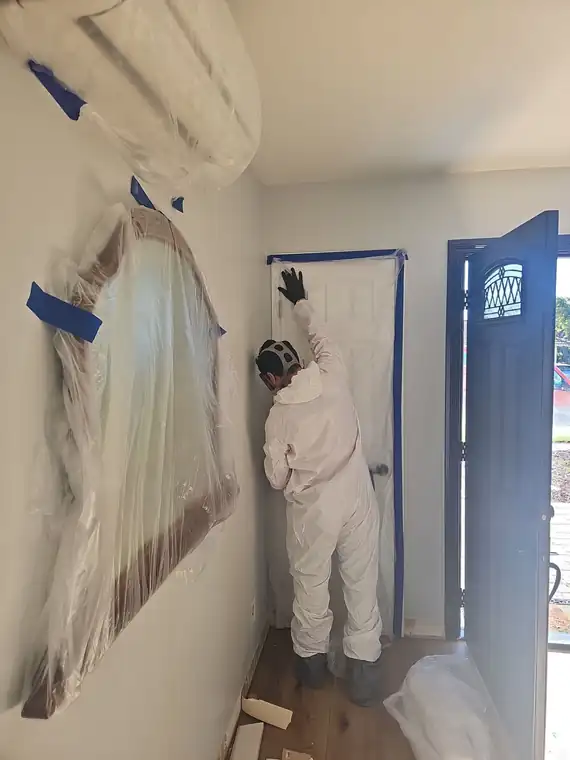
What you get instead is documentation. The loss gets photographed before a fan is set down. A pin meter, the handheld probe with two needles that reads how wet a material is, goes into the bottom of the drywall, into the subfloor and into a stud. The same reading gets taken in a closet on the far side of the house that never got wet, so there is a normal number to measure the wet ones against.
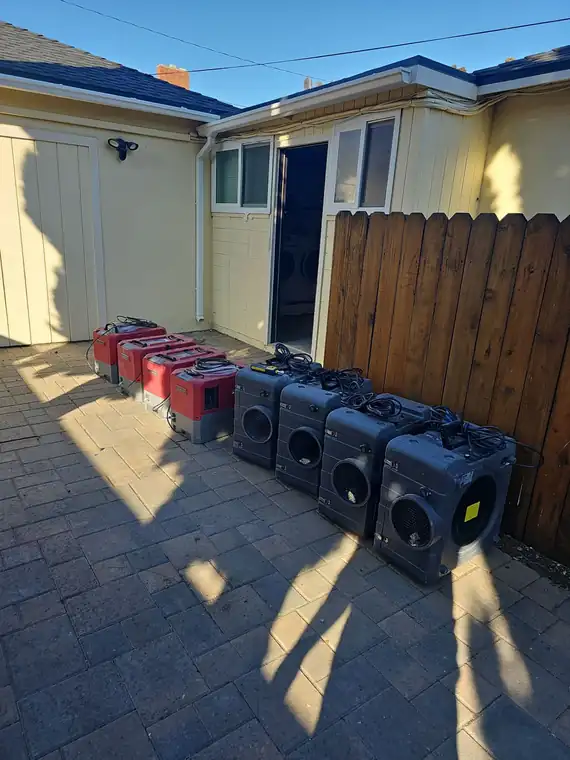
Those numbers go in the log every day until they stop falling. A bathroom-and-hall loss in a Long Beach tract house typically runs three air movers, the low flat fans that push air along the floor, and one dehumidifier pulling the water back out of the air. Each machine and each day it stayed is a line on the invoice. Anything that comes out, the bottom twelve inches of drywall or the pad under the carpet, is written down with the reason.
You get that file. You, or whoever is handling the claim for you, files it.
Nobody can make you use a company the insurer picked. California’s claims regulations say an insurer may not require that your property be repaired by a specific company, and may not even suggest one unless you asked for the referral or you have been told in writing that the choice is yours.
One thing to understand before you sign anything: a work authorization for restoration work is a contract with the contractor, not with the insurance company. If the carrier pays less than the invoice, the balance is still yours. Ask the awkward version of that question before the equipment goes in.


My carrier assigned an adjuster and a company I never called. Who are they?
The adjuster works for your carrier or was hired by it, and the restoration company that called you got your name from the same place. Neither one is your contractor until you sign something.
Get the name, the firm and who pays them, and write it down the day you meet them. Some adjusters are staff at the insurance company and some are independent, meaning an outside firm the insurer pays to look at the loss and write the estimate. Either way, the number that comes back is the carrier’s opening position, not a verdict. That is what you want on the table when the estimate reads short.
A restoration company that phoned before you called anyone was almost certainly dispatched off a list your carrier keeps. Nothing about that list is illegal and the crew on it may be very good. The rule above is still why you can say no thanks and hire whoever you want. If the person at your door will not say who sent them, you have your answer.
The water came from the unit above mine. Who pays?
Most of the time your own policy pays first, and the two carriers sort reimbursement out between themselves afterward. What settles it in the end is paperwork: your own policy, the upstairs owner’s policy, and the association’s CC&Rs, the recorded rules that say which parts of the building belong to the owners and which belong to the HOA.
That line between the common area and your unit moves from building to building, so somebody has to actually read it. Your own policy covers your side of it. The upstairs owner’s policy only becomes the answer if their carrier accepts fault, which is a separate fight from whether the water was accidental.
Read your CC&Rs, or ask the board for the section on water crossing between units. The longer version is here.
Downtown and Alamitos Beach are where this gets tangled, because one failed supply line on a fourth floor can open three claims at three different carriers before breakfast. If you rent, your policy covers what is yours and stops at the paint. The ceiling itself belongs to the owner or to the association, and those two argue with each other rather than with you.
One thing gets skipped constantly. Somebody has to authorize work in two units and sometimes in the hallway between them, and only an owner, a property manager or the board can do that. A tenant standing under the drip cannot. Get a name and a number for that person before you call anyone, because drying the lower unit while the cavity above it stays wet leaves half the water in the building.
How long does a water damage claim take?
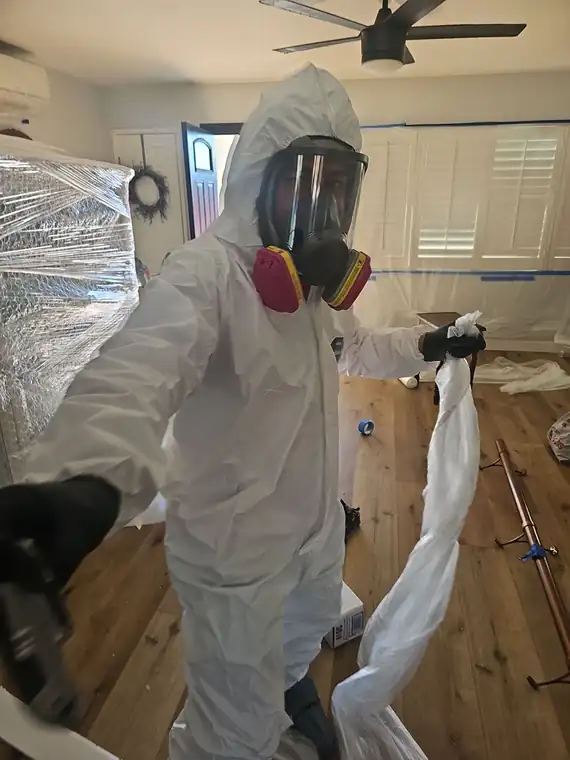
Drying equipment usually comes out in a matter of days. The claim behind it, and the rebuild behind that, run for weeks. Two clocks, nowhere near the same length.
What moves the drying end: how much water, how long it sat before anyone found it, what drank it, and how closed up and warm the house is. Tile over a concrete slab gives moisture back quickly. Hardwood over a wood subfloor, or a wall cavity packed with insulation, holds water long after the surface feels dry to a hand, and a meter is the only honest way to tell those two apart. What the drying week actually looks like has its own page.
The carrier’s side has clocks on it too, and they are longer than they sound. Your insurer gets fifteen calendar days to acknowledge the claim and send you the forms and instructions, and the same fifteen to answer a letter that expects an answer.
The one that hurts is forty days. That is how long the carrier has, once it holds your proof of claim, to accept or deny it in whole or in part, and it can write inside that window and say it needs more time. A carrier can use every one of those days and still be inside the rule while you are living in a house with the floor open.
After it accepts, there are thirty more days for the money to actually come. That is the published pace, not a delay you can chase.
What is going to come out of my pocket?
Your deductible comes out first. After that it is the gap between what your carrier pays and what the work costs, and nobody can size that gap for you before somebody has walked the loss.
What people are really asking is whether they are about to be handed an invoice they have no way to check, by a company whose name they got off a phone screen while standing in water. SOS bills by the hour. Hours, how many machines, and how many days those machines stayed is the whole of it, and the cost page pulls that apart before you have to agree to anything.
Emergency work does not get paid on top of the claim, which catches almost everybody. Payments for temporary repairs come out of the total loss settlement, not beside it.
Keep the receipts for whatever you bought at eleven at night. A carrier will reimburse reasonable costs to protect the property from further damage, and that includes the shop vac and the box fan you went out and got yourself.
Then there is depreciation. On a replacement cost policy the first check is actual cash value, which means the cost to replace with age and wear subtracted, and the rest is released after the work is genuinely done. California does not let anyone depreciate labor, and whatever is taken off has to be itemized in dollars with the reasoning put in writing for you. That is usually why the first check looks small.
One red flag, plainly. If a contractor offers to cover, waive or eat your deductible, walk out of the conversation. In California that is the classic fraud exposure on a repair claim, and it lands on the homeowner as well as on the contractor.
Does insurance pay for somewhere to stay while the work happens?
Sometimes. The standard form pays additional living expense when a covered loss makes the part of the house you actually live in not fit to live in, and it covers the necessary increase in what your life costs while that is true.
Not fit to live in is a real threshold, and it sits higher than uncomfortable. No working bathroom. No safe way to the bedroom. Four air movers being loud does not get there on its own.
What counts is more ordinary than people expect: the extra you spend eating out, higher housing costs, rented furniture, moving and storage, getting a phone put in, and the extra driving to school and to work. Keep every receipt, including the small ones.
Ask your carrier in writing for its own list rather than guessing at it, because California requires an insurer to tell you which items it believes may be covered.
Loss of use is generally capped at 20 percent of your dwelling coverage, though plenty of carriers limit the number of months instead of the money.
Whether you can stay in the house through the drying is its own question. We wrote that one out on its own.
Is fire damage covered the same way?
Fire is covered on every homeowners form, so a fire claim rarely fights about whether it happened. It fights about how far the smoke went, and about the water the hoses left behind, and that water gets dried exactly the way a burst pipe does.
Soot gets into closets and up the ductwork in rooms that never burned, and the odor outlives the staining you can photograph. That is what makes the scope, the written list of what has to be cleaned or replaced, hard to defend.
Your side of it is the same as on a water loss: tell the company in writing without unnecessary delay, and keep the property from getting worse in the meantime. Both halves sit on the fire and smoke page.
What happens after you leave?
You keep the file: photographs from before anything was touched, the daily moisture log with each material named and each reading dated, the equipment list naming every air mover and dehumidifier and the hours it ran, and a written note of what came out and why.
That log exists for one reason. It is the proof the structure hit a dry standard: the wet materials finally read the same as the parts of the house that never got wet, and nothing got closed up before that. The next contractor wants it so they are not building over a wet stud. Your carrier wants it for the same reason it wants the photographs.
The rebuild is a separate contract with a different company: the drywall, the flooring, the paint, the cabinet doors, the baseboard. Ask that company for their license number and check it against the state’s lookup before anyone starts. Ask them to price from the moisture log and the photographs instead of from a walk-through. And ask them in writing what happens if they open a wall and find more than the scope covers, because that question is where most rebuild disputes are born.
If something reads wet again two weeks later, call. The number has not changed.
Can't call right now? Send it and we call you.
Your phone number is the only thing we really need. Everything else helps us load the truck right.
SOS Restoration answers the phone in Long Beach 24 hours a day, so call (657) 660-4185 and get the drying started before anyone has decided anything about the claim.