
In Torrance the water that ruins your floor almost always came out of your own pipes, not out of the sky.
If a Torrance floor is wet right now, shut the water off, keep everybody off the soaked carpet, and call (657) 660-4185. We cover water, mold, smoke, sewage and storm work across all five Torrance ZIP codes, and the first thing you get is a plan for the next hour.
Why is the water in a Torrance house almost never rain?
Because the rain here has nothing to work with and the plumbing has everything. Pull the federal flood claim records and the five Torrance ZIP codes have thirteen claims between them in the whole history of the program. Two of them, 90502 and 90503, have never had one. A single Long Beach ZIP code has a hundred and fifty one. Same coast, different problem.
The city says it about itself in plainer words. Torrance’s own Safety Element, the hazard chapter of the General Plan, says the few small areas FEMA mapped as flood zones here come from water ponding in shallow depressions and sumps rather than from any channel overflowing, and that the largest of them is Madrona Marsh, a nature preserve with no houses in it. When the worst flood zone in town is a wetland the city keeps on purpose, you look down instead of up.
Down is where the trouble lives. Half of Torrance was standing by 1964, and 82.3 percent of the housing here went up before 1980. Roughly six of every ten units went up in the fifties and sixties, on concrete slab poured on grade. Under your feet there is copper and galvanized supply line, cast iron and clay drain, sixty and seventy years old, cast into concrete. It does not fail on a schedule and it does not announce itself.
There is a second thing working on that pipe. A quarter of the drinking water here is squeezed out of a fourteen square mile pocket of salty groundwater by the Goldsworthy desalter, which sits inside Torrance itself, and the city’s water quality report lists seawater influence as a source and puts chloride at an average of 127 parts per million. That chemistry is rough on old copper. It is a large part of why leaks here weep out of pinholes under a slab for months instead of breaking loud enough to hear from the next room.
What should you be doing before anyone knocks on the door?
No arrival time gets promised before anybody knows where the truck is sitting. Hawthorne Boulevard at five on a weekday and the same street at five in the morning are two different roads, the 405 decides the rest, and the crew you want may already be under a house in Gardena when your call comes in. So you get the truthful version on the phone: where the crew is, what it is finishing, and whether somebody else can reach you sooner.
The time before that is yours, and it matters more than the first hour after a truck parks.
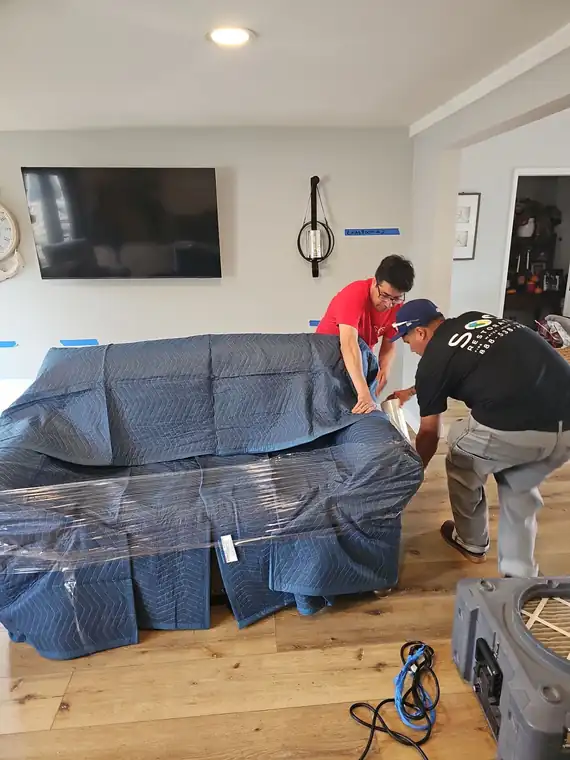
Shut the water off, and know in advance who your provider is, because this city is split
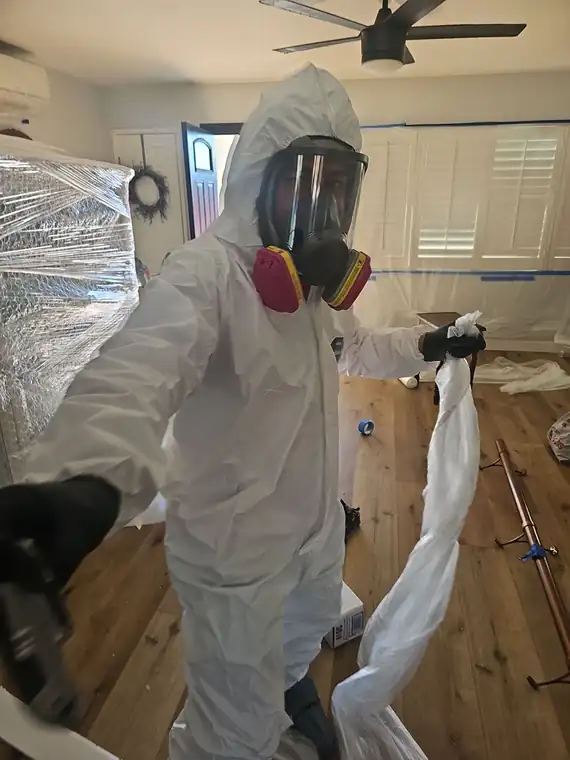
Turn the breaker off to a wet room before you walk into it, especially barefoot with a power strip on that floor
Photograph the room wide, then close on the wet edge of the carpet and the bottom of the baseboard, before you move a thing
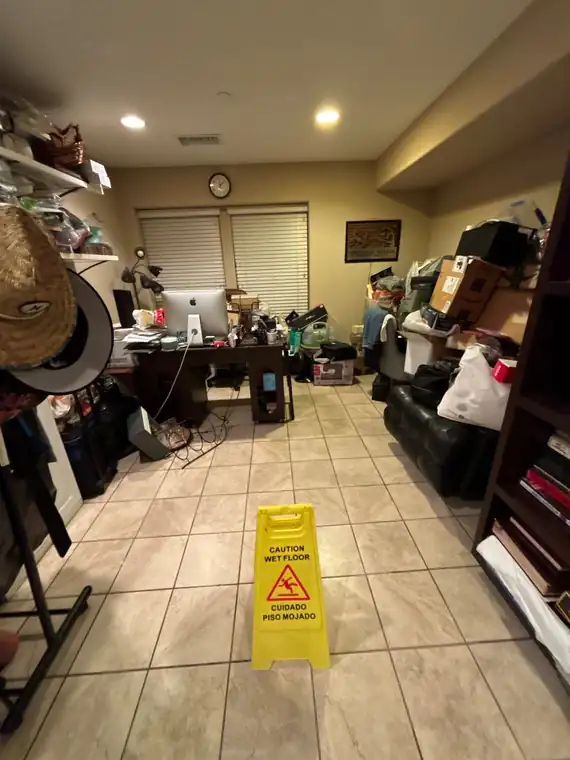
Get furniture legs up on blocks or foil, and lift books, boxes and paper off the floor
Leave the air conditioning running if it works, and keep the windows shut
Is your house on a slab, or over a crawlspace?
That answer decides where the damage hides. Most of Torrance is slab. The exception is Old Torrance, the 90501 side around the original townsite, where the census counts 1,805 homes built in 1939 or earlier. That is about seventy two percent of every pre-1940 house in all five Torrance ZIP codes, and those sit on raised perimeter foundations with a vented crawlspace under the floor.
On a slab, a leak reads as a warm patch on the floor, a hot water bill nobody can explain, baseboards swelling along one wall, water running when every tap is closed. The water travels sideways under the flooring and climbs into the bottom of the drywall. Over a crawlspace none of that reaches the living room. It shows up underneath as wet insulation sagging off the joists and growth on the subfloor, and the first sign upstairs is a smell in one corner of one room. The crew that guesses wrong loses the first day of drying.
Torrance is really five housing markets wearing one name. The median build year runs from 1959 in North Torrance up to 1973 in 90502, so a house in 90504 carries about fourteen more years of pipe than one a few miles south, and in 90504 nearly half of everything standing went up in the 1950s alone.
Then there is the vertical part of town. About seven and a half thousand Torrance units sit in buildings of fifty or more, bunched along the Del Amo corridor in 90503, where close to one unit in five is in a building that size. Water in those does not stay put. It goes through the ceiling into the unit below and out under the corridor door, and by the third neighbor’s call you have a manager and an association on top of a wet floor. Torrance also has around a thousand mobile homes, most in 90502 and 90501, where the floor is wood over open air with insulation stapled under it. They wet fast and dry slow.
And there is one Torrance detail nobody a few miles up the coast has to think about. The Torrance Oil Field runs under a large part of the city, from about Lomita Boulevard on the south up to the BNSF right of way on the north, and the city’s Safety Element warns in writing that methane can collect in poorly ventilated crawlspaces, basements and attics. So a wet crawlspace in that stripe of town gets vented and checked for gas before any electric equipment goes down the hatch. Ask about that step no matter who you hire.
Which of the five jobs does your house actually need?
Same trucks, five different problems, and each behaves its own way in this housing stock.
- Water damage is the common one: slab leak, water heater, washer hose, condensate line off the air conditioner. On a Torrance slab the drying is mostly dehumidifier work, because the floor does not come up and concrete holds moisture long after the carpet feels dry to your hand.
- Mold removal is what a small leak turns into when it runs quietly. In the Old Torrance crawlspace houses it grows on the subfloor and joists where nobody looks. In the slab tracts it hides behind the baseboard and inside the wall just above the floor, and the smell arrives before the stain.
- Sewage cleanup comes with a Torrance rule that costs people real money. City policy leaves the whole sewer lateral to the property owner, including the connection to the city main, so a clog under the pavement is still your pipe and your bill.
- Fire and smoke in a sixties tract house usually starts in the kitchen or the attached garage, and the smoke goes up into an open attic and comes back down through every ceiling vent. Torrance also has a 750 acre refinery running 166,000 barrels a day inside its own city limits, which makes soot on the outside of a house a normal question here and an odd one in Manhattan Beach.
- Storm damage is the smallest category here, and the FEMA count says so. When it happens it is rain driven through 1960s aluminum window frames, a failed roof over a flat addition, or water ponding in a low spot because the county drain is already full.
What does this run in Torrance?
Water damage work starts at $60 an hour here. An emergency call, meaning nights, weekends and holidays, starts at $90 an hour. Neither number moves because you sound frightened on the phone.
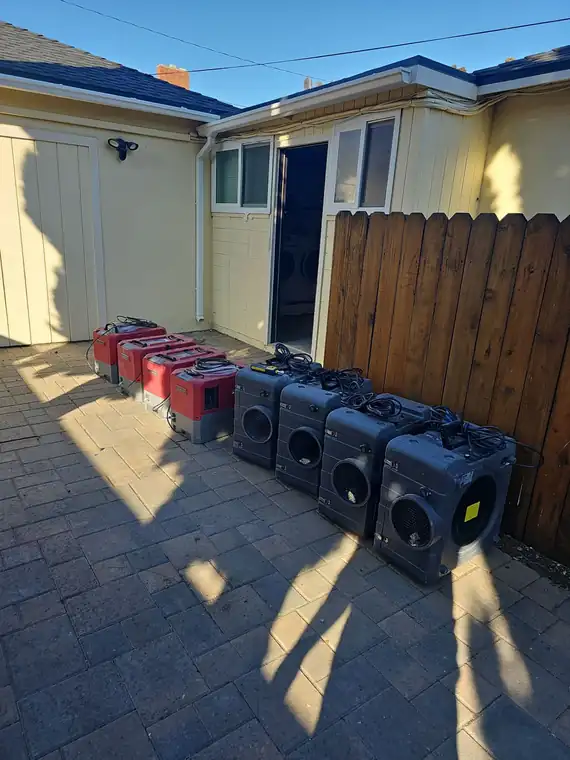
The hours come from how far the water ran sideways and how long the concrete under it keeps giving that moisture back. On a Torrance slab most of the clock is dehumidifier time rather than fan time, and in an Old Torrance crawlspace it is wet insulation and joists nobody can see from the living room. One bathroom caught the same morning needs a couple of air movers and a single dehumidifier. A 90504 slab house that ran all weekend with nobody home is a different animal, and no one can hand you a day count until the third set of readings comes back. The cost page walks through it line by line, including why a house built before 1981 changes the tear-out.
Some of this you should not pay anybody for. A supply line that let go onto a tile floor and got mopped up inside the hour is a fan, an open door and two days of watching the bottom edge of the drywall. If the paint bubbles along the base or the baseboard goes soft, call. If it stays hard and dry, you saved yourself a visit, and that is the true answer even when it is not the profitable one.
What happens after you leave?
You get a dry house and a file, not a finished house. Worth saying plainly, because that is where people get surprised.
The file is a moisture reading every day off the same points on the same meter: baseboard, the bottom two feet of drywall, the subfloor under the pad, the framing behind the cabinet. Pictures shot the first hour, with nothing picked up yet. A map of the wet rooms, a log of what equipment ran and for how long, and a line on everything cut out and why. Your claim handler needs that packet, and so does whoever rebuilds, since they bid off the readings and the tear-out map instead of off your memory of a bad week.
Because putting the house back together is a different trade. Drywall, texture, paint, flooring, cabinets: that crew starts when the readings say the cavity is dry, and that crew is not us. Ask whoever you hire for that part to show you their state contractor number, ask whether the permit gets pulled at Torrance’s own counter, and in a house this old ask how they plan to handle disturbed paint and presumed asbestos material. If they cannot answer that last one clearly, you found it out for free instead of in month two.
The main page lays out everything we cover and the cities we run to. If it is not an emergency and you would rather write it down, tell us what happened and it lands at the same phone.
Nearby
Torrance is the middle of the South Bay on our map: Gardena on the inland side, Manhattan Beach on the water, Carson between it and Long Beach.
Can't call right now? Send it and we call you.
Your phone number is the only thing we really need. Everything else helps us load the truck right.
If a Torrance floor is wet tonight, call <a href="tel:+16576604185">(657) 660-4185</a> and we will start with what you can do yourself before anybody gets there.