In Carson the water almost always comes out of the house's own pipes, and we answer the phone at three in the morning.
SOS Restoration covers Carson: water extraction and drying, smoke and soot, mold, sewage, and board-up after a storm. Carson sits well inside the ten miles we work out of Long Beach. Open 24 hours, and a person answers. Call (657) 660-4185.
Does the same Long Beach truck cover mold and sewage, or only water?
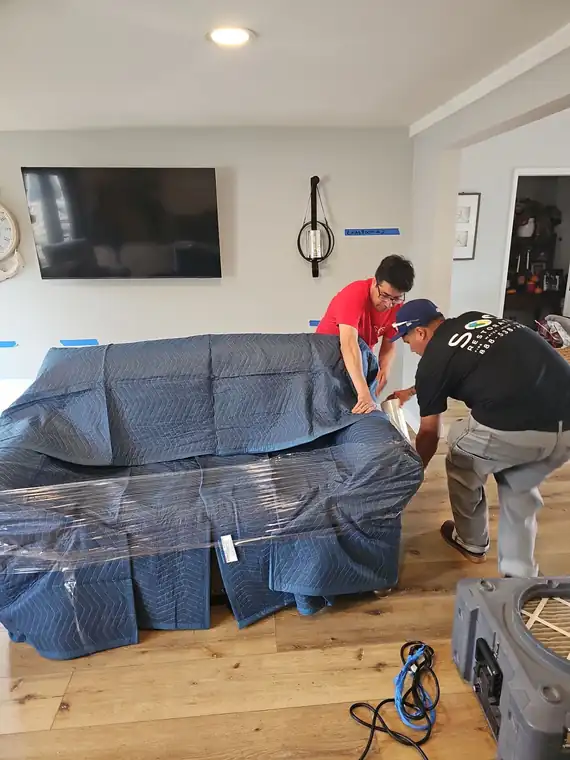
Carson gets all five services off the same trucks that work Long Beach: water, mold, fire and smoke, sewage and storm.
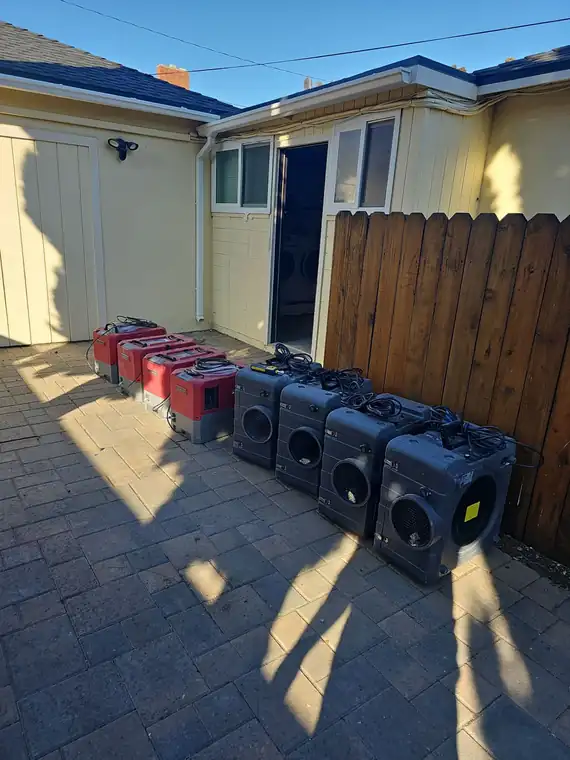
- Water damage means pulling the water out and drying the structure. In a slab tract that means drying a floor nobody can lift, with the dehumidifiers doing the real work and the air movers only pushing air across wet material.
- Mold removal in houses this old usually turns up behind a baseboard or under a cabinet, off a leak that ran for months before anybody smelled it.
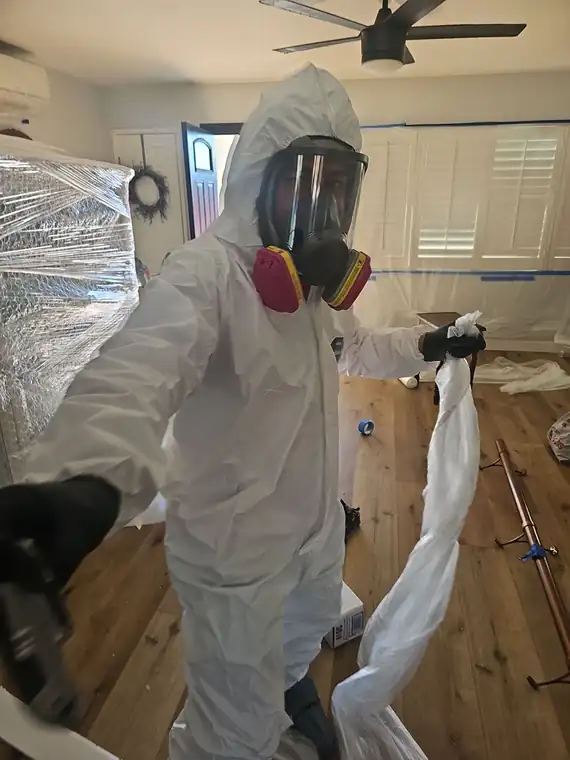
- Fire and smoke in a sixties tract house tends to start in the attached garage or the kitchen, and the smoke goes up into an open attic and comes back down through every ceiling vent in the building.
- Sewage cleanup runs into a split that is particular to Carson. The city owns the sewer pipe under its streets, but Los Angeles County Public Works is who actually maintains it, so a backup in the street is one phone call and a backup in your hallway is another.
- Storm damage, in a city sitting outside the flood zone, is roof work and holes in the outside of a sixty-year-old building. Tarp and board up while it is still raining, dry the framing after.
The crew works in Spanish. In the parks that is usually how the whole job gets run, from the space number on the phone to the walk-through at the end.
When it backs up into the hallway, the first question is whose pipe it was, because that is the question that decides who pays for it. The county’s treatment plant sits inside Carson’s own city limits, so your wastewater never travels far, and the answer is nearly always close to home: the lateral, the line running from your house out to the street, or the main under your own block.
What usually breaks in a Carson house this old?
The water on your floor came out of your own plumbing. That is truer in Carson than in most places, because two out of three houses here were finished in 1969 or earlier and plenty of them are still running the pipe they were built with.
Almost nothing newer got built to change that. The whole city added 225 homes between 2000 and 2020, so what stands now is mostly what stood then.
So the short list at the front door:
A 1951 house and a 1968 house are two different builds behind the drywall. That is why the first ten minutes in a Carson house get spent looking instead of guessing, the same ten minutes we spend in Lakewood and come out of with different answers.
Flooding is the thing Carson owners ask about and mostly do not have. FEMA has the city down as minimal flood risk, and in 2000 it pulled the eastern third of Carson off the hundred-year storm map after the Los Angeles River levees were repaired. The river, the Dominguez Channel and Compton Creek all run in concrete. Water in a Carson house came from a pipe, a roof, a drain or an appliance.
The parks are their own job. About one home in ten here is a mobile home, spread across 21 rent-controlled parks, and a coach does not dry like a house. Water runs down into the insulation and into the belly wrap, the fabric sheet slung underneath the floor, and sits there for days after the surface reads dry. There is barely a wall cavity to open and dry from the side. And the ground under the coach belongs to the park, which is what decides who authorizes the work. Sort that out in the first hour, not on the third day.
Galvanized supply pipe, the gray steel kind, sixty-odd years in the wall, letting go at a joint or through a pinhole and running quietly for weeks before a stain shows
Cast iron drain lines that crack low and wet the slab from underneath
A water heater in an attached garage, standing on a floor that slopes toward the house instead of out the driveway
The angle stop under a sink or toilet, that little football-shaped valve on the wall, which has not been turned since the Carter administration and shears off the day somebody finally tries
A slab leak, which shows up as a warm patch on the floor and a water bill nobody can explain
How fast can someone get to Carson?
Somebody picks up in Carson at any hour, and the truck comes from Long Beach, a straight run up Carson Street of about seven miles. Nobody here will quote you a number of minutes. No one can promise that on the 405 at five in the afternoon and mean it.
The rest of the clock is yours, and you can start it before anyone knocks:
- Shut the water off. The angle stop under the fixture if you know which one let go, the main out at the meter box by the sidewalk if you do not.
- Kill the breaker to that room if water is anywhere near an outlet or a power strip.
- Photograph the room wide, then close on the wet edge of the carpet and the bottom of the baseboard, before you move anything.
- In a park, have the space number and the gate code ready, and say which lane. A truck pulling a trailer needs that before it commits to a turn.
Then tell us what room you are standing in. A bathroom is two air movers and one dehumidifier on the truck. A hallway plus two bedrooms is six movers and two dehumidifiers, and that gets loaded in the shop, not worked out in your driveway after we have already parked. If it is not an emergency and you would rather write it down, tell us what happened and it reaches the same phone.
How much does damage cleanup cost in Carson?
Water damage work starts at $60 an hour in Carson and an emergency call-out starts at $90 an hour; both depend on the job, and neither moves because you sound frightened on the phone.
What runs the hours up is how much material got wet, how many air movers and dehumidifiers the space takes, and how many days the readings stay high. One room caught the same morning is two air movers and one dehumidifier. A slab house that ran all weekend with nobody home is eight movers and two dehumidifiers, and nobody can give you the day count until the third set of readings comes back. Our cost page walks through what water damage restoration actually costs, line by line, and why each item is on the invoice.
Some of it you do not need us for. A washing machine that overflowed onto a garage slab and got mopped inside the hour is a fan and an open garage door. Look at the bottom edge of the drywall in two days. If it is soft, or the paint has bubbled along the base, call.
Do you have to cut into my slab?
We do not drill into a Carson slab without pulling up the parcel first. The city sits on two old oil fields and more than two dozen closed dump sites, and the building code here makes anyone building near one of them design the foundation around methane. That gas travels up through cracks in concrete.
Coring, which means drilling a hole through the concrete floor to blow air underneath it, is routine in most towns. In Carson a hole punched through a gas barrier is a far bigger problem than the wet floor that prompted it. So the drying plan starts on top: mats laid on the surface to pull water back up through the concrete, dehumidifiers carrying the load, and the wall opened at the bottom instead. Signal Hill gets handled the same way and for the same reason.
If the readings say the slab is still holding water and nothing on the surface will pull it out, that becomes a conversation with you and with the city before a drill touches concrete.
What happens after you leave?
What you get when the trucks pull out is a file, and it outlives them. A reading every day off the baseboard, the bottom two feet of drywall, the subfloor under the carpet pad and the framing behind the cabinet, dated, all taken on the same meter. Photographs from before anything moved. A map of which rooms were wet. A log of what equipment ran, where it sat and for how many hours. And what got cut out and why: forty inches of drywall on the north wall because it still read wet on day two, the carpet pad because it sat in sewage, the toe kick, the board your feet hit under the cabinet doors, because the cabinet box was pulling water up into itself.
That file is what you hand to whoever is working your insurance claim. It is also what the next contractor prices from.
Because the next part is a different trade. Drying the structure and putting drywall, paint, flooring and cabinets back are two separate crews under another license, and the second one starts when the readings say the cavity is dry.
Ask that contractor for their license number. Ask whether the permit gets pulled at Carson’s building counter rather than Long Beach’s, because your house sits in a different city from the trucks that dried it. And in a sixties tract house, ask how they plan to handle disturbed paint, because anything built before 1978 needs lead-safe work practices. If they cannot answer that last one, you found it out for free instead of in month two.
Nearby
Carson is the western edge of where we go, up the 405 from Long Beach. The rest of the map is east and north, all of it inside Los Angeles County.
Can't call right now? Send it and we call you.
Your phone number is the only thing we really need. Everything else helps us load the truck right.
If your Carson house is wet, burned, or backing up right now, call (657) 660-4185. The phone is answered 24 hours a day, and Carson is a short run up Carson Street from Long Beach.