
We come look at the mold in your Long Beach house, then we take it out
SOS Restoration does mold inspection and mold removal in Long Beach, California. We find the water feeding it, seal the room off, cut out the moldy material, and dry what is behind the wall so it does not come back. Open 24 hours, Spanish spoken. Call (657) 660-4185.
How can I tell if my house has mold?
Look where something got wet and then stayed wet. The cabinet floor under the kitchen sink. Start there. Then the drywall behind a shower valve, and the closet built against the north exterior wall. Mold does not start on dry material and it does not start somewhere random.
You do not need a laboratory to know you have a problem. Any one of four things is enough to start opening walls: water damage now or at some point in the past, material that is damp today, growth you can see, growth you can smell. The state health department weighs all four the same, and none of them needs a lab behind it.
In a Long Beach house the pattern is usually seasonal. A wall that took on water in spring can go quiet through the dry end of the year and turn up again the following May, because the air here never gets dry enough for long enough to finish the job. The humidity numbers behind that are on the water damage page.
Some of it you will never see. Suspect something hidden when the house smells moldy and you cannot find the source, or when you know water got in: behind wallpaper, above a ceiling tile, in the pad under the carpet. Cardboard stored against a garage wall goes soft before drywall shows anything, so squeeze the boxes before you cut anything expensive.
If water is still arriving, whether that is a hose under the sink still weeping or the unit upstairs, that is a water damage call in Long Beach before it is a mold call. Drying the wall out is what stops the growth.
A mold inspection is that same walk done with a moisture meter, a probe that reads how wet a material is behind its face. Somebody reads the materials where the water went and opens up only where the readings say to. It is billed by the hour, the same way the work itself is, and no laboratory is involved in any of it.
Why does my house smell musty?
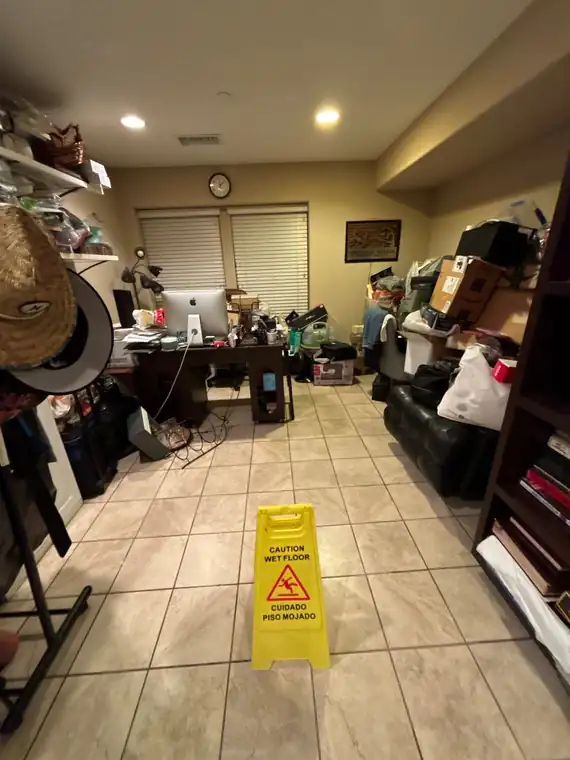
A musty smell means something in the house is holding water that never dried out, and most of the time it is something small. Walk these down first:
- A bathroom whose exhaust fan does not actually move air, in a house where two people shower every morning.
- The rubber gasket on a front-loading washer, which holds water in its folds between loads.
- The drain line that carries condensation off your air conditioner, backed up into its pan.
- A crawl space vent blocked by a planter, a bag of soil, or a stack of patio tile.
- Towels and beach gear shut in a hamper. This is a beach town and that one is real.
The smell is the finding. You do not have to see anything for it to count: a moldy odor sits on the same list as visible growth and damp material, and what it goes with is more coughing and more wheezing in that house. A candle does not change that. Neither does paint.
Two of those five cost nothing to fix. And if the smell is worst at six in the morning and mostly gone by mid-afternoon, that is this city’s daily swing, not your house getting worse; August mornings here sit near 83 percent humidity and the afternoon cuts that close to half. It still points at a material somewhere in the structure holding water.
Is it safe to stay in a house with black mold?
Whether it is safe to stay depends on how much growth there is and on who lives in the house. Color is not one of the inputs. The California Department of Public Health went through the evidence and would not set Stachybotrys, the species people mean by black mold, apart as more dangerous to a healthy person. What tracks with risk is extent: how much water damage, how much dampness, how much visible growth, how much odor.
A dark patch the size of your hand is a small job whatever a laboratory would name it. Grout in a shower is a Saturday. Growth running behind a bedroom baseboard means opening the wall.
Who lives there moves the line further than the species does. Children are more sensitive to this than adults, so an infant or an asthmatic at home lowers the threshold for getting people out of the room.
What this does to people is breathing: coughing, wheezing, a nose that will not clear, chest infections, asthma getting worse or showing up for the first time. If somebody at home has that, it is a conversation with their doctor and not with us.
How long after a leak does mold start to grow?
Fast. A wall that got wet can be growing inside a couple of days, out of sight, well before there is anything to see or smell on the room side. So the clock that decides this is not the one counting from the leak. It starts when the material gets wet and it stops when the material is dry again. The drying deadline on a fresh water loss is laid out in full on the water damage page.
Long Beach makes that window harder to hold than it sounds. Something like 115 days a year here come with fog or mist, and on those days the air coming through the window is wetter than the wall you are drying with it. Opening the windows and aiming a box fan at a wet wall is a plan that works in Phoenix.
Whether water is still arriving changes everything. A cabinet floor soaked once and dried out over a weekend is usually fine. A slab leak, meaning a pipe weeping under the concrete floor, is different: it feeds the bottom plate, the flat board every stud in that wall stands on, for weeks, and by the time the baseboard stains the framing has been wet far longer than the mark suggests.
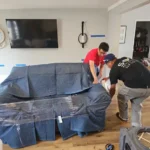
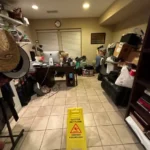
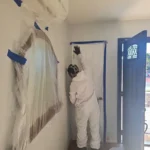
What happens after you leave?
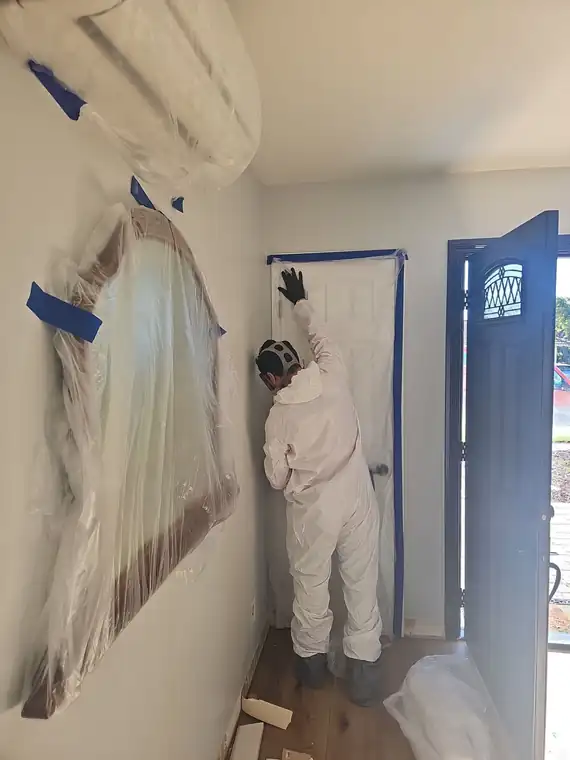
The plastic comes down last, and what brings it down is the meter rather than the calendar. What you keep is the drying log: the same three marked spots, read every morning, ending at the numbers that let the equipment go. Once the wall is closed up, that log is the only thing left that can say what is behind it was dry.
With it go the photographs taken with the wall open, and the cut lines showing how far past the stain we went and why. SOS stops at the mitigation; the wall itself is a different trade, so all of that is written for the person who takes it from here rather than for us. Two things to ask that person:
- Their license number and proof of insurance, before anything gets scheduled.
- That they read the last page of the drying log before they close the wall. New drywall over damp framing starts this page over from the top.
And no clearance result is stapled to the front of it, for the reason in the section above: a passing grade written by the crew that swung the saw is worth nothing to you when it is your house.
West of Long Beach most of what we take out is old, small and behind something. In Inglewood it is usually a wall shared with the unit upstairs, because the leak started in somebody else’s bathroom. In Gardena it is a vanity a shutoff valve wept under for a year in a house built before anyone used plastic pipe. In Manhattan Beach it is a bathroom in a place that sat closed all winter. Different houses, same three questions: where did the water come from, how long has it been there, and what has to come out.
Can I clean the mold myself?
You can clean most small mold yourself. The federal homeowner guidance draws the line at about ten square feet, roughly a three-foot by three-foot patch, and says a job that size is usually yours to handle.
Do it in this order:
- Find the water and stop it. Cleaning first means repainting the same wall next spring.
- Scrub the hard surfaces with detergent and water: tile, a painted door jamb, the underside of a vanity, sealed hardwood, the concrete in the garage.
- Dry them all the way. A fan on the spot for a day, not for an hour.
- Throw out the soft material that soaked and stayed soaked: ceiling tile, carpet pad, cardboard, the paper face of the insulation. Those do not come clean.
- Never mix chlorine bleach with a cleaner that has ammonia in it. The two together give off a gas that will hurt you, and people do this in small bathrooms with the door shut.
Do not paint over it. The film sits on material that is still wet from behind, and it lifts inside a year.
Stop and call us at (657) 660-4185 when the growth is bigger than that patch, when it is inside the wall rather than on the face of it, or when you have cleaned the same spot twice. A second return means the water never left. You can also get in touch here and send a photo before you cut anything open.
Can we stay in the house while you work?
Most of the time, yes. Most people asking this have a toddler at home or a kid with asthma, and that is the part worth answering.
A zippered plastic wall goes across the doorway and a scrubber pulls the air out of that room, so the hallway and the kitchen stay on their own air. You lose the bathroom and the six feet of hallway leading to it. Everything else you keep.
Three things change the answer: how much of the house is involved, whether the only bathroom or the kitchen sits inside the sealed area, and who is in the household. Children being more sensitive to damp and mold than adults is a fair reason to send a toddler to a grandparent’s house for the noisy part, even when the work itself is small.
The equipment is loud, and it runs at night too.
If you are not sure which side of that line your house is on, describe it on the phone before you move anybody: (657) 660-4185. Other practical questions about living around the gear are on the FAQ, and there is a longer piece on staying put during the work.
Is mold testing worth paying for?
Almost never. If you can see it, a test tells you what your eyes already told you, and the money goes to a laboratory instead of to the removal.
The reason is that there is no number to fail. Nobody has set a limit for mold or mold spores in indoor air, so a sample has nothing to be measured against. Any report that grades your house is grading it against a figure the company selling the test picked for itself.
The EPA says sampling is unnecessary in most cases where you can already see growth, and the CDC does not recommend mold testing at all. Naming the species does not change what happens next either, because every mold gets removed the same way.
An inspection and a test are two different purchases. The inspection is a person walking your house with a meter to find the water and how far it went, billed by the hour. The test is a laboratory naming a species. Visible growth plus a water source is already enough to act on.
Two situations where a sample earns its money:
- You can smell it, you have opened the obvious places, and you still cannot find it. Hidden mold is hard enough to chase that sampling becomes one of the tools the person chasing it uses.
- The work is done and you have hired your own industrial hygienist, somebody whose whole job is testing buildings, to check whether the area actually got cleaned. That is the one use the EPA endorses for a surface sample.
Outside those two, a test mostly buys paper. The longer version of this argument lays out what a sampling report can and cannot tell you.
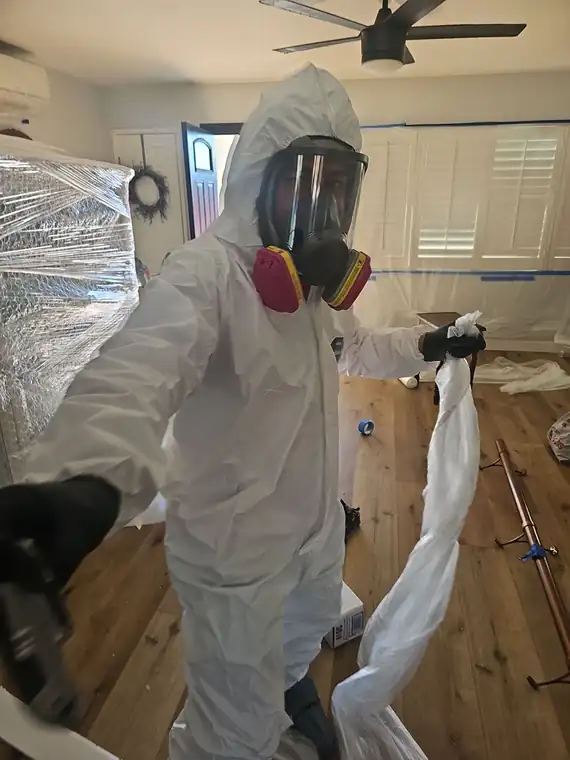
What does mold removal actually involve?
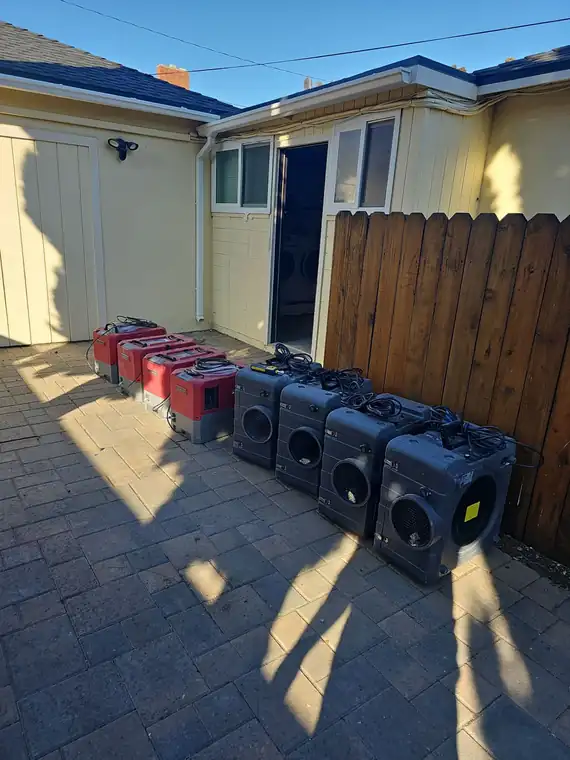
First the water, then the material, then the drying. In that order, because reversing them wastes the money. Stop the source, get the wet material out or dried fast, then clean up or carry off what grew on it.
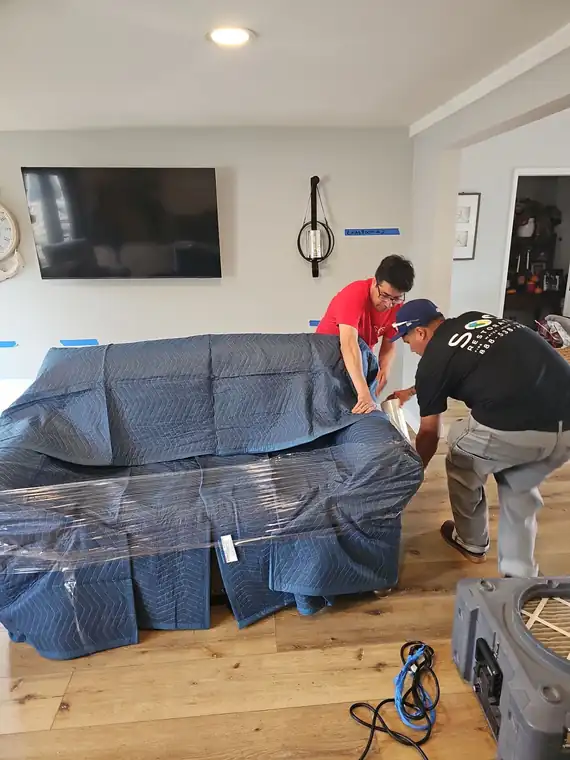
On a small Long Beach job that looks like this. Plastic sheeting with a zipper across the doorway. An air scrubber, a filter box on wheels, pulls air out of the sealed room so whatever gets stirred up cannot drift down the hallway. The saw line goes about a foot past the last stain, because the stain is always smaller than the wet area behind it. Drywall and soaked insulation come out and go into bags at the door. The framing gets vacuumed with a HEPA filter, the kind fine enough to hold spores, and wiped down. Then a dehumidifier and one or two air movers, squat blowers aimed along the wet surface, sit on the open wall.
The meter goes into the same three marked spots every morning. The gear comes out when those spots read within a couple of points of a wall in the same house that never got wet. That comparison is the whole standard, and there is no date in it.
Killing mold is not the same as taking it out. Dead spores set off the same allergies the live ones did, which is why the EPA is blunt that the material has to be removed rather than sprayed. If a bid says fungicide and primer and never says demolition, that is what you are buying. And the leak itself has to be repaired, or you will be reading this page again next year.
How long does mold removal take?
The cutting on a small mold job is frequently one day: sealing the room, taking out the wet drywall, bagging it, vacuuming the studs. The drying that follows ends when those morning readings land where they need to land, not on a date somebody wrote down in advance. Nobody can put a number on it off a phone call, and anybody who does is guessing at framing they have not seen.
Two things stretch it. Old plaster over lath, the thin wood strips nailed across the studs in the older houses here, holds water differently than drywall and gives it back more slowly, and about a third of Long Beach housing went up before 1950. The other is a source that never actually got repaired, which moves the range further than anything else.
Weather moves it too. A December job runs into the rain season and the worst natural drying of the year at the same time.
Do you do clearance testing when the work is done?
No. Clearance testing means a sample taken afterward to say the room passed, and the crew that did the removal should not be the crew grading the removal.
You may be told a passing test is required before the wall goes back. Nothing in California law says that about a house. We hold the line anyway, because homework graded by the person who did it is worth nothing to you. If a sample matters, hire the person taking it separately from the person who swung the saw, and read it knowing no laboratory can call a house mold-free; spores are in the outdoor air everywhere. What a surface sample can honestly show is whether an area got cleaned properly, which is the narrower claim the EPA actually makes for it.
What you get instead is the photo set from before the demolition, the daily moisture log by location, and a sheet saying where each cut stopped and why it stopped there.
What is this going to cost me?
We bill by the hour and tell you the rate on the phone before anyone drives; an emergency call-out starts at $90 an hour and depends on the job. The fear underneath that question deserves an answer as well: an hourly rate is harder to pad than a flat mold package quoted before anybody has opened a wall.
A bathroom vanity wall is usually half a day of sealing off and two hours of cutting. A hallway that runs behind a shared wall is two days before the dehumidifier even goes in. Sealing off a small area takes nearly as long as sealing off a large one, which is why small jobs feel expensive by the square foot and big ones do not.
If a quote you are holding does not say what is being removed, how far past the stain the cuts go, and how the drying will be measured, push on that before you push on the price. What actually drives the cost of this work is broken out on its own page.
Then there is your insurance company. Keep the photograph of whatever failed: the split hose, the pan that overflowed, the date you found it. A mold claim gets read backward from the water, and the stain on the baseboard is the end of that story rather than the start of it. What your particular policy covers is between you and them; we document and photograph, you file. Assembling that file, and what it is for when they push back, is worked through on its own page, and the mold-specific version is on the blog.
Water damage
Fire & smoke
Storm damage
Sewage cleanup
The cities we drive to for this work
Mold follows water, and the water here follows the same handful of house types from Long Beach out to the ring of Los Angeles County cities around it. Each city page says what is different about its houses.
Can't call right now? Send it and we call you.
Your phone number is the only thing we really need. Everything else helps us load the truck right.
If you are looking at something dark on a Long Beach wall and cannot tell how far it goes, call (657) 660-4185 and describe it to us, at any hour of the day or night.