
Water, fire, mold, storm and sewage cleanup in Lakewood, California, at any hour
SOS Restoration of Long Beach cleans up water, fire and smoke, mold, storm and sewage damage in Lakewood, and the trucks load one city south of you. Call (657) 660-4185 and a person answers, at three in the morning included, and tells you straight whether you need us.
Why does one broken line wet half a Lakewood house?
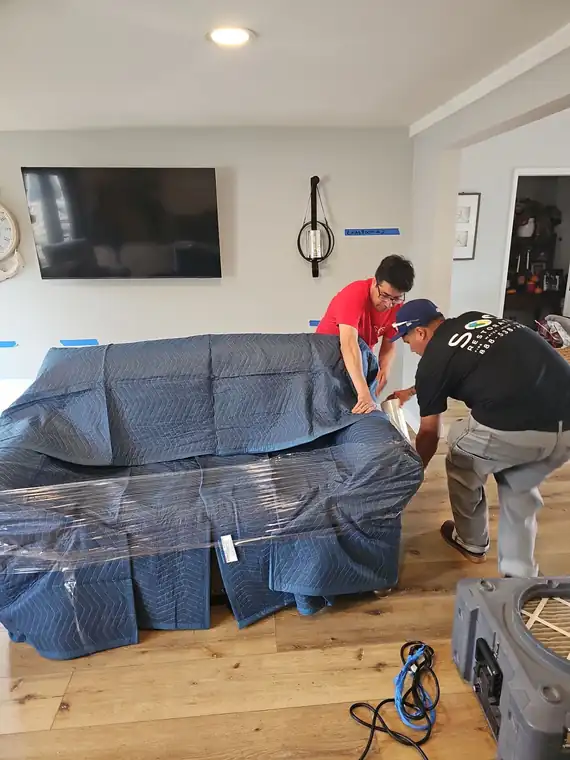
Almost every house we work in Lakewood sits on a slab poured in the same few years, off the same few plans. On a Lakewood job we are not guessing where the water went.
Because there is nowhere for the water to fall. No basement, no crawlspace under most of these floors, no second story. It is a slab, and concrete neither drinks water nor drains it, so the leak travels sideways, under the flooring and along the bottom plate of every wall it reaches. By the time the hall carpet feels cold underfoot, the wet is usually three rooms wide.
The build explains the rest. The city’s own published history, The Lakewood Story, lays out the original tract: 17,500 houses on 3,450 acres, done in under three years, a finished house every seven and a half minutes, a foundation trench dug every fifteen minutes, concrete coming off a line of cement trucks a mile long into wood forms. Nobody builds at that speed now, and nobody repeats one floor plan that many times either.
The numbers stuck. The American Community Survey puts the median year of construction for a Lakewood home at 1957, with 18,315 of the city’s 26,867 housing units standing before 1960. Inside the 90713 ZIP it is tighter: 6,819 of 9,516 units, 71.7 percent, went up between 1950 and 1959. One ZIP over, that share falls under a quarter. So when a crew says it knows your house, here that is a checkable claim, not a compliment.
Here is what fails in them.
- The shared plumbing wall. Kitchen on one side, hall bath on the other, one wall carrying the lines for both. When one of those lines opens up inside that wall, the kitchen, the bath and the hallway between them all take water at once, and you see it in one of the three.
- The water heater closet. A tank in a hall closet or a garage corner, fed by hard well water, rusting from the bottom. When it opens up it empties at floor level, into carpet, pad and the wall behind it.
- Copper run through the slab. The one nobody catches early. The tells are a warm strip on the floor, a meter turning with every fixture closed, a bill that jumps for no reason. That water sits under the concrete for weeks before it reaches an edge you can see.
- The original drain lines. Cast iron carrying seventy years of scale, under a hall bath that has taken every shower and flush in the house. When it backs up, it backs up into the lowest fixture, which is almost always that bathroom.
- One open attic. These roofs were framed as one space over the whole house, nothing dividing room from room. A leak over the back bedroom shows up on the front hallway ceiling, and kitchen smoke lands on ceilings the fire never got near.
One more thing about the year. In a 1957 house we treat the ceiling texture and the old vinyl squares with their mastic as asbestos until a test says otherwise, and that changes how we cut and what we bag. Tell us the build year on the phone and the truck leaves loaded for it.
When does a truck actually reach your street, and what do you do until it does?
Honest version: the phone gets answered right now, day or night, and the trucks sit in Long Beach on your southern line. That is a short run when the streets are empty and a much slower one once Del Amo and the 605 fill up, and it depends on whether a crew is already in somebody else’s kitchen. Anyone quoting an exact arrival off a web page has never sat on Del Amo waiting for a light.
What happens on that call matters more than the drive. We ask what broke and when, whether the water is clean or came up a drain, whether the power is still on in the wet rooms, and what year the house went up, because that last answer decides what the truck carries. Then we tell you what to do while we load.
- Close the main valve. On most of these lots it is out front near the meter box, or on the garage wall where the line comes in. If you cannot find it, stay on the phone with us.
- Cut the breakers to any room with water near an outlet, a floor lamp or an extension cord. Do not wade through standing water to reach a panel that is also wet.
- Take pictures of every wet room before you drag anything out of it. Your phone is the cheapest record you will have of this night.
- Get cardboard, paper and anything with wooden legs up off the floor. Furniture feet stain carpet in a couple of hours, and the stain outlives the water.
- If it is sewage, keep kids, pets and bare feet out of the room, and leave the heater and air conditioning off if a return vent sits in there. Running the system pushes the smell through the house.
- Leave the carpet alone. Pulling it yourself usually costs you the pad, the tack strip and a day.
If nobody is in danger and you would rather start with a message than a ringing phone, the contact page reaches the same people.
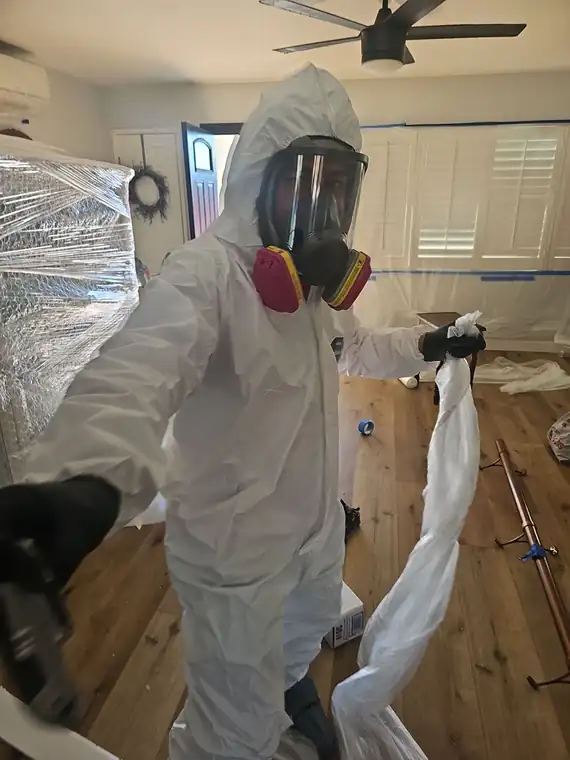
Close the main valve
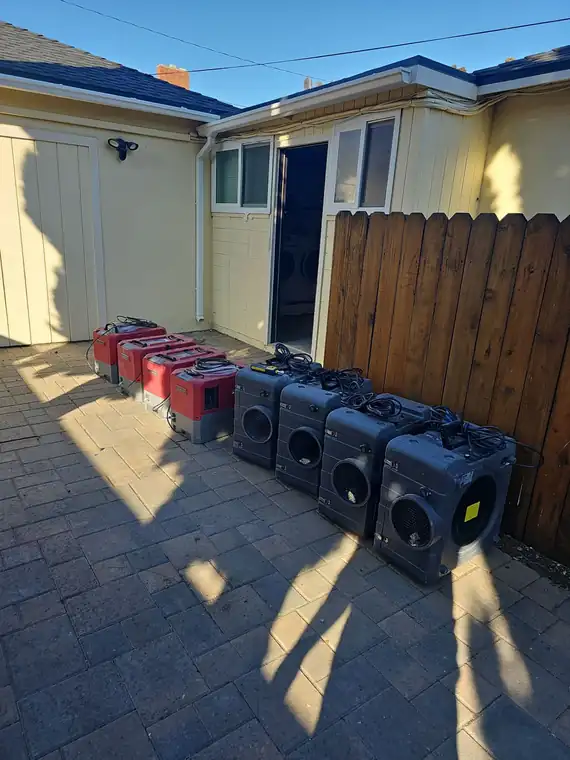
Cut the breakers to any room with water near an outlet, a floor lamp or an extension cord
Take pictures of every wet room before you drag anything out of it
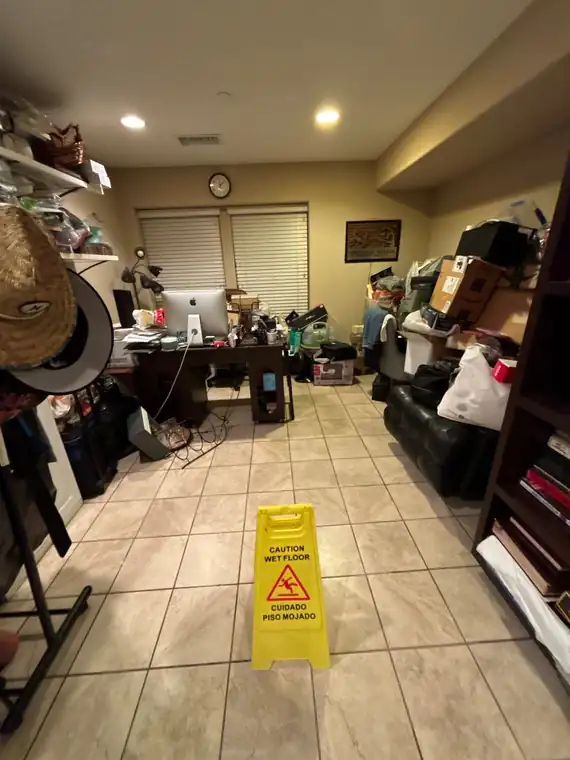
Get cardboard, paper and anything with wooden legs up off the floor
If it is sewage, keep kids, pets and bare feet out of the room, and leave the heater and air conditioning off if a return vent sits in there
Which of the five jobs do you bring into a Lakewood house?
All five, off the same trucks that cover Long Beach and the cities around it. Same work as anywhere. Older house, which changes the order of operations more than people expect.
- Water damage. On a 1957 slab water only travels sideways, so one failed line under the kitchen sink puts three rooms and a hall in play, and we meter each one daily until the concrete gives back the last of it.
- Mold. In these houses it is usually small, old and hidden: behind the vanity where an angle stop wept for a year, or inside the wall a slab leak kept warm and damp all spring. We take out the source, not just the stain.
- Fire and smoke. With one attic running the length of the house, a kitchen fire leaves soot on bedroom ceilings at the far end, so we open the hatch before judging anything downstairs.
- Storm damage. A roof recovered two or three times in seventy years gives up at the flashing on the few nights this city gets its year of rain, and we dry the ceiling cavity and the attic and mark the entry point for your roofer.
- Sewage. Nearly always that same hall bathroom on that same tired cast iron. Nobody needs to feel embarrassed calling. We remove what cannot be cleaned, disinfect the rest, and leave the hallway safe to walk barefoot.
Your neighbors get the same trucks: Bellflower to the north, Cerritos to the east, close enough that a rig loaded for a Lakewood job is loaded right for theirs. If Spanish is easier, say so when we pick up. Se habla español.
Does Lakewood water come out of the sky or out of the wall?
The wall, nearly every time. FEMA’s flood claims file holds every claim recorded from 1978 through 2025, and across all three Lakewood ZIP codes it holds ten. Seven in 90712, two in 90715, one in 90713, the ZIP with most of the fifties houses. Rising water is not what ruins floors in this city.
Worth learning before something breaks: the San Gabriel River splits water service in two here. The City of Lakewood delivers west of the river, Golden State Water Company east of it. The city’s 2023 water quality report describes its half as 100 percent groundwater: eleven deep wells feeding roughly 180 miles of main between four and twenty-seven inches, more than 20,000 metered connections. Which side you live on decides who owns a break out at the street, and midnight with a wet parkway is a poor time to learn that.
What does drying a Lakewood house run?
Water damage work starts at $60 an hour. An emergency call, meaning the phone rings after hours and a truck leaves that night, starts at $90 an hour. Both are starting points; the job moves them.
What moves them here is the slab. Concrete spreads water thin and hands it back slowly, so a wet hallway in one of these houses needs more air movers for more days than the same square footage over a raised wood floor. The rest is ordinary: how many rooms took water, how many hours passed before anybody noticed, whether it was clean or came up a drain, and whether there is oak strip flooring under the bedroom carpet, because that changes the drying plan.
One line item belongs to the year. If the work means cutting ceiling texture or lifting floor tile, testing comes first and testing has a price, and we would rather say that on the phone than on day two. Coming out to look and read the meters costs nothing. How an estimate gets built, line by line, sits on the cost page.
What happens after you leave?
You end up holding a file, and the file is the point. Dated pictures from the first walkthrough, daily moisture readings from each wet room measured against a dry room in the same house, an equipment log, a list of every material we pulled and why it came out, and the source of the water named in plain words. When the wet rooms read the same as the dry room and the leak has a name, we stop. We do not leave fans running to pad a bill.
We dry and we remove. Putting the house back together is a different trade, and whoever does it bids off that same file, which is why it gets written that way. Get the source repaired and the readings flat before a wall closes over any of it, because nobody enjoys opening new drywall in March.
Then there is the counter. Lakewood incorporated in 1954 and has run as a contract city ever after, so building work here is priced off Los Angeles County’s Building and Safety fee schedule with an 18 percent city overhead charge added on top, set by City Council Resolutions 2010-22 and 2012-42. Plumbing, sewer work, re-roofing, mechanical work and bath or kitchen upgrades all pull a permit. Ask your contractor in writing who pulls it and who pays that 18 percent, before the first day of work.
And if the floor is still getting wetter while you read this, stop reading. Call (657) 660-4185.
Nearby
Lakewood sits directly north of Long Beach, on our own city line; Bellflower and Cerritos came out of the same years and the truck loads the same way for all three.
Can't call right now? Send it and we call you.
Your phone number is the only thing we really need. Everything else helps us load the truck right.
Lakewood sits one city up from where the trucks park, so if yours is the wet floor tonight, call <a href="tel:+16576604185">(657) 660-4185</a>.