Most of the water damage we see in Manhattan Beach started in a supply line, not in the ocean.
SOS Restoration works Manhattan Beach for water, sewage, mold, fire and smoke, and storm cleanup. Call (657) 660-4185 and a person picks up, day or night. We pull wet material out, dry what can be saved, and tell you plainly what is ruined. No sales visit, no guessing at your kitchen table.
Why does the ocean almost never soak a house in Manhattan Beach?
Because the beach is too wide and the land behind it climbs too fast. When the California Coastal Commission reviewed the coastal hazards chapter of this city’s local plan in 2023, its staff ran the shoreline through the USGS coastal storm model under five sea level scenarios and reported that no private development sits inside the identified shoreline hazard areas. Public infrastructure does. Houses do not. The shoreline runs 2.1 miles, the beach is 300 to more than 400 feet wide in places, and past the sand the ground goes up like a stair.
FEMA’s flood claim file says the same thing in a colder way. Pull it by ZIP code and 90266 has produced fourteen claims in the entire history of the program, and eight of those fourteen share a single month: February 1998. Every one that carries a recorded zone sits in Zone X, outside the mapped hazard area. Fourteen claims across five decades, in a city with more than fifteen thousand homes.
So when a floor here is soaked at four in the morning, the water came from inside the walls. There are three doors it walks through, and all three are plumbing.
The supply line in an expensive old house
The census counts 15,281 housing units in 90266 with a median build year of 1970, and 5,700 of them went up before 1960, including 1,145 that date to 1939 or earlier. The largest single slice of the whole city is the 1950s: 3,416 houses. That is the era of galvanized steel supply and cast iron drain, and both fail from the inside, where you cannot look. Galvanized pipe does not burst on a schedule. It scales shut, thins at a thread, and one night the thread lets go behind a hall closet.
Two out of every three homes here are detached single-family houses, 10,068 of them by the census count. No shared building, no association, no master policy spreading the hit. Whatever the pipe does, the owner eats alone.
The clay pipe under the street
The city publishes its own numbers. Roughly 86 of the 92 miles of sewer under Manhattan Beach belong to the city, mostly 8-inch vitrified clay in a 6 to 21 inch range, with the oldest run, ceramic-lined concrete, under the Sand Section closest to the water. Six pump stations lift wastewater out of the low ground. Clay pipe joins at a bell. Roots find bells. A joint shifts a quarter inch, the line starts collecting instead of carrying, and one Sunday the downstairs shower fills instead of drains.
Read the municipal code and the lateral running from your building out to the main is yours, not the city’s. A sewage backup here is a private bill from the first minute, no matter whose roots did it. Sit downhill of one of those six pump stations and you stand where a station failure shows up first.
The water department is the city itself
Manhattan Beach runs its own water system, about 112 miles of distribution main, two city wells and a storage tank, with roughly 80 percent of your tap water imported through West Basin. If the wet is coming up out of the parkway or the meter box instead of out of your wall, the City of Manhattan Beach water and sewer desk answers at (310) 802-5304 during business hours, and that call is free.
Nobody arrives in five minutes, so what do you do first?
Our trucks run out of Long Beach, the 405 or Pacific Coast Highway depending on the hour, and anyone quoting you a fixed number of minutes for that drive has never made it at five on a Friday. What you get from us is the truth about where the truck is when you call. We run the same crews through Torrance and Rancho Palos Verdes, so somebody is usually already on this side of the county.
The half hour before we get there is worth more than the first half hour we are on site:
- Shut the water off. The street valve is in the meter box at the curb and takes a key or channel locks. If you know the house shutoff, use that first.
- Kill power to the wet rooms at the panel, and only if you can reach the panel standing on something dry.
- Get pictures on your phone before anything gets picked up or slid out of the way. One wide frame from the doorway, then close on the dark line where the water stopped, the toe kick under the cabinets, and the bottom couple of inches of baseboard. On a slab the wet climbs the wall and fades from sight within a day, and in a house that sat empty a few weeks there is nobody who can say later how far it ran. Your phone in the first hour is the record.
- Lift what you can. Books off the bottom shelf, rugs up, wood furniture legs onto blocks or foil.
- If it is sewage, shut the door and stay out. Do not aim a household fan at it. A fan turns a contained mess into an airborne one.
- Do not tear out carpet you want to keep. Pad is cheap. Carpet pulled wrong stretches and never lies flat again.
Then call. If it is not urgent, the form on our contact page goes to the same crew.
Shut the water off
Kill power to the wet rooms at the panel, and only if you can reach the panel standing on something dry
Get pictures on your phone before anything gets picked up or slid out of the way
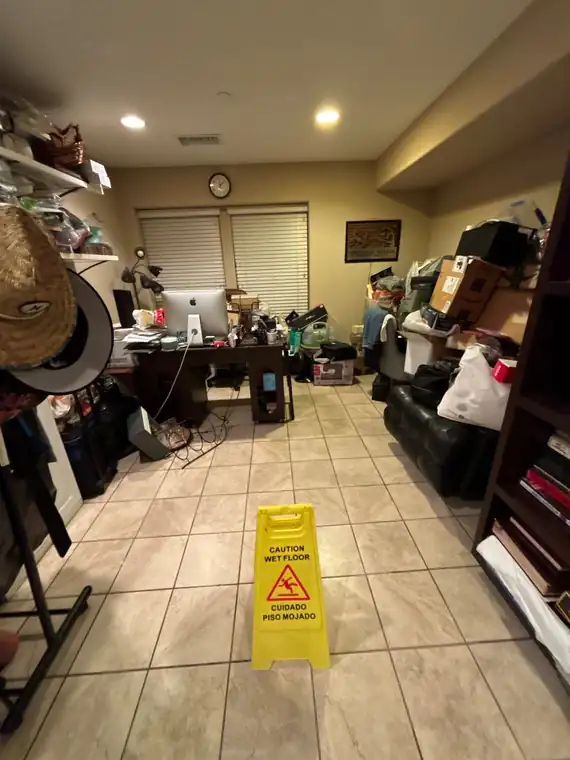
Lift what you can
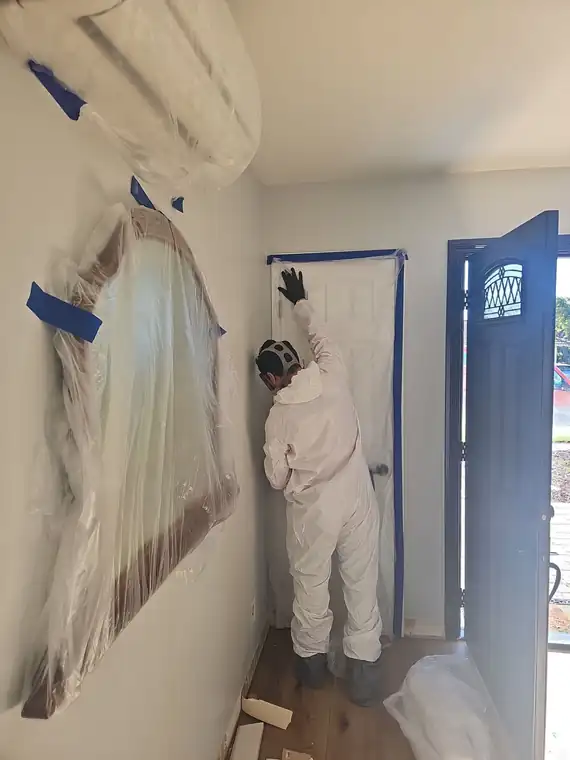
If it is sewage, shut the door and stay out
What does a slow leak do in a house nobody has slept in for three weeks?
This is the number that makes Manhattan Beach different from every town around it. The census finds 1,912 of the 15,281 homes here vacant on an average day. One in eight. El Segundo sits at 5.7 percent and north Redondo Beach at 5.4 percent, so this city carries more than double its neighbors’ share of second homes and seasonal rentals.
A supply line weeping behind a vanity in an occupied house gets caught in a day or two, because somebody hears it or steps in it. The same weep in a house whose owners are gone until Labor Day runs for weeks. By the time a cleaner opens the door, the water has been through the baseboard, into the subfloor, under the cabinet toe kick and out into the insulation. That is no longer a drying job. That is demolition, and the smell reaches the sidewalk before you reach the door.
Then add the marine layer, which keeps outdoor humidity up all year, and the wave of tight modern rebuilds with a lower level sitting down in the ground. Mold in this city is rarely a rain story. It is water that got shut inside a room where no air moves. If you own a place here that sits empty, the cheapest thing you will ever do is pay somebody to walk it weekly and put a hand on the floor around every toilet and under every sink. That costs almost nothing, and it will save you more than we would ever charge you.
Which five jobs actually come up on these streets?
Water
Most of what we do in 90266 starts at a supply line, a water heater, or a refrigerator line inside a house that predates 1960. Where it goes depends on the floor: over a crawl space it drops and travels sideways out of sight, on a slab it spreads flat and wicks up the bottom few inches of every wall it reaches. Our water damage crew reads moisture through the material instead of guessing from the stain on the surface.
Mold
The vacancy rate and the marine layer put this second on the list rather than fifth. What we find sits in a closed lower level, a wall cavity, or under a floor that got wet weeks before anyone noticed. Mold removal in a tightly built house means containing the room first, because an envelope that trapped the moisture will also hold whatever you kick into the air.
Sewage
Clay pipe plus an owner-side lateral is the combination that produces these calls, and they land hardest in the older low blocks near the sand. Sewage cleanup is not a mopping job. Porous material that touched it leaves the house, hard surfaces get cleaned and treated, and the room dries under containment, not under a fan.
Fire and smoke
There is no wildland edge in Manhattan Beach. It is dense city fabric on small lots, so the fires start at a stove, a panel, or a garage, and the real damage is smoke that traveled much farther than the flame. Fire and smoke work here often means treating a neighbor’s smoke in a house that never burned, because the buildings sit that close.
Storm
Storm damage in this ZIP code is wind and wind-driven rain, not rising water, which is exactly what the flood claim record shows. A shingle lifts, a skylight seal fails, a top-floor window takes a night of sideways rain, and the water lands two floors down. Storm damage work starts with covering the opening, because nothing dries under a roof still letting water in.
What does the first day really run in a house like yours?
Hourly, and posted, so you can do the arithmetic before you say yes. Our water damage work starts at $60 an hour. An emergency call, meaning nights, weekends and holidays, starts at $90 an hour.
What moves the total is not your ZIP code. It is how far the water traveled and how long it sat. A supply line caught the same afternoon is a few days of drying equipment and one crew. The same line found three weeks later is cabinets out, drywall cut to a line, and a far longer clock. We write the scope down before we start and do not change it without showing you the reading that changed it. The cost breakdown lives on its own page.
What happens after you leave?
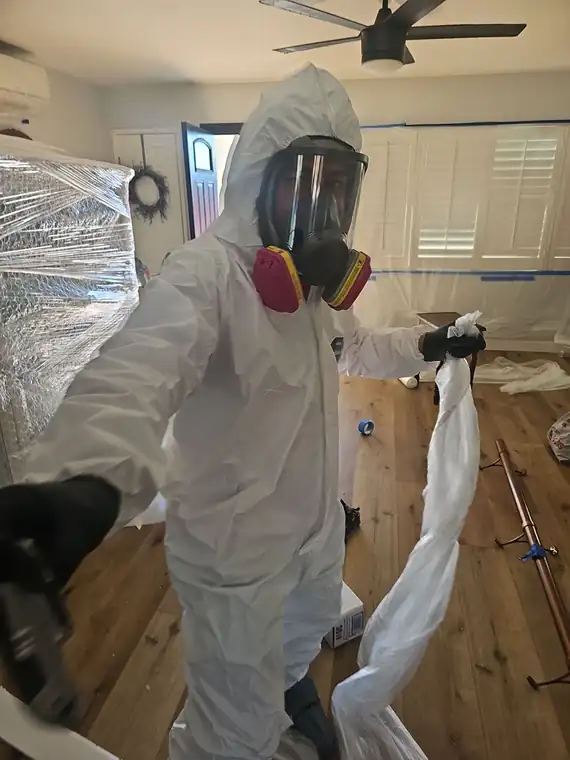
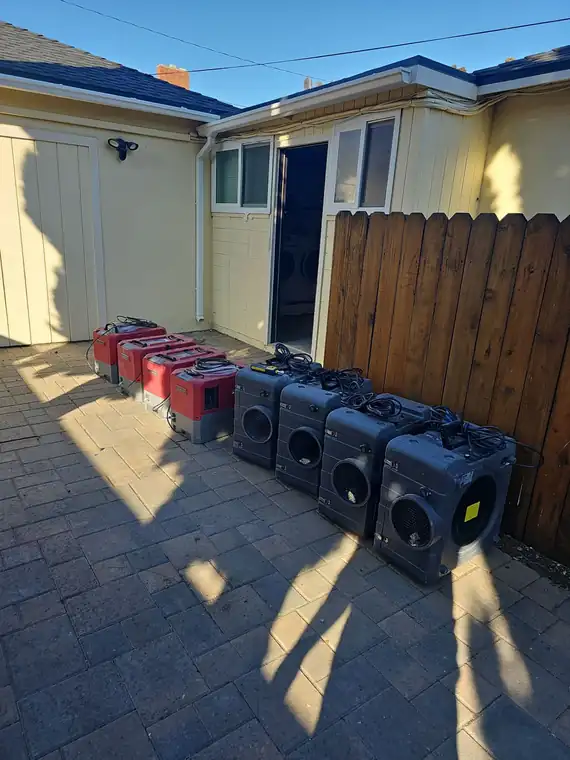
Straight answer, and you should have it before you hire anybody. We handle mitigation. We stop the water, take out what cannot be saved, dry the structure down to a number we can show you, clean and treat what stays, and pull the humidity back out of the air. We do not put the house back together. No drywall, no cabinets, no paint, no flooring. That is a general contractor’s trade, not ours.
What you get from us on the way out is the file: moisture readings by day and by location, photographs of every cavity we opened, a list of which materials were removed and the reason for each, and the drying log. Hand it to whoever puts the house back together so nobody is guessing at what is behind the wall they close up. Ask that contractor to show you their state board number, and look it up yourself before you sign.
The other services and cities we cover sit on our main page. If you want to talk through what you are looking at, call and describe it. A fair share of the time the honest answer is a box fan, an open cabinet door and two patient days, and we will say so on the phone.
Nearby
Manhattan Beach is the coastal edge of the map. Torrance sits directly behind it and Gardena behind that, all on the same drive out from Long Beach.
Can't call right now? Send it and we call you.
Your phone number is the only thing we really need. Everything else helps us load the truck right.
If the floor is wet right now and you are standing in it, stop reading and call <a href="tel:+16576604185">(657) 660-4185</a>.