
Sewage backup cleanup in Long Beach: what a mop can handle, and what has to be cut out.
Stop using every drain in the house before you do anything else, because one flush upstairs puts another gallon on your floor. Then call SOS Restoration at (657) 660-4185. Sewage cleanup in Long Beach, California, 24 hours a day: extraction, removal of everything soft enough to have soaked it up, cleaning, and drying.
Sewage came back up into the house. What do I do before anyone arrives?
The first thing to do after a sewage backup, before anyone arrives, is stop using every drain in the building. No toilets, no showers, no dishwasher, no laundry. Say it out loud to whoever else is home, because the person who has not seen the bathroom yet is the person who flushes.
Then, roughly in this order:
- Shut the door on the room. Kids, pets, and anyone in bare feet stay on the other side of it.
- Kill the breaker to that room if the water is anywhere near an outlet, an extension cord, or a floor lamp.
- Photograph it from the doorway before anything moves. Wide shot first, then close on the waterline on the wall and the edge of the carpet.
- Get a plumber on the way. Until the line runs again, nothing that gets cleaned stays clean.
- Write down the time it started and what was running in the house when it did. The plumber asks. So does the claim.
- Leave your shoes at the doorway when you step out, and wash your hands.
Call the plumber before you call the city, because the city is going to ask you what the plumber found. Long Beach Utilities keeps a sewer line answering around the clock at (562) 570-2390, and their own fact sheet is blunt about the order of operations: the property owner gets the lateral inspected, cleared, and drained first, and the utility investigates after that. Your lateral is the pipe that carries everything out of the house to the sewer main under the street.
A toilet that overflowed with clean bowl water onto tile, caught in the first few minutes, is a mop, a household disinfectant, a fan, and a look at the same spot in two days. Nobody needs to be called for that. What changes the answer is anything that came up through a floor drain or a shower pan, anything that reached carpet, and anything that ran under a cabinet or into a wall.
Is my family safe to be in the house?
Most of the house is fine to be in. The risk sits in the rooms the water actually reached, so shut the doors on those, keep the traffic and the bare feet out, and have everybody wash their hands after they have been anywhere near it.
Ask a doctor about anyone in the house who is pregnant, very young, elderly, or on medication that suppresses the immune system. And if two rooms have to stay sealed for a few days, sleeping somewhere else for those days is a normal decision, not an overreaction.
If it got out of the house, into the yard or down to the gutter, expect somebody from the health department and not just a plumber. Long Beach runs its own health department instead of sitting under the county, and the utility has to notify that department within two hours of a spill it grades as serious. When the backup came from your own lateral and the main under the street is clear, the utility calls the Fire Department, the Fire Department calls the health department, and the health department runs it from there. Worth knowing, so a knock at the door is not a surprise on top of everything else.
How long does a sewage cleanup take?
One room, caught the same day, is usually cleaned out in a day or two, with three to five days of drying running behind that. Past one room, nobody can hand you a date until they know how far the water went.
Five things stretch it. Whether the plumbing is actually repaired, because nothing finishes while the line still backs up. How far the water traveled, since hallway carpet will pull it sideways into two more rooms in an afternoon. Whether it got under the kitchen cabinets, which have to come out to be cleaned behind. Whether the house sits on a concrete slab or on a raised floor with a crawl space beneath it, and whether a person can physically get down there. And whether a wall had to be opened.
Long Beach housing tips several of those the slow way. More than half the homes in Long Beach date from before 1960, which around here means raised floors over crawl spaces, cast iron and clay laterals, and plaster over wood lath in the oldest of it. None of that gives water up as fast as a 1990s slab.
The drying half runs on the same rule as any other loss: the readings say when it is finished, not the calendar. That is laid out on the water damage page.

What happens after you leave?
When the cleanup is finished you get the file. Daily moisture readings, each one set against a dry standard, measured in a room the sewage never reached. A map of what was wet and how far it went. Photographs from the first walkthrough, through demolition, through the last reading. A list of what left the house and why. The equipment log, with every fan and dehumidifier listed by unit and the days each one ran. And the invoice, billed by the hour, with the hours on it.
Somebody else puts the room back. Drywall, texture, paint, floors and cabinet boxes are a separate scope with a separate estimate and often a permit of their own, so hand that person the whole file instead of a summary of it.
Before anything gets closed up, ask that contractor for their license number, and ask for a moisture reading of their own taken on the day they hang board. Then ask the plumber for written confirmation that the lateral was camera-inspected after the repair. That last one is the sewage-specific one, and it is the one people skip. A line that backed up once because of roots or a joint that has shifted out of line will do it again, and finding that out through a finished wall is expensive.
Keep the file after the room looks normal again. If that same floor goes wet in two years, those readings are how you find out whether the pipe was ever really fixed. The contact page reaches the same people at the same number, whether you want another copy or want to send photographs of something you are keeping an eye on.
The pipe under the street is not the same age everywhere we go. In Inglewood the city sewer is mostly clay laid before 1960 and only eight inches across, and when it blocks the water leaves through the lowest drain in the lowest unit. In Gardena the question is usually whether the blockage sits in your lateral or in the city main, and that answer decides who pays. In Rancho Palos Verdes the ground itself keeps moving the pipe. We clean the same way in all three and tell you which side of the property line the problem is on.
What has to be thrown away, and what can be saved?
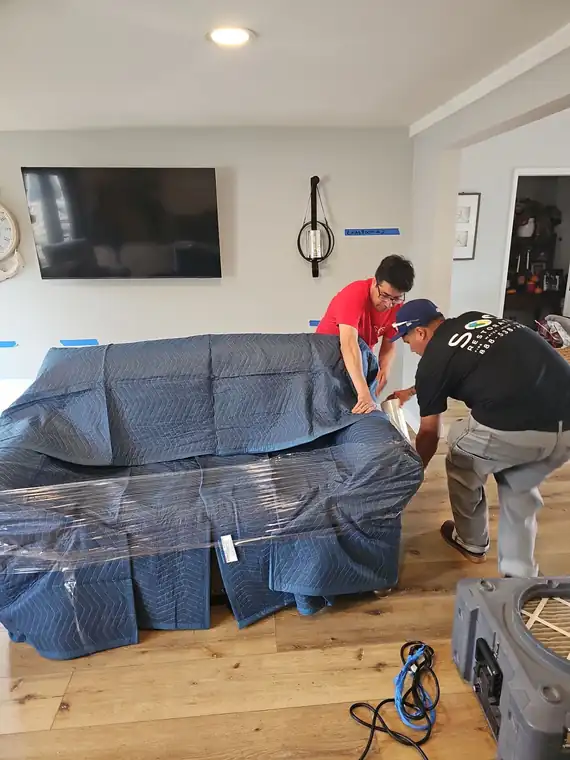
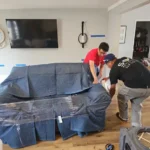
Anything that soaks water up and holds it goes: carpet and the pad under it, drywall cut above the waterline, particleboard, mattresses, upholstery. Anything hard and sealed gets cleaned and stays, which covers tile, concrete, metal, and glass. Soft goes, hard stays.
The argument on the day is almost always about the couch. The EPA’s guidance for houses with sewage in them settles that one: upholstered furniture, mattresses, and anything soft that got wet and cannot be disinfected is discarded, while paneling and wallboard get cleaned and dried immediately, with the bad sections taken out and replaced. In a house rather than in a document, it reads like this:
- Carpet, and the pad under it. The pad is a sponge and it is never worth the argument.
- Drywall, cut above the waterline, and whatever insulation is behind it.
- Baseboard, and the thin strip of trim at the bottom of it, which has to come off anyway once the drywall is opened.
- Particleboard: the toe kick under a cabinet, the floor of a vanity, cheap furniture that stood in it.
- Laminate flooring and the foam sheet under it, which swells and cannot be cleaned from below.
- Mattresses, upholstered chairs and couches, pillows, stuffed animals.
- Food, and anything in a cardboard box that sat in the water.
What stays is most of what people assume they have already lost. Tile, sealed concrete, metal, glass, dishes, solid wood with a hard finish. Hardwood floor depends on how long the water sat on it and what is underneath. Clothes and bedding that a hot wash can reach usually come back. Photographs, documents, and anything with sentimental weight are a case-by-case call, and they are worth asking about before somebody bags them.
Anything you are on the fence about, photograph it before it leaves the house, and get the model number off whatever has one.
Is the backup my responsibility or the city’s?
In Long Beach the responsibility splits at your property line, and it is written down, which is the good news. Everything from the building out to the property line is yours, including finding the problem and paying to fix it. From the property line to the main under the street belongs to the Utilities Department. If your lateral crosses a neighbor’s lot or a private easement on its way there, that stretch is still yours.
The plumber’s camera is what settles it. Until somebody has run one down the line, whose bill this is remains an opinion.
Some of the pipe under this city is old enough that the camera is worth insisting on. The city’s own sewer program lists a lateral repair on Broadway Court, on a main it records as built in 1916. If your block is that vintage, push for the camera rather than a cable run through the clog and a shrug.
Then there is the money, which follows the same line. If the failure sat on your side of it, it is yours, and that is where insurance comes into it. The standard homeowners form takes out water that backs up through sewers or drains, and the people who do have that coverage generally bought it as a separate add-on. None of that is a reading of your policy, because only your carrier can tell you what your policy says. What gets documented for a claim is worth understanding before you start hauling things to the curb.
Why does category 3 water cost more to clean up?
Category 3 water costs more because almost none of it can be dried where it sits. It comes out instead: cut, bagged, carried down the driveway, and dumped. That is hands and hours, rather than equipment humming in a closed room overnight while everybody sleeps.
Category 3 is not a judgment somebody makes by looking at your carpet. The standard the cleanup trades work from calls it grossly contaminated water that can carry disease, and it puts anything that came back up through a drain, or past the trap of a toilet, in that bucket no matter what it looks like or what color it is. The trap is the bend of standing water that keeps sewer gas out of the room. Once something has come past it, the crew will bag a carpet that looks clean and dry to you, and arguing about that on the day only costs you hours.
What that buys on a real job:
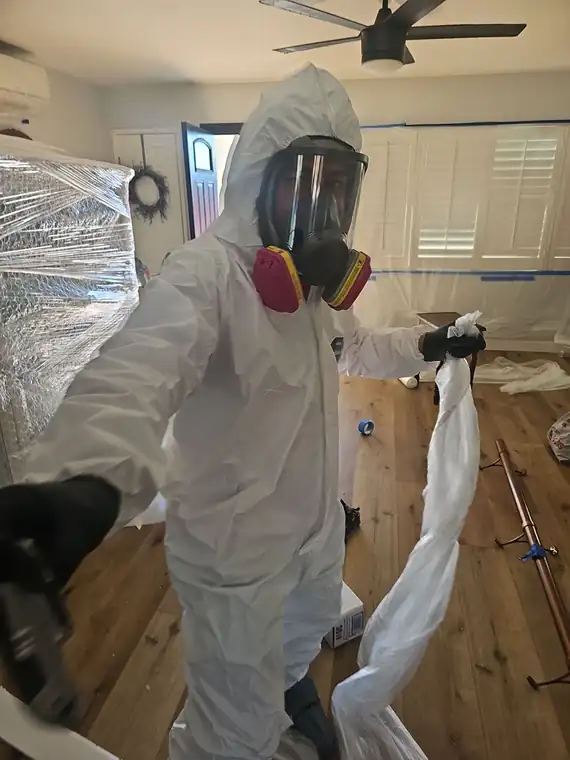
- Demolition, bagging, and hauling what got bagged, plus the gloves, suits, and boot covers that go in the trash every time somebody walks out of the room.
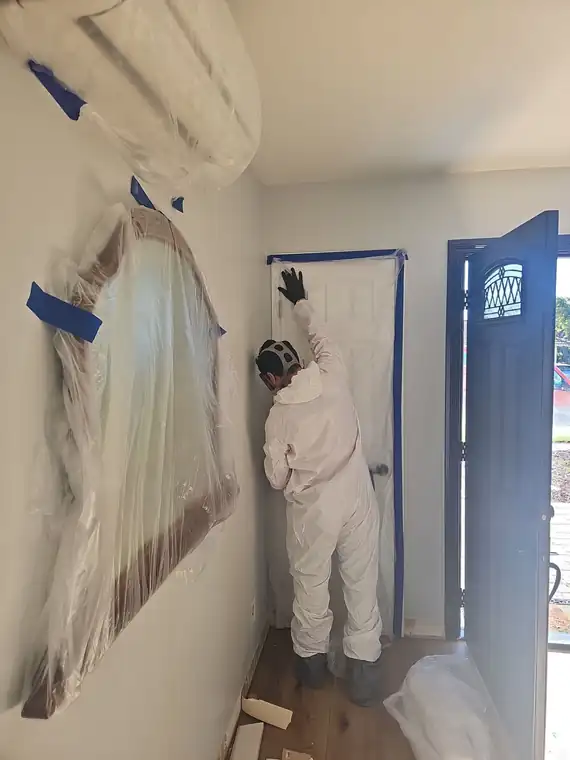
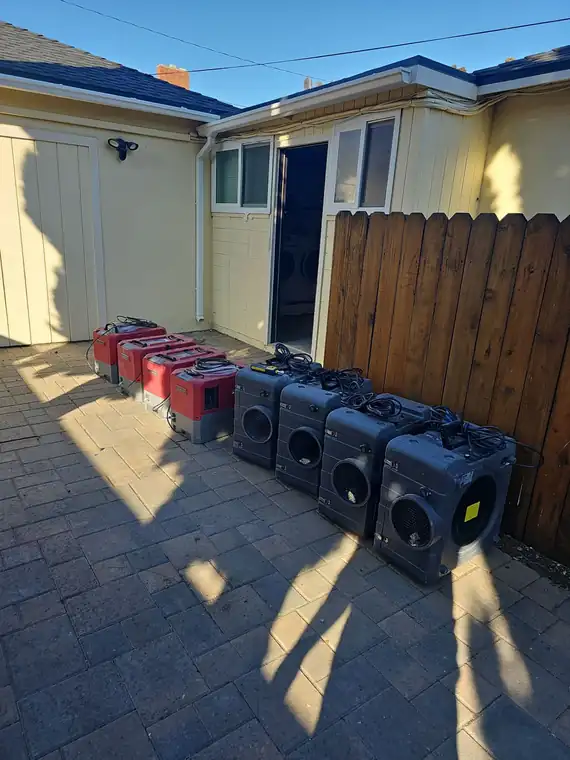
- Sealing the wet half off behind plastic with a filtered fan pulling air out of it, so the dry half of the house stays dry and stays clean while the wet half is opened up.
- Two passes with a hospital-grade disinfectant over every hard surface the water touched, wall studs included, before the first drying fan goes in.
- Whether a wall has to come open at all, which is the difference between a two-day job and a week.
Under all of that sits the ordinary drying job a clean water loss would have been. Two people and a truck is the usual crew for one room, and more rooms means more hands. We bill by the hour, an emergency call-out starts at $90 an hour and depends on the job, and the hours move with how much material has to leave and how far the water traveled, which is why a real number needs somebody standing in the room. How the hours add up has its own page.
Water damage
Mold
Fire & smoke
Storm damage
The cities we drive to for this work
A backup is a same-day call wherever it happens. Long Beach is home, and the Los Angeles County cities out to about sixteen miles are the rest of the map; each city page says how its plumbing tends to fail.
Can't call right now? Send it and we call you.
Your phone number is the only thing we really need. Everything else helps us load the truck right.
If there is sewage on your floor right now, call (657) 660-4185 and tell us which rooms it reached, because somebody in Long Beach answers at two in the morning the same as at two in the afternoon.