After the fire trucks leave, half the house is burned and the other half is soaked.
Call (657) 660-4185 and a person in Long Beach picks up, at three in the morning, in English or Spanish. SOS Restoration of Long Beach does the fire and smoke damage cleanup: the house gets closed up first, then the water the fire department left, then soot and odor. Any hour, any day.
What do I do in the first 24 hours after a fire?
Do not go back inside until the fire department releases the building, and when they do let you in, photograph everything before you move one thing. Those pictures are the only record of where your things sat and what they looked like before a single hand touched them.
Then shut the heating and air off at the thermostat. A blower running after a fire pulls soot out of the burned rooms and pushes it down every duct in the house, and that is how a small stovetop fire becomes a whole-house smoke job by Tuesday. Leave it off until somebody has opened the return, the big grille that pulls air back to the furnace, and put a light down the first run of duct.
A short list for the walk-through:
- take prescriptions, glasses, chargers, and any documents that survived
- leave everything edible, sealed cans and jars included, because heat cooks food through the container it is sitting in
- do not wipe soot with a wet rag or a household spray, since water drives the residue into the paint and the grout and sets it there
- wear shoes and clothes you are willing to throw out, because whatever you walk through comes home with you
- report the loss to your insurance company the same day, and keep every receipt for what you spend closing the building up, because the claim side runs on paper
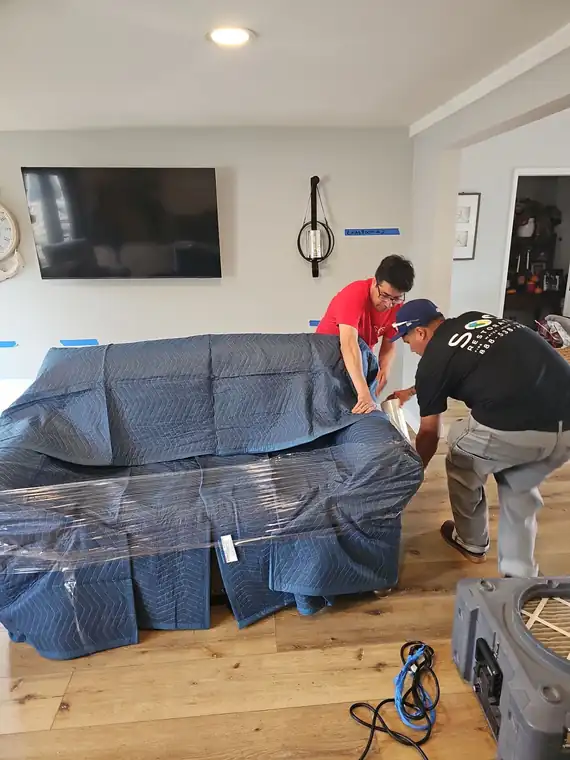
Half the house burned and the rest got soaked by the fire department. What happens to that half?
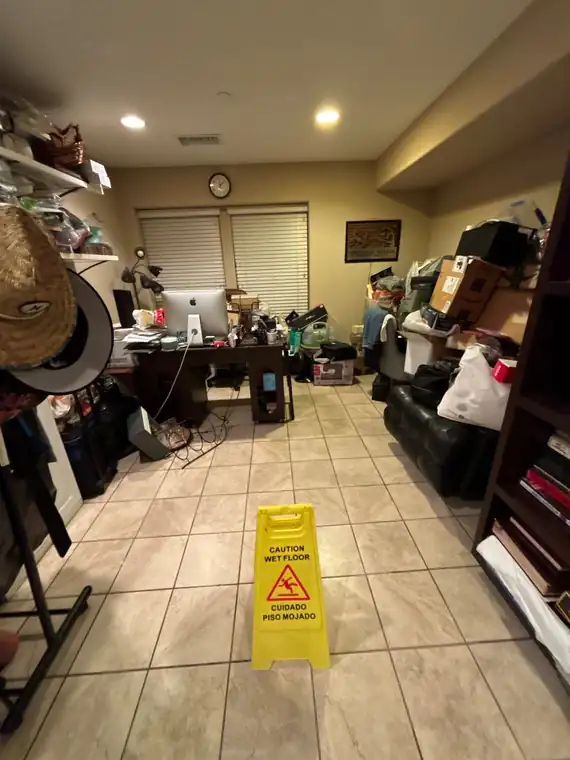
That half is a water loss, and very often it gets worked before anybody touches the soot. Hoses move an enormous amount of water, and most of it lands in rooms that never saw flame.
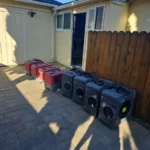
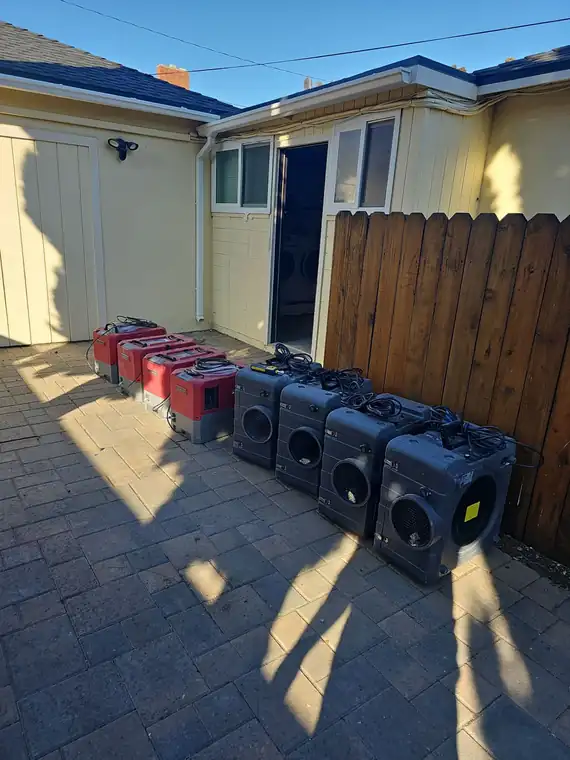
Worked like a water loss means moisture readings taken room by room, soaked insulation and carpet pad hauled out, and drywall cut off the wall as high as the water climbed it. In an average bedroom that is two air movers, which are low fans aimed along the floor instead of at you, and a dehumidifier, and they stay until the subfloor, the plywood your finish floor sits on, reads under 16 percent three mornings in a row.
A burned house looks like it is drying itself out. Windows vented, sometimes a hole cut in the roof, the front door off its hinges. It is not drying. On roughly 165 mornings a year the marine layer, the low cloud that sits on this coast until noon, parks over the city, and air that shows up almost saturated pulls close to nothing out of wet wood. A box fan in the window is not a drying plan here. Why that is true of this city, in numbers, sits on the water damage page.
You have a day or two, not a week, before soaked material starts growing something. Ignore the wet half and it comes back as a second job.
The same crew handles both halves, and the truck that comes to board up the openings is already carrying the meters and the first set of fans. That is deliberate. Tearing out for the water moves the plastic sheeting that keeps soot out of the clean rooms, so the drying plan and the soot plan get written together. If the water is the bigger part of your loss, the water damage side of this work, drying clock included, is laid out in more detail, and what grows behind a wall that stayed wet is covered under mold removal.
Can I just paint over the smoke damage?
No. Paint is not a barrier to smoke odor, and on soot it will not even stick.
Ordinary latex is porous, so the residue underneath keeps releasing straight through it. The room smells fine for two weeks, then smells like the fire again on the first hot day. The bonding problem is worse. Soot is an oily, acidic film, and paint rolled over it bleeds through in yellow-brown rings around the can lights and the ceiling penetrations, usually inside a couple of months.
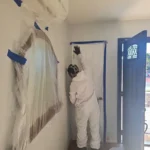
The order is clean, dry, seal, paint, and the seal is the step people skip, which is why they are painting that ceiling again in February. Take the soot off the surface. Put a moisture meter on the framing and in the cavity behind it and confirm both are dry. Seal with a pigmented shellac or a primer sold for blocking odor. Then paint.
What do I throw out after a fire, and what can I keep?
Throw out whatever absorbed smoke and cannot be washed, plus everything edible or medicinal in the building. Dishes, glass, flatware, tools, most furniture frames, hardwood, tile and metal clean up and go back into the house. What goes in the dumpster:
- all food, sealed cans and jars included
- medications, supplements and cosmetics
- formula, bottle nipples, pacifiers and anything else an infant puts in their mouth
- mattresses, pillows and carpet pad
- anything plastic that charred or warped
Electronics are the judgment call, and the wrong call is expensive. Soot is acidic and it carries a little current, so a television or a laptop that sat through a fire can power on today and corrode itself quietly to death over the next six months. Do not switch on anything with soot on it or in it. A set goes out to an electronics restorer instead: expect it gone a couple of weeks, and expect a bill the insurance company’s adjuster will read against the price of a new one before anybody agrees to it.
Clothing usually comes back through a launderer that runs restoration work. Books and loose paper rarely do, unless they cannot be replaced at any price.
What happens after you leave?
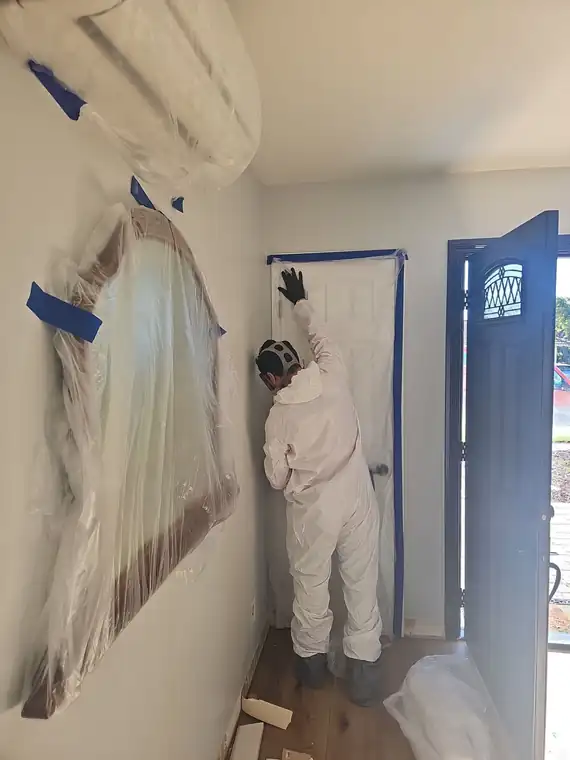
You get the file. Photographs from before anything moved, moisture readings by day and by location, the equipment log, an inventory of what left the house and where it went, and the scope in writing.
Those readings are the proof the house hit a dry standard on a given date, which just means the wet rooms finally read the same as a part of the house that never got wet. Your insurance company reads them. So does whoever builds next, because a rebuild started over a subfloor that never dried is the second claim, and it is a worse one.
Putting the house back is permitted construction under a separate contract with a building contractor: framing, drywall, texture, paint, roof. In Long Beach that matters more than people expect. Patching drywall and plaster only escapes a permit under a limit the city counts across the whole building instead of room by room, and the city’s Express Permit covers replacing fire-damaged framing only up to a tenth of what is already standing. Past either line the job goes to plan check, where a city reviewer reads the drawings before the permit issues, and the schedule stretches.
Ask whoever picks the work up for their license number and a copy of the permit before demolition starts, and hand them the drying log. If something in the file does not read right six months from now, call and ask.
The soot ends up in rooms the flame never reached. In the older tract houses of Torrance one open attic runs the length of the roof, so a fire in the kitchen puts soot over a bedroom that never saw flame. On the hillside lots of Rancho Palos Verdes it moves with the wind through a house that opens to a canyon. And in Signal Hill the call is often the neighbor’s fire, not yours. We work all three the same way, from the far room back toward the burn.
Who decides when it is safe to move back in?
The fire department and the city building official decide that, not the cleanup company and not the insurance company. Long Beach Fire releases the scene, and Building and Safety, out of the Permit Center downtown, decides whether anybody can live in the structure. The notice taped to your front door is theirs to hang and theirs to take down.
Utilities are a separate gate. Gas and electric come back on after the utility’s own inspection, and where the fire reached the panel or the meter, that alone can hold up re-entry for days after the house is otherwise fine to walk through.
Three blocks north of the city line it goes differently. Signal Hill runs its own building safety division and takes its fire clearance through the County fire code, so the same loss on the other side of that line moves on its own clock.
What a crew can tell you is what the meters read, what is still contaminated and what has been hauled out. Whether you sleep there is somebody else’s signature.
How is soot actually cleaned off walls and contents?
Soot comes off dry before anything wet touches it. First a vacuum with a filter fine enough to hold the particles instead of breathing them back into the room, then a dry chemical sponge, which is a block of soft rubber used with no water and no cleaner at all, drawn across the wall in one direction and turned to a clean face every few passes. Scrub in circles and you grind the soot into the paint for good.
Soot from a grease fire behaves nothing like soot from a burned mattress, and the method changes with it. Grease is the one that fools people. What it leaves is a film you can barely see on a white cabinet door, so the kitchen looks survivable while the smell is sitting in the hinge grease, the drawer slides and the underside of the range hood, and every one of those has to come apart to be cleaned.
Ceilings eat sponges. A smoke-loaded ceiling in a two-bedroom goes through a box of them, and the face gets swapped the moment it starts smearing instead of lifting.
Wet cleaning comes last, once the dry pass has taken everything it is going to take. A solvent for the sticky residue a slow smoldering fire leaves, a degreaser for the greasy kind, and the film off burned plastics and wiring goes first of the three, because it is acidic and it is eating the finish underneath while everyone is still arguing about the sofa.
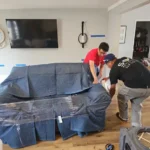
Dishes, tools, flatware and ceramics wash well, and they usually leave the house to be cleaned somewhere the dust is not still falling. Clothes and linens go to a launderer that runs restoration work. The call you have to make yourself is on the soft cheap things: cleaning a smoke-loaded sofa runs four to six hours of labor, billed by the hour, against a couch that cost less than that afternoon when it was new, so the line should read replace.
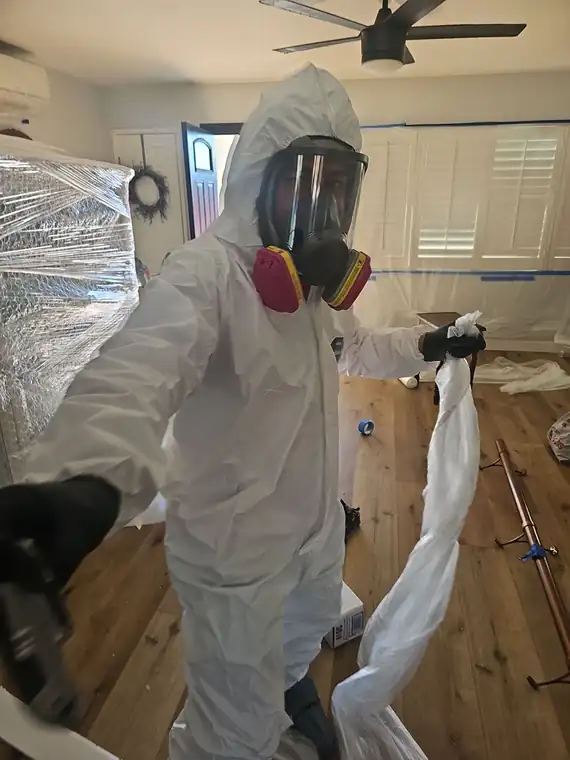
How do I get the smoke smell out, and why does it keep coming back?
Getting the smell out means taking out the soft material holding it: carpet pad, smoke-loaded insulation, the dust coating the inside of the ducts. What cannot come out gets sealed with a pigmented shellac primer, the shiny white sealer that puts a lid on a surface instead of just coloring it. A lid, not a perfume.
It keeps coming back because smoke particles are small enough to settle inside the paper facing on drywall, the foam in a couch cushion and the bare wood behind the trim. Cleaning takes off what sits on the face of things. What is down in the pores stays there, quiet and odorless, until heat and humidity open the material up and it lets go again, on the first warm afternoon or the first night in November when the heater runs. If the fire was not at your address at all, what smoke does to a place it only passed through is its own question.
So carpet pad comes out. Insulation comes out of any cavity the smoke reached, which is usually whatever shares a wall or a ceiling with the fire room, plus whatever the hoses opened. Ducts get cleaned before the system is allowed to run again.
If this was a pan on the stove and the smell lives in the kitchen curtains, you do not need a crew. Wash the textiles, wipe the cabinet faces and the inside of the range hood with a degreaser, then open the place up on one of the days the wind comes off the desert instead of the ocean and the air is bone dry, and see where you stand in a week. Long Beach gives you about 49 of those days a year.
Ozone and hydroxyl machines, the boxes that are supposed to chase odor out of a shut room, have a place at the end, after the removal and the cleaning, never in place of them. The test that settles it is crude and reliable: warm the room up, close it, walk away for an hour, come back and smell it.
How long does the cleanup take?
The drying half usually runs in days rather than weeks. The odor half runs longer, because it arrives in stages: tear-out, cleaning, sealing, and then a deliberate wait to find out whether the smell comes back once the house warms up. Nobody can give you a real date over the phone. The fans stay until the moisture numbers hold flat for days running, and that depends on how much water went in and what it went into.
What actually moves the number:
- how much soft material is in the loss: a tile and plaster bathroom is quick, a carpeted bedroom with a foam mattress is not
- whether the roof or an exterior wall is still open, because nothing dries under a tarp in the rain season
- the year the house went up, since most of Long Beach was built before 1980 and lead-safe work practices are a line on the average job here
- asbestos, which stops demolition dead until a survey by a qualified consultant comes back, and if that comes back positive the regional air-quality district gets ten working days of notice before anyone opens up more than a patch
- whether contents leave the building to be cleaned off site, which adds inventory and transport but usually shortens the schedule inside the house
That ten-day clock is the one that catches people out. It starts when the survey comes back, not on the night of the fire, so a positive result on day one still means two more weeks of standing still. What that adds up to in dollars, and what the hourly rate does and does not include, is broken down on the cost page.
Does insurance cover fire and smoke damage cleanup?
Usually, yes. Fire is one of the causes the standard homeowners policy names outright, and on most policies the soot removal, the odor work and the drying of what the fire department soaked all come out of the dwelling and contents coverage, less your deductible. The arguments are rarely about whether. They are about how much, and about which items on the contents list were worth cleaning instead of replacing. What your own policy does with this particular loss sits between you, your carrier and the wording on your declarations page, which is the summary sheet at the front of the policy.
One thing is worth knowing while you are still standing in the driveway: under the standard policy, keeping the loss from getting any bigger is your job, not the carrier’s. Boarding the openings and tarping the roof is that job. Pay for it expecting a separate check back and you will be disappointed, because that money comes out of the same settlement as the rest of the loss.
An insurer also may not require you to use a particular repair company. That one is in California’s claim regulations, and it matters the first time somebody hands you a list of names.
Our end of it is paper: the room shot before anybody touched it, the scope in writing, the readings by date, the equipment log, all of it billed by the hour and itemized. You, or the insurance company’s adjuster, take that file from there. How a claim actually moves is written out step by step, because the paperwork stage is where most of these losses go sideways.
Water damage
Mold
Storm damage
Sewage cleanup
The cities we drive to for this work
Smoke does not stop at a city line, and neither do we: Long Beach first, then the Los Angeles County cities out to about sixteen miles. Each city page tells you what its houses tend to do after a fire.
Can't call right now? Send it and we call you.
Your phone number is the only thing we really need. Everything else helps us load the truck right.
If the fire was last night and you are standing outside a house nobody will let you into yet, call (657) 660-4185 — the phone is answered in Long Beach at any hour, in English or Spanish, and the board-up is the first thing on the list.