
Most wet floors in Downey start inside the house, in a pipe about as old as the house itself.
SOS Restoration does water, fire and smoke, mold, storm and sewage cleanup in Downey, California, around the clock, weekends and holidays included. Downey is a short run up the 605 from our yard in Long Beach. The number is (657) 660-4185, a person answers it at three in the morning, and Spanish is fine.
Why does the water in a Downey house almost always come out of its own plumbing?
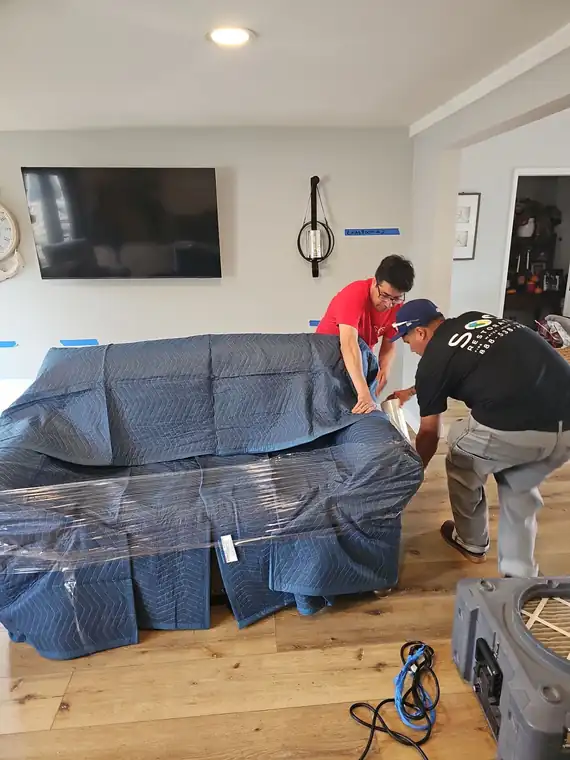
Two rivers run past this city, the Rio Hondo and the San Gabriel, and neither is your problem. Both are lined in concrete, both downstream of the Whittier Narrows dam. The federal flood insurance record says the same thing in plainer language: across all four Downey ZIP codes, in the entire history of that program, single family homes have filed fifteen claims. Ten of the fifteen paid nothing. The last one carries a loss date of June 18, 2003.
The largest flood payout in the city’s history, on the books for February 2024, did not land on a house. It landed on a non-residential building FEMA has mapped in Zone X, outside the official floodplain. Nearly all the flood money ever paid here went to buildings like that one, not to homes.
What does break here is the plumbing, and the reason is the calendar. The Census puts the median Downey home at 1959. Cerritos, a few minutes down the road, comes in at 1974. Of the 35,919 housing units in this city, 13,859 went up in the single decade of the 1950s, and more than half of everything standing today was finished before 1960. So the supply lines, the shutoff valves, the drains and the water heaters in most of Downey have been in service sixty five years and more, and they all aged on the same schedule.
Then there is the floor they sit on. Post-war tract houses here were poured on slab, concrete straight onto dirt, one story, no basement, no crawlspace. I could not find a public count of slab versus raised foundation for Downey, so take that as the pattern of the era, not a measured number. The age is measured. What a slab does to a loss is not subtle. Nothing underneath drains, so the water spreads flat across the plan and climbs the drywall and the 1950s framing by wicking. A tile floor can feel dry underfoot while a wall three rooms away is soaked.
Downey is not one housing market but three. By ZIP, the Census puts the 90240 at a median of 1957 with seven in ten homes free standing, the 90241 newer at 1961 with under half free standing and many more apartments, and the 90242 between them. The 90239 is post office boxes only. Which side of town you are on changes what I expect behind the wall.
Which of the five does a 1959 Downey house actually need?
We run five, the same five we run out of Long Beach. What changes here is how each behaves in a 1959 slab house.
One more thing about who is on the phone. Ownership here splits almost down the middle, and 5,637 units sit in buildings of twenty or more, so on plenty of these calls the person standing in the water is not the one who pays, and one supply failure upstairs lands in three apartments at once. Get the owner or the manager onto the call early. It saves a day. The same crew covers Paramount and Bellflower.
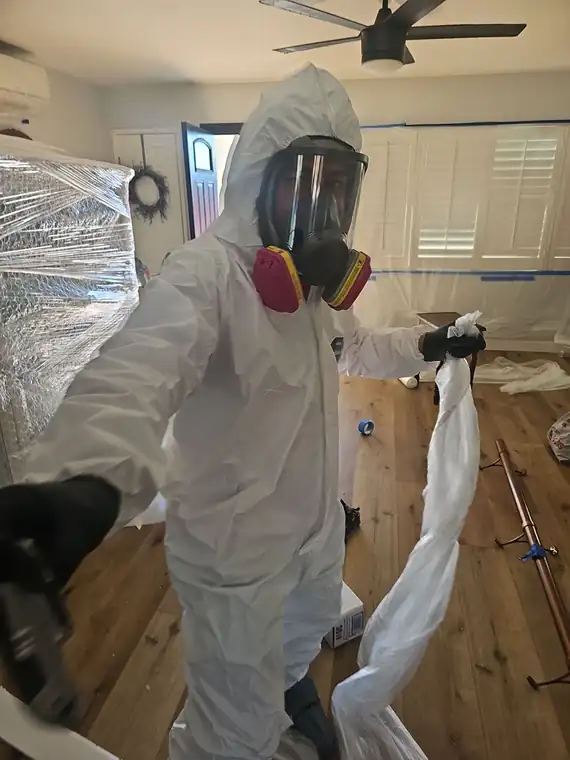
Water damage restoration here is a slab problem
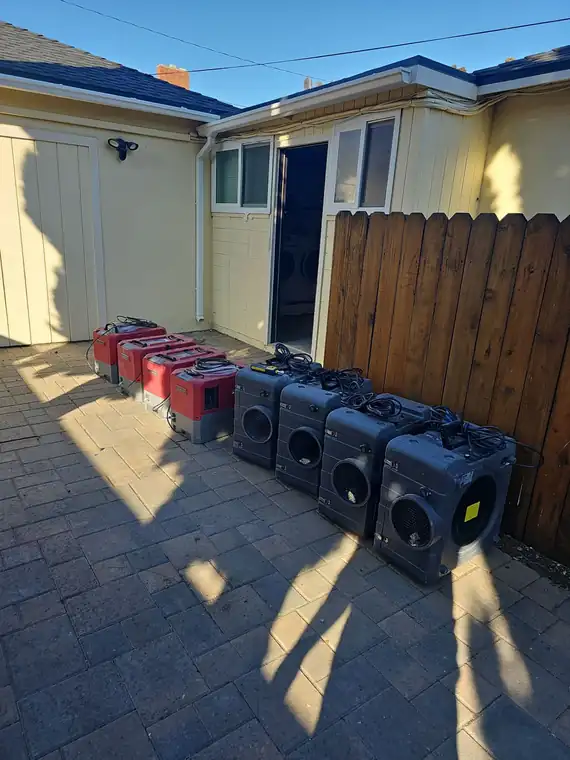
Mold removal and inspection here is usually old, small and behind something
Fire and smoke damage cleanup covers board up, soot, odor and contents
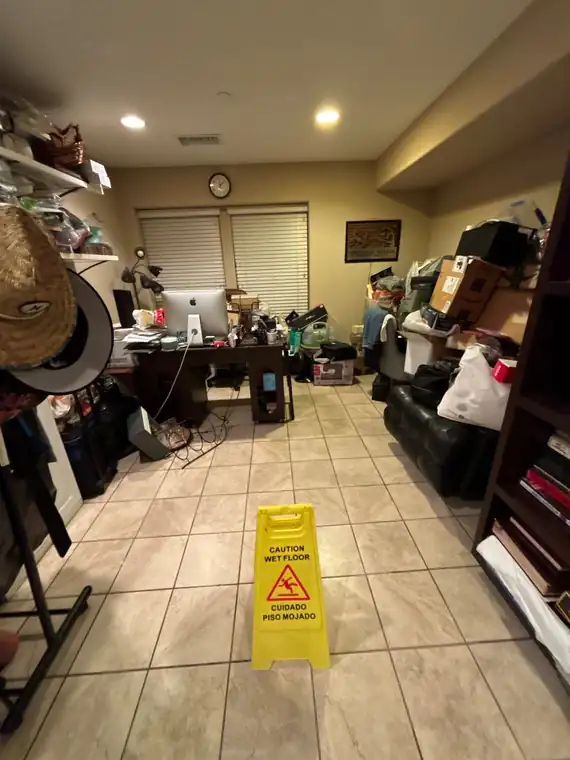
Storm damage restoration in Downey is roofs and windows, not rivers
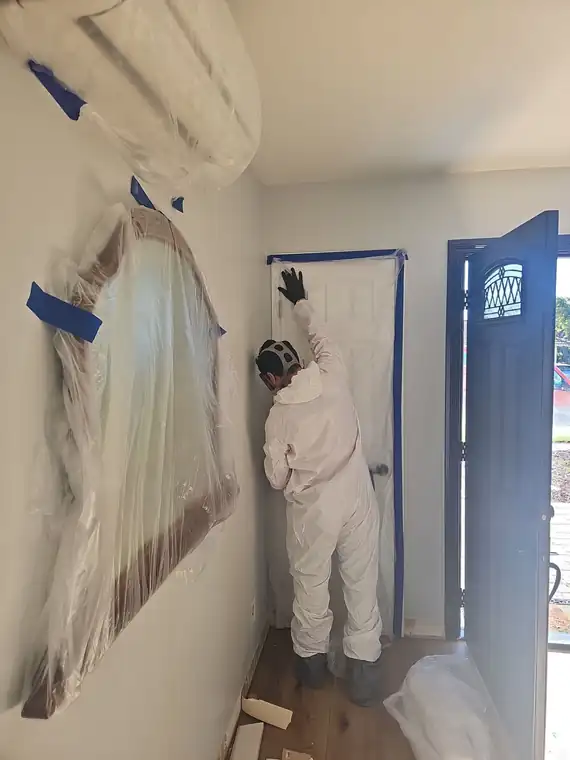
Sewage cleanup comes down to who owns which pipe
What is Downey well water doing to the plumbing behind your walls?
Downey is unusual, and the city publishes the details itself. Every drop of tap water in town comes out of the ground under the town: twenty municipal wells, no imported water at all, pushed through roughly 276 miles of main to about 23,500 meters. The same report gives the hardness, which is the number that matters to your house. 15.7 grains per gallon, with samples running from 9.8 up to 23.7. Water gets called very hard at around 10.5.
Hard water does three things over decades and all three end in a phone call. It cakes a water heater with scale until the tank runs hot and thin, then splits. It crusts the little oval shutoff under the sink, the angle stop, so the one time you twist it, it does nothing or breaks off in your hand. And it pits copper from the inside. Old pipe carrying water this hard is the most common reason a Downey living room ends up wet.
Do not copy the neighbors on this. Norwalk blends imported supply into its well water and reads different numbers entirely.
Here is the cheap answer, and the cheap answer is the true one. On a dry Saturday go find the main shutoff and turn it until you know it turns. Do the angle stops under every sink and toilet while you are down there. Check the date on the water heater, and if it is past ten years and rumbling, replace it on your schedule instead of at two in the morning on its schedule. That hour prevents more of my calls than anything I could sell you. The City of Downey Utilities Division takes meter and main questions at (562) 904-7202.
What should you do in a Downey slab house while you wait for a truck?
We are open 24 hours and Downey is close. I still will not put a clock on the drive, because the 605 at five on a weekday is nothing like the 605 at midnight. Some nights a loaded truck is idle and we leave while you are on the phone. Some nights we are six hours into a contaminated job across town and the honest answer is the morning. You will hear which one before you decide whether to keep waiting on us.
First, stop the water. The angle stop under the fixture, or the main shutoff, does it in about a minute, which beats any phone tree. Second, get it all on your phone while it is still where the water left it, ceiling and cabinets included. Third, get what you can up off the floor and prop the cabinet doors open. Do not run a household fan across a sewage backup, because all that does is push contamination into rooms that were still clean.
Then tell us the room, the floor material, how long the water ran, and whether it arrived from a supply line or backed into the room the wrong way. That is what gets counted onto the truck. A wet twelve by fourteen bedroom with the bottom of the wall gone dark is a few air movers and one dehumidifier. A hallway that came back up the drain means plastic sheeting over the doorway, a heavier machine, and a crew in protective gear. Hours are on the contact page.
What is drying out a Downey slab going to run you?
In Downey, water damage work starts at $60 an hour and an emergency call-out starts at $90 an hour, and both depend on the job in front of us. The rate does not move because the clock says 2am, and it does not move because the address says Downey.
Three lines make up the bill on a Downey job and you should see all three before we start, not at the end. Labor is hours. Equipment is a count times days: air movers, which are low fans built to blast air along a surface, plus a dehumidifier, usually three to five days when water is sitting on concrete. Materials are what leaves in the truck: drywall, baseboard, the carpet cushion underneath. Equipment days move a total more than any other line, and how many days you get is decided by how wet the framing is, not by us. The breakdown lives on the cost page.
If the water came in off the street instead of out of a pipe, that is a different conversation with your carrier, because a homeowners policy does not cover flood. Flood is a separate policy bought before the rain. Judging by the federal record for these four ZIP codes, almost no house here has ever needed it. We document what we find. You file.
What happens after you leave?
You should know the edge of what we do before you hire us. SOS does mitigation. We stop the damage from spreading, take out materials too wet to save, dry the structure and write down the numbers. We do not put the house back together afterward. New drywall, paint and flooring are a separate trade that picks up once our equipment comes out and the readings hold flat.
What you keep is the file, and you are going to want it. Daily moisture readings on every wet material. A dry standard, the meter number from a room the water never touched, so the wet rooms have a target. The photographs taken before anything moved, the equipment log, the drying plan. On a slab this matters more than usual, because the surface reads dry long before the wood behind the baseboard is, and the readings are the only thing that tells the two apart. Whoever handles your claim will read that file.
When you bring in the next contractor, get their license number in writing, ask for a scope that says thirty two linear feet of baseboard instead of hallway, and have them read the meter themselves before a single wall goes back together. A wall closed while the framing still reads wet is the mold call in March. If something opens back up after we are gone, the hours are on the contact page.
Nearby
Downey is the top of the eastern side for us, past Bellflower and Paramount and still inside Los Angeles County; the 605 gets a truck there without touching a surface street.
Can't call right now? Send it and we call you.
Your phone number is the only thing we really need. Everything else helps us load the truck right.
If a floor is wet in Downey tonight, call <a href="tel:+16576604185">(657) 660-4185</a> and say which room you are standing in and whether it came out of a pipe or up out of a drain, because that decides what goes on the truck before it leaves.