
Water in your Long Beach house? We get it out tonight and dry what it soaked into.
A pipe let go, the water heater gave up, or the washer hose finally split, and the floor is wet. SOS Restoration pulls the water out of Long Beach homes, dries the walls and floors it soaked into, and proves it with readings, at any hour. Call (657) 660-4185 and tell us what room you’re standing in.
What do you actually do when you get here?
We stop the water getting worse, and then we dry the house until a meter says it’s dry. That’s the job. Here’s what it looks like in your living room.
First, the walk-through. Before a hose comes off the truck, one of us goes through every room with a moisture meter and finds the edge of the water, which is never where the wet carpet stops. It’s usually two feet further, inside the wall. Everything gets photographed exactly as we found it, before anything moves.
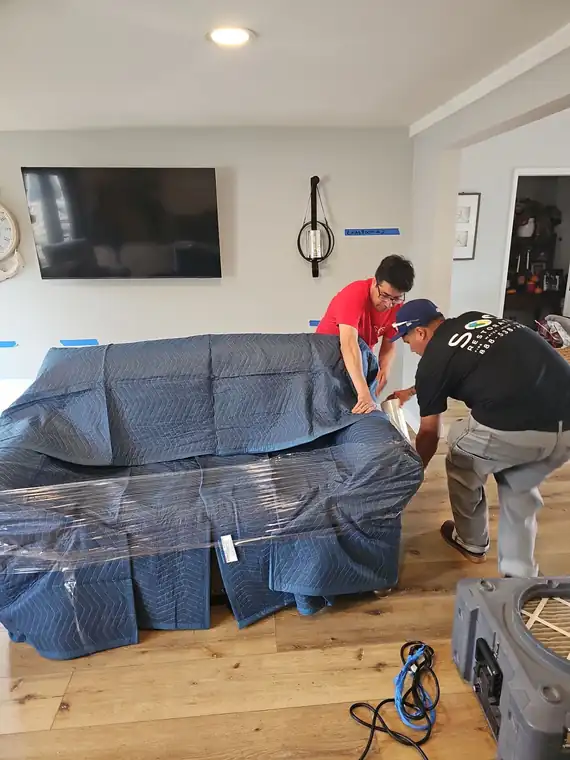
Then the extraction. Standing water comes off the floor with a truck-mounted vac, the carpet pad comes up if it’s soaked, and anything that can’t be saved comes out that night: the swollen baseboard, the bottom foot of drywall if the insulation behind it is wet, the particleboard toe kick under the cabinets. You hear what’s coming out and why before it comes out. Not after.
And then the part nobody sees
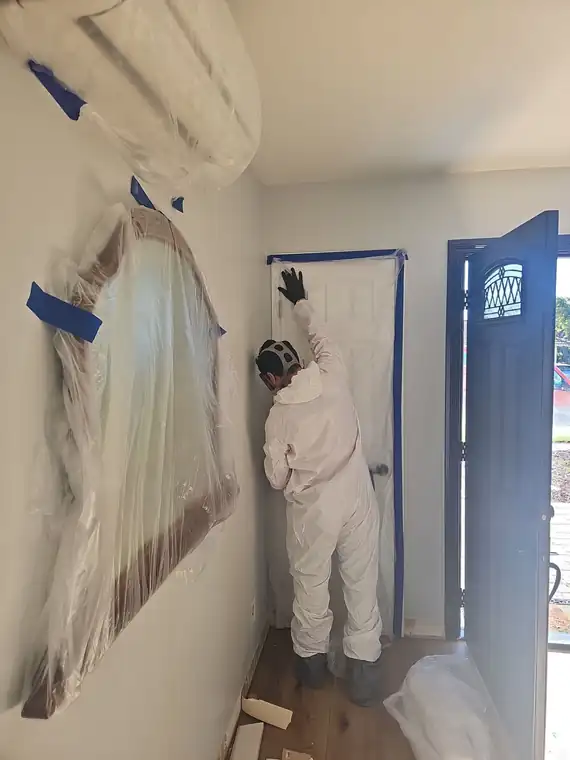
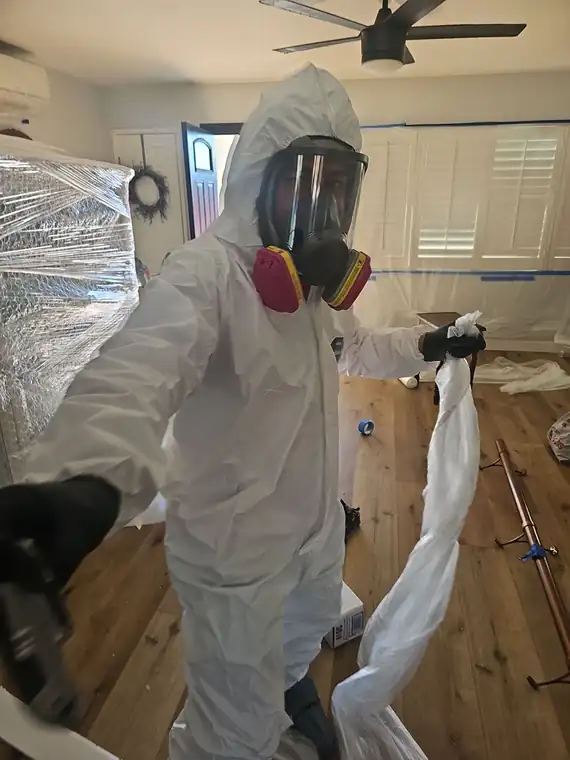
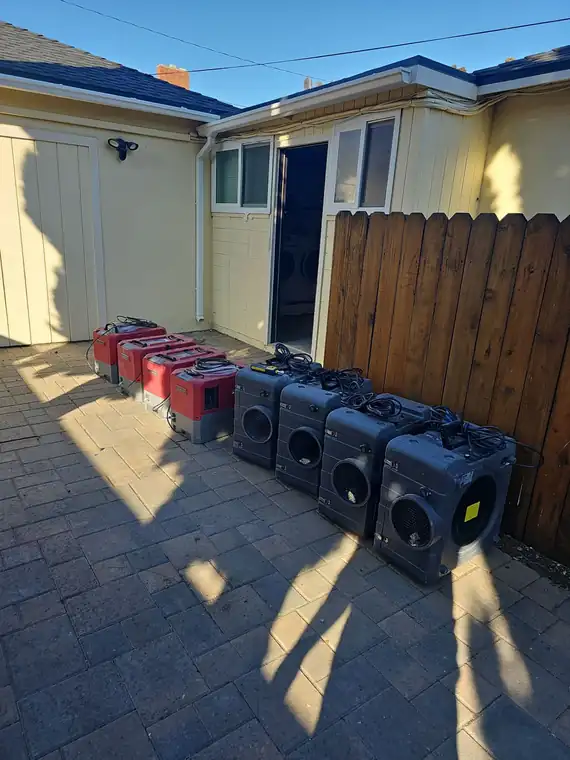
Then the drying. Air movers on the wet material, a dehumidifier pulling the water out of the air, the room closed up so the machines work on your walls and not on the whole neighborhood. One wet bedroom takes three movers and a dehumidifier. A kitchen that ran all night into two rooms takes nine and two. We come back every day, read the same marked spots, and write the numbers down.
What you get when it’s over: a dry house, verified against a wall the water never reached. A moisture map of where the water went. The photographs taken before we touched a thing. The equipment log with the days each machine ran, and a written scope of what came out. That file is what your insurance company reads and what the next contractor prices from. Most people never get one. You will.
And before any of that, you get a straight answer on the phone. Plenty of wet floors don’t need a company, and we’ll say so.
Why does it take someone who knows Long Beach houses?
Because water goes where the house lets it, and the houses here are particular. Half of Long Beach went up before 1960, a good part of that with plaster over wood lath instead of drywall, and most of the tracts east of the river sit on a concrete slab. Plaster holds water and gives it up slowly. A slab keeps sweating moisture for days after the surface reads dry. A 1926 Wrigley bungalow and a 1955 tract house don’t dry the same way, and we don’t set them up the same way.
Then there’s the air. Most of the day the wind comes off the ocean and Alamitos Bay, and it comes in wet. Open the windows to dry a room in this city and you’ve moved the moisture around without taking any of it out. So the room gets shut, a dehumidifier does the work, and we read the walls morning to morning, because the air here is wet before dawn and dry by three, and the wall follows it.
Downtown is a different job again. Apartments and condos, one failed line on the fourth floor, three wet ceilings under it, and the drying is three separate conversations with three separate neighbors.
What should I do in the first hour after I find the water?
Don’t panic. Shut the water off if you can reach the valve, and if you can’t find it, keep going. Cut the power to any room where water is near an outlet, photograph everything before you move a thing, and call us. That’s the list, and we’ll tell you on the phone whether this needs us tonight, in the morning, or not at all.
That last one is real. Half a gallon over the side of the tub onto tile, wiped up before it reached the doorway: you’re fine, and the first-hour guide has the morning check. Carpet, a cabinet, a wall cavity, or a subfloor changes the answer, because once water is inside something you can’t see, a fan on the surface is decoration, and that’s when you call.
One thing not to do that people do every week: don’t wait for an estimate to be approved before the drying starts. Wet drywall past the second day starts growing something.
What's the difference between water damage restoration and mitigation?
Mitigation is the emergency half, the part that keeps the loss from getting bigger: extraction, removing what can’t be saved, drying, holding the humidity down, and documenting every bit of it. It’s billed by the hour and then by the machine for each day it stays in the house. The machines bill by the day, and the day doesn’t stop when the crew goes home, which is why you hear the number on day one.
“Restoration” gets used two ways, which is where the confusion starts. On a website it usually means the whole arc, from the first wet vac to the last coat of paint. On an estimate it means the second half only: board, texture, paint, flooring, and cabinets, after the structure is dry. Two phases, two sets of line items, and often two permits.
Why it matters to you: the mitigation invoice and the rebuild estimate normally reach the insurance company as two documents on two schedules, so the emergency half and the rebuild half get discussed separately even though one loss produced both. How the drying gets documented for a claim is worth reading before the first check shows up.
What happens after you leave?
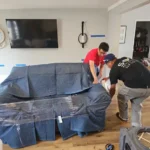
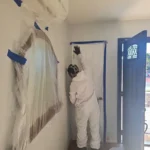
The equipment comes out the morning the wet material reads back at your dry standard. You can put the furniture back that afternoon. Leave the closet and cabinet doors on that wall open another week, and if a musty smell is still there two weeks later, something in a cavity didn’t dry, and we come back and meter it. That’s not a new job.
What you keep is the file you saw above. We’re done when the readings say dry, what couldn’t be saved is gone, and you know exactly where it came from. Whoever rebuilds the wall and the floor works from that file, so it’s worth more than it looks. Hand him the whole thing, and before he hangs board, have him read the cavity himself and write the number down. Then ask him about the permit. Long Beach counts its patch-and-repair exemption across the whole building, not room by room, so a flood cut in the kitchen and another in the hall have usually used it up between them, and the third room needs paper before it gets board.
Keep the file after the room looks finished. If the same wall goes wet again in two years, those readings are the difference between a new loss and a leak nobody ever fixed, and they’re the only proof the wall was ever dry. Need another copy, or want to send us photographs of something you’re watching? The contact page reaches the same people at the same number.
Why do I have a water stain on my ceiling but no leak?
A ceiling stain with nothing leaking above it is usually the air conditioner, not the roof. The drain pan under the attic air handler backs up and spills, or a bare cold duct sweats onto the drywall. In a Long Beach summer the roof is the last suspect; the whole of June through August brings about a tenth of an inch of rain.
The other reason there’s no leak where the stain is: water travels. It leaves a shower pan or a toilet flange, runs along the top of a joist, and drops through at the first low point, six or eight feet from the actual failure. Cutting under the stain finds the water. Finding the source usually means a second hole upstream, and that one is ours to find, not yours.
Tonight, mark the edge of the stain with a pencil and look again tomorrow. If it crossed your line, it’s active, and you call us. If it’s firm and papery, it dried months ago and can wait for daylight.
January is a different conversation. Almost every rainy day this city gets is a winter day, so a stain that showed up while the storm was blowing is water getting through the shell of the house, and that one lives on the storm damage page.
How do I know if my walls are actually dry?
When the wet wall reads the same number as a wall the water never touched. Not when it feels dry, and not when the fans have run five days.
Before anybody touches a hose, one of us walks to the far bedroom and pushes a pin meter into a wall that stayed dry. That reading is your dry standard. Everything for the next four days is measured against it, and it has to come from your house, because a plaster wall in Wrigley and a gypsum wall in a Lakewood tract don’t share one.
Then the wet material gets read every day at the same marked spots, at roughly the same hour, and each reading goes in the log with the date, the room temperature, and the humidity. Morning to morning, because the wall follows the outside air and the outside air here swings hard between dawn and mid-afternoon.
A wall can feel dry to your hand and still read wet on a pin driven into the stud behind it. The surface always dries first. The framing decides when the equipment leaves.
Ask to see the log. Every day, on paper or on a screen, your readings next to your dry standard. Drying is the one part of this work that leaves a number behind, so there’s no honest reason for that number to be hard to get.
Is the water in my house clean, or is it contaminated?
Category 1 is clean water, category 2 is dirty water, category 3 is dangerous water, and the category decides what can be saved. A supply line, the water heater, an ice maker line, a tub left running: category 1, and you can walk in it. Washer or dishwasher discharge, a toilet that came over from the bowl side: category 2, and the kids and the dog stay out of the room. Anything that came up a floor drain, across the yard, or off the street is category 3, and it’s handled that way from the first minute.
Time moves it. Clean water that sat three days in a warm closed house isn’t clean water anymore, and no amount of arguing puts it back.
What that changes for you: category 1 means the pad, the drywall, and the cabinet boxes are candidates for drying in place. Category 2 or 3 means the porous material leaves the house, the room gets sealed behind plastic, and you sleep somewhere else that night. The full breakdown, step by step, is in the water categories guide.
Long Beach has a category 3 source most cities don’t: the tide. In Naples, a king tide over the seawall is category 3 water, and the salt it leaves keeps pulling moisture back for months. Sewage is its own job with its own containment and its own honest line between what can be cleaned and what goes in the dumpster, and it has its own page: sewage cleanup in Long Beach.
Readings, every day
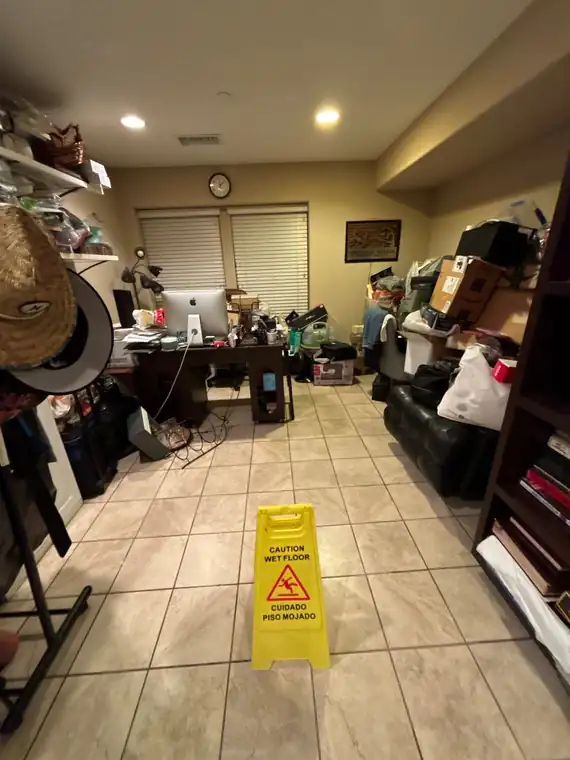
Photographs, before anything moved
The scope, in writing
How long does water damage take to dry out?
Three to five days in a slab tract; a plaster bungalow runs longer. That’s clean water, caught the same day, soaked into drywall, carpet pad, and baseboard. Two days happens on a small tile-and-drywall job. Ten to fourteen days happens too, and when it does it’s one of five things.
- What got wet. Carpet, pad, and half-inch drywall give moisture up fast. Plaster over lath, hardwood over a subfloor, and the underside of a plywood floor hold it and release it slowly no matter how many fans you point at them.
- How long it sat. Water found at six and extracted by noon dries on the short end. The same failure running all weekend has pushed moisture into the bottom plate your studs stand on, and then up the studs. That adds days.
- How much of it. One wet bedroom reads dry around day four. A kitchen that ran overnight into two adjoining rooms is closer to seven.
- Slab or raised floor. A slab keeps releasing moisture after the surface reads dry. A raised floor over a crawl space can be dried from below, which is faster, wherever there’s room to get equipment under it.
- The air. Ocean air doesn’t dry anything. The dehumidifier is the machine drying the house; the movers only keep wet air from sitting on the material.
Does wet drywall always have to come out?
No. Clean water, caught the same day, board still firm under your thumb: that dries in place with air movement and a dehumidifier, and nothing gets cut. Plenty of jobs end exactly that way, and we’d rather run the machines two more days than cut a wall that would have dried.
It comes out when one of these is true:
- The paper face has separated from the core, or the board crumbles under a thumb.
- The insulation behind it is wet. Fiberglass holds water against the back of the board and can’t be dried through it, so the board comes off in a straight line a foot or two above the waterline. That cut has a name on the invoice: a flood cut.
- The water was dirty. Washer discharge, a toilet that came over, anything off the street. That board leaves even when it’s barely damp.
- It sat wet long enough that the only way to know what the cavity looks like is to open it.
Where the cut lands is set by the meter, plus a margin above the highest wet reading. A foot, two feet, four feet. Anyone who quotes you a height before metering the wall is guessing.
What does it cost, and what moves the number?
Water damage work starts at $60 an hour and depends on the job. An emergency call-out, the truck that leaves at two in the morning, starts at $90 an hour. On a water job the thing that moves the number most is the machine day. Every air mover and every dehumidifier is billed for each day it stays in the house, so machines times days is most of the invoice. A wet bathroom on tile is three movers and one dehumidifier for two days. A ground floor on carpet over slab that ran all weekend is a dozen machines for a week, plus the hours of pulling pad and cutting board before the first one is switched on. That daily charge is the part people don’t expect, and you’ll hear it from us on day one, not on the bill.
Having us come out and meter the house commits you to nothing. If the honest answer is a fan and two days, that’s the answer you get, and the visit ends there. When it’s more than that, you’ll know what we’d cut, how many machines, and roughly how many days before you decide. The line items, machine days included, and how to spot an estimate that pads them, are on the cost page.
The same work goes out past Long Beach in both directions, and the house decides how it goes. East, in the postwar slab tracts of Lakewood, Downey and Cerritos, there is nowhere down for the water to go, so one failed line under a kitchen sink wets three rooms and a hall and we meter all of them. West, in Torrance, the first thing we settle is whether the floor is a slab or wood over a crawlspace, because the water ends up somewhere different in each, and drying the wrong one is how a house stays wet.
The cities we drive to for this work
Long Beach is home. Around it, the Los Angeles County cities out to about sixteen miles, and each city page says what is actually different about its houses.
Can't call right now? Send it and we call you.
Your phone number is the only thing we really need. Everything else helps us load the truck right.
If there is water on your floor right now, call (657) 660-4185 and tell us what room you are standing in. Somebody in Long Beach picks up at three in the morning the same as at three in the afternoon.