
In Long Beach, water damage work is billed by the hour at a starting rate that depends on the job, and the rest of this page shows what moves every other line. The rest of the bill is the part nobody explains.
Water damage mitigation in Long Beach is billed by the hour at SOS Restoration, with equipment, materials and disposal on top of the labor, and the starting rate depends on the job. The total depends on how much material got wet, how long it sat, what kind of water it was, and how slowly a closed-up house gives water back at this humidity. Open 24 hours: (657) 660-4185.
How much does water damage restoration cost in Long Beach?
The hourly rate is the only part anybody can honestly tell you before they see the house, and ours starts at $60 an hour for water damage work; an emergency call-out starts at $90 an hour. Everything else on that invoice is a quantity somebody has to go and measure: square feet of wet drywall, fans and dehumidifiers counted per machine per day, the volume of ruined material that leaves in the truck. Until a meter has been on your walls, a number over the phone is a guess made with your money.
Four things move the total more than everything else put together. How much material got wet, which is always wider than the wet patch you can see, because water wicks up drywall and runs sideways under flooring. How long it sat before anyone pulled a baseboard off. Whether the water was clean, dirty, or sewage. And what your house is made of: the old plaster in a Wrigley bungalow holds water far longer than the drywall in a Lakewood tract house, so identical square footage can mean twice the days on machines.
There is a local reason the equipment line runs long on this coast. Air off the water keeps the inside of a closed-up house damp enough that opening the windows moves the moisture around instead of taking it out, so the drying gets done by machines, and machines are billed by the day. The weather sets that day count as much as the leak does. The longer version of why a house here gives water up slowly sits on the water damage page.
Plenty of what people call us about is not worth paying an hourly crew for. A pinhole fitting that dripped into the cabinet under the sink overnight and left a dark ring on the shelf: empty it, leave the doors open, aim a fan into the cavity, then lay your hand flat on the particleboard tomorrow and again the day after. Dry and hard both times, you kept your money. Still cool, or soft under your thumb, or the front edge has started to swell, and now there is something to buy.
What is actually on a mitigation invoice?
A mitigation invoice has six kinds of line on it, and every one of them is priced by something you can count for yourself.
- Labor. Hours on site, by person. Ours starts at $60 an hour for water damage work; an emergency call-out starts at $90 an hour.
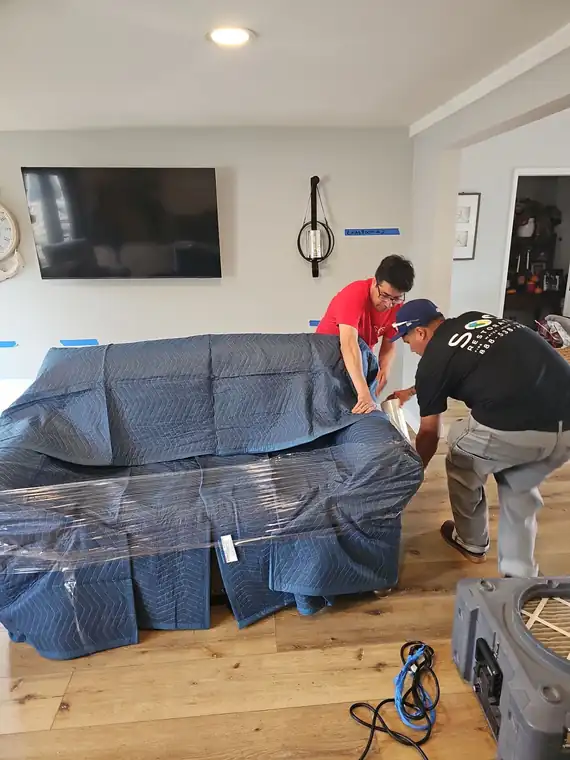
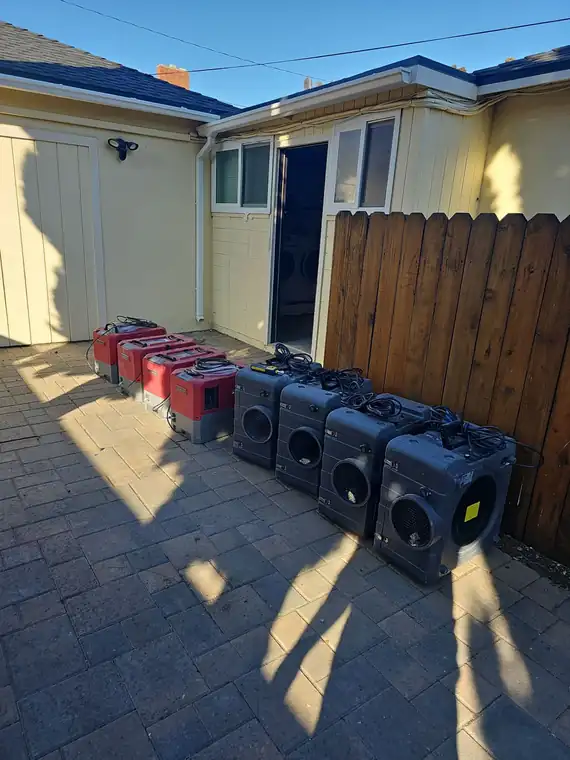
- Equipment. Every air mover, the squat fan that sits on the floor blowing along a wall, and every dehumidifier, counted per machine, per day it stood there. Air scrubbers, which are a filter box pulling dust out of the room air, get counted the same way.
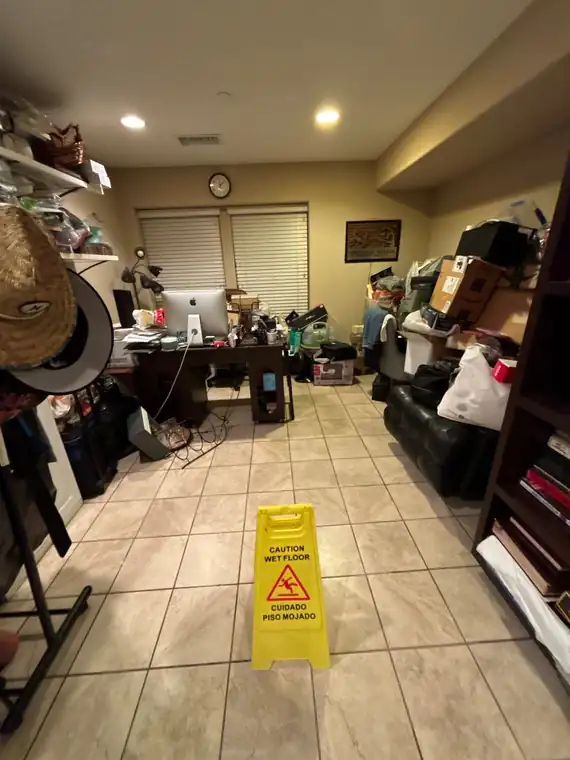
- Demolition and disposal. Square feet of drywall, flooring, or insulation removed, plus the volume of it that went to the dump. Dump fees are real and they belong on the paper.
- Materials. Plastic sheeting and tape, zipper doors (a zippered slit cut into that plastic so people can walk in and out without the dust following them), antimicrobial, suits and respirators on a dirty job.
- Documentation. Moisture readings, photographs, the drying log. Some firms bill this out, some fold it into labor. Ask which, because you are paying for it either way.
If you are in an apartment or a fourplex, settle one thing before anybody starts: whose paper does each side of the wall land on. Water pays no attention to the line between two units. A supply line lets go upstairs in Belmont Heights and it wets the unit it started in, the ceiling of the unit below, and the cavity the two of them share, so the demolition footage and the containment plastic are being counted at two addresses while the invoice carries one name. Four in ten homes in this city sit in a building of five units or more, so it is not an edge case here. That argument is far cheaper before the machines go in than after the drying is done.
There will probably be a line at the bottom called overhead and profit, a percentage added on top of everything above it. It is an ordinary line, and worth understanding before you argue with it. What O&P means on an estimate is its own conversation.
Take a pen to the estimate and write the unit beside every line: hours, machine days, square feet, cubic yards, each. The line where you cannot write a unit is the one to ask about first.


How do the water categories change the price?
What kind of water it was decides how much of your house gets dried where it stands and how much of it leaves in bags, and that one distinction is most of the cost difference between two jobs of the same size. The trade sorts water into three categories.
Category 1 is clean water: a supply line, a water heater, a burst washing machine hose. The copper line under a kitchen sink, caught the same morning, is three or four fans, a couple of days, nothing cut out. Category 2 has picked something up along the way, like a washing machine discharge, an overflowed bowl without solids, or clean water that sat warm for three days and went stale. More material comes out and cleaning steps get added to the hours.
Category 3 is sewage, ground water, or anything carrying waste, and in Long Beach it usually starts at the sewer lateral, the pipe that runs from your building out to the city main. You own it as far as the property line and Long Beach Utilities owns it from there, which settles who pays for the plumbing repair and changes nothing at all about the cleanup on your floor.
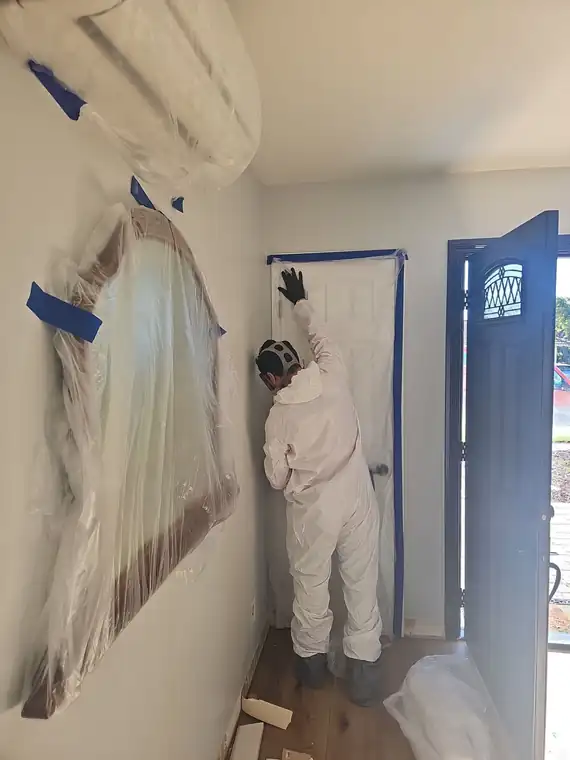
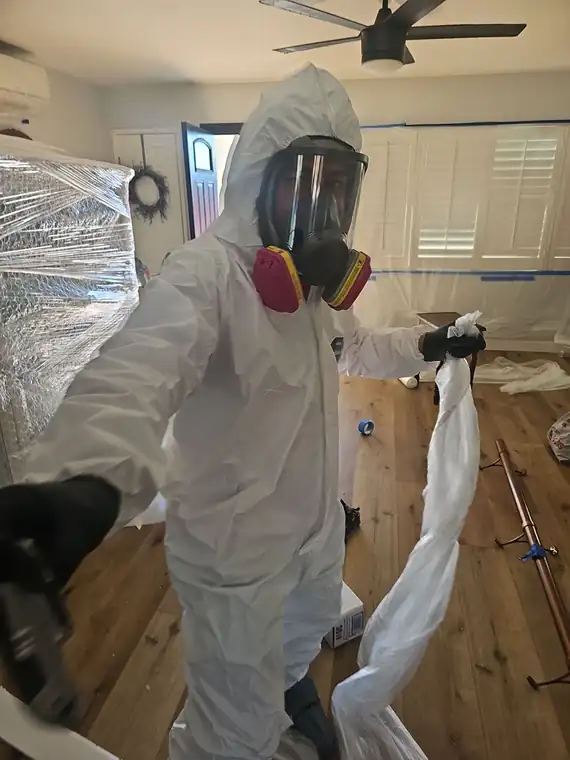
Two techs in Tyvek suits and half-face respirators work behind a zipper door with a negative air machine running, a fan that holds the room at slightly lower pressure than the rest of the house so nothing drifts out of it. Anything that soaks up water goes out in contractor bags: the carpet and pad, the particleboard vanity, the baseboard, and the bottom two feet of drywall, which the trade calls a flood cut. A small bathroom fills something like eight of those bags, and every bag is a billable quantity. That is why a sewage backup costs a multiple of a supply line failure across the very same square footage.
Category 1 turns into Category 2 in about forty-eight hours in a closed-up house at this humidity, and water that arrived dirty never gets cleaner sitting there. The Tuesday leak you call about on Friday is a different invoice than the same leak on Tuesday.
How much are they charging me per day for each fan and dehumidifier?
Two numbers, and you can have both before anyone drives out: the rate per machine per day, and how many machines will be standing on your floor on each of those days. A wet kitchen and hallway is commonly four or five air movers and a dehumidifier for three or four days, which the invoice will show as unit-days, one machine standing for one day. Get that per-machine, per-day rate in writing before anything goes down on your floor; ours comes over the phone at (657) 660-4185.
Equipment days are the easiest thing on a mitigation invoice to pad, so this is the line to audit. The count should be built on something. Fans get placed off the square footage and the shape of the wet area, since an open kitchen takes fewer than the same footage chopped into a hallway and two closets. Dehumidifiers get sized to how much air is sealed inside and how wet the place is. Both counts should fall as rooms reach the dry standard: the wood and the drywall read the same as a room the water never touched. The last machine comes out the day the readings get there. If the log shows machines running three days past that day, those are billed days somebody has to justify.
Four questions get you all of it:
- Can I see the daily moisture readings, by room and by material, for every day you billed equipment?
- Where in my house did you take the dry standard reading? It should come off an unaffected part of the same building, a closet wall in a dry bedroom.
- How many machines were on the floor each day, and what date did each one come out?
- Which day did the readings meet the standard, and how many equipment days were billed after that day?
A company keeping a real drying log can answer all four out of the file. A company that cannot is either not documenting the job or billing days it cannot defend, and both of those are cheaper to raise now than after the check clears.
Fewer machines can cost you more. Too little dehumidification during the May and June marine layer is how a four-day drying job turns into a two-week one, and you pay for the extra days either way.
Does the inspection cost anything?
You will know what a visit to your address costs before anyone gets in the truck, because we say it on the phone: (657) 660-4185, any hour. What you are buying is somebody walking the house with a moisture meter and a thermal camera, telling you what is wet and what is not, and leaving those findings with you whether or not you hire us.
"Free inspection" means two different things in this business and only one of them is free. In the other version the visit costs nothing because it is built to end with a signature on the hood of a truck, on the paper that authorizes the work, before anyone has measured a single wall. If the person at your door wants a signature sooner than a reading, that is the version you are looking at.
One thing to read before you sign anything at the door. A contract for repair work on a home damaged by a disaster has to carry a notice, in bold type, telling you that you may cancel at any time prior to midnight of the seventh business day after the date of the transaction. That is California law and it is on the paper or it is not. Find it, keep your dated copy, and count the seven business days from the date written on it.
How much does mold removal cost?
Mold gets priced on how much material has to come out, and how much sealing off it takes to get it out without spreading spores through the rest of the house.
Growth on the back of one bathroom baseboard is a couple of hours and a bag. The same organism inside a wall cavity, fed by a slow supply-line leak for eight months, is plastic containment, negative air, opening up the cavity, days of air scrubber, and a plumber before any of it starts. Both get written on the invoice as mold remediation. One of them is an afternoon. The other is most of a week and a second trade.
Two things about the housing here push the number up, and neither is optional. Almost four out of five Long Beach homes predate 1980, which puts lead-safe work practices on the job by default instead of as an upsell, and that is hours and materials rather than a line you get to decline.
The second one costs weeks rather than dollars. Past a certain amount of demolition, the regional air district, the agency that regulates dust and emissions across the LA basin, wants an asbestos survey signed by a consultant and then ten working days of notice before anybody swings a hammer. The threshold is on the questions page. On an invoice it shows up as two more weeks of equipment sitting on your floor, which is the part nobody warns you about.
Here is where you can honestly save money: skip the test. The CDC does not recommend testing mold and says you do not need to know what type it is. If you can see it and you know where the water came from, a lab report changes nothing about what has to happen next. Whether testing is worth paying for has a short answer, and it is usually no. The long version sits on the mold page.
How much does fire and smoke cleanup cost?
The fire sets the ceiling on a fire loss, but the smoke sets the price of the cleanup, because smoke went everywhere the air went: closets, drawers, the inside of the ductwork, the underside of every horizontal surface in rooms that never saw a flame.
That changes what gets counted. Surface area to be cleaned instead of floor area, which means ceilings, the tops of door casings, the back of every shelf. Contents sorted item by item into what can be cleaned and what cannot. Sealing whatever stays. Deodorizing in more than one pass, because the smell comes back on the first warm day. And the part nobody warns you about at the curb: the fire department put the fire out with water, so a fire invoice usually has a whole drying job buried inside it, priced by exactly the rules above, marine layer and all.
Contents are where a fire and smoke estimate quietly doubles. Ask for the inventory in writing, with the clean-or-replace call marked next to each line, before anyone boxes a single thing.
How do I read a quote and spot a bad one?
Read it for quantities. If square feet, machine days, cubic yards, and hours are not on the paper, there is nothing on it you can check and nothing you can dispute three weeks from now.
Nine things that should stop you cold:
- One line and one number for the whole job.
- A price given over the phone before anyone opened a wall.
- A signature asked for at the door, tonight, while your hands are still shaking.
- No cancellation notice on a contract for work on a residence damaged by a disaster.
- Anybody who tells you what your policy covers. They have not read it. Neither have we.
- Anyone offering to eat your deductible for you. That offer ends the conversation.
- An offer to negotiate with your insurance company on your behalf. California treats representing a policyholder on a claim for compensation as public adjusting, which is its own separate line of work with its own rules.
- "Sign tonight or the claim gets denied." The standard homeowners form ties a coverage problem to the failure actually prejudicing the insurer, not to a clock a salesperson invented in your driveway.
- Equipment counts that never move across a two-week job, with no readings attached to explain why.
Then turn the paper over and look at the depreciation. If what you are holding is your insurance company’s estimate, California’s claims regulations say that depreciation has to be "discernable, measurable, itemized, and specified as to dollar amount," with the basis for it explained to you in writing. A depreciation line that lands as one lump sum with nothing itemized under it is money still sitting on the table. Ask them to show that arithmetic.
Two more things that estimate owes you under the same regulations. A copy of every document the settlement was built on, if you ask for it. And repair costs the carrier has taken reasonable steps to verify are representative of the local market, not a national table. The claim page walks through the rest of it.
Get a second estimate. It costs you an afternoon, and if you would rather have another pair of eyes on the one already in your hand, we will read your estimate with you.
What happens after you leave?
Every line we billed leaves with a document standing behind it. The unit-days answer to the equipment log and its dates in and dates out. The hours answer to who was on site and for how long. The demolition footage and the dumpster volume answer to the photographs taken before anyone cut. The day the last machine went out answers to the readings that finally met the dry standard. Line, then proof. Anything you cannot trace back to one of those, ask us about, because it is the same question the next contractor and your insurance company will put to it. Keep your own copy.
We stop when every wet material has read at the dry standard three days running and the file closes on that reading. Putting it back, meaning drywall, texture, paint, flooring, and cabinets, is a general building contractor’s contract and it belongs on a separate piece of paper. Ask the next contractor for their state license number. Ask whether they also carry a Long Beach city business license, because the city wants both and the permit counter checks for them.
Then ask about permits, which is where the real money hides. In Long Beach, patching plaster or drywall needs no permit up to 90 square feet, and that is 90 across the whole house rather than per room. One flood cut around a bathroom and a hallway can pass it before the first fan goes down.
Above that line the city has an Express Permit covering interior drywall and plaster replacement up to a tenth of the building’s walls and ceilings. Past that it is drawings and plan check, and plan check is where a rebuild schedule goes to sit.
The permit counter closes for lunch from noon to one every day, and on Wednesdays it does not open until nine. Small thing. It costs people an afternoon every week.
One last piece, because it is the part that gets skipped: fix the thing that leaked. Leave the source running and the problem comes back, and the second visit is not free. Put the plumber’s invoice for that repair in the same folder as the drying log, because the next contractor and your insurance company both ask when the leak was actually stopped.
Can't call right now? Send it and we call you.
Your phone number is the only thing we really need. Everything else helps us load the truck right.
If you have an estimate on the kitchen table and something about it does not sit right, call us at (657) 660-4185 and read it to us; we are up, and we work Long Beach around the clock.