
Why does category 3 water cost more to clean up than a clean-water leak?
The number on your estimate is not about how much water there is. It is about what is in it. Clean is category 1, dirty is category 2, contaminated is category 3, and that grade decides what gets dried where it sits and what gets cut out and carried to a dumpster. That is where a Long Beach bill actually moves.
What is the difference between category 1, 2, and 3 water damage?
The same toilet gives you two different answers depending on which way the water came. Overflow off the clean bowl side is category 1. Anything pushing back up from beyond the trap, the curved section of pipe underneath, is category 3. Category 1 came from a sanitary source and carries nothing that will hurt you. Category 2 is dirty enough to make somebody sick if they drink it or sit in it. Category 3 is the one nobody argues about: sewage, anything from past that trap, water that came up out of the ground or ran in off the street.
Roughly, by source:
- Category 1: a burst copper supply line, a failed water heater, an ice maker line, a tub left running, rain landing straight on a clean floor
- Category 2: dishwasher and washing machine discharge, a toilet overflow of urine with no solids, a punctured aquarium, condensate that has been sitting in a pan for months
- Category 3: a sewer backup, a toilet coming up from beyond the trap, bay water, water that crossed a yard or a street before it got inside, and either of the two categories above once it has sat long enough
Clean water that sat all weekend in the carpet pad, the foam sheet under the carpet, is not clean water on Monday. It gets graded on Monday, not on Friday.
Nobody in Sacramento wrote these categories. The restoration trade wrote them for itself, and no state agency publishes them, adopts them or enforces them. They decide what you pay anyway, because the estimate in your hand, the drying plan behind it and the software your insurance company reads it in are all written in that vocabulary.
How do I know which category of water damage I have?
Start where the water came from, because the source sets the floor and nothing downstream lowers it. A supply line under the sink is category 1 the second it fails. A drain line never is.
Then ask what it touched on the way to you. Water that ran out of an upstairs bathroom and down through the space between that floor and your ceiling picked up whatever has been living in there, which in an old Long Beach house is decades of dust, rodent droppings and insulation nobody has opened since the place was built.
This city adds a source the rest of the country does not have. Water that comes over a Naples seawall on a high tide is bay water, and bay water is not clean water. The city has rebuilt two of the six seawall sections so far, so the stretches still waiting put tide up onto the sidewalk. Salt then changes what can be saved, on top of whatever the water was already carrying.
When you honestly cannot tell, work as though it is the higher category. You may pay to tear out something that could have stayed. The other way around, you dry sewage into a wall and find out about it in six weeks.
Can I clean category 1 water damage myself?
Category 1 is the one you can usually handle on your own, and with a small spill caught early you should. A gallon out of an overflowing sink onto sealed tile, wiped up inside the hour, needs a towel, a box fan and a second look in two days. It does not need a company. The same gallon on laminate flooring is a different conversation, because under that printed top layer is a core of pressed sawdust, and pressed sawdust swells once and never comes back down.
Two checks tell you most of it. Lift a corner of the carpet and squeeze the pad underneath. Then press a knuckle into the drywall six inches up from the floor and see whether it gives. If a cabinet is anywhere near the water, add a third: open the doors and reach down to the underside of the toe kick, the recessed panel your feet go under, where water sits for weeks without anybody seeing it.
Still damp on day three means air alone is not going to finish this, and something behind the surface is holding water, which is why a house stays wet after the surface dries.
Category 2 and 3 both end with material in a dumpster. The wet carpet and the bottom of the drywall come out of the building, and almost nobody wants to be the person who decides to start taking their own kitchen apart.
How quickly does category 2 water become category 3?
Nobody publishes a clock for this. What turns water bad is warmth, time and whatever it has to feed on. Dishwasher discharge soaked into a pad in a warm closed room moves along faster than the same water on a cold slab with the doors open.
Set your clock by the drying side instead. Wet material wants to be dry inside 24 to 48 hours, which is the window the EPA gives before mold starts, and that is a deadline for the drywall and the pad rather than a countdown on your family’s health. The guidance keeps its attention on the water and leaves it there.
Winter is the hard season for this here. Almost all of the year’s rain arrives in a handful of storms, and those are the same weeks when the outdoor air is least willing to take moisture away, so a job opened in a December storm dries slower than the identical job in September. The water gets longer to sit while that happens.
What can be dried in place, and what has to come out?
Anything the water cannot soak into can be cleaned and kept, whatever the category: tile, glass, metal, sealed concrete. Anything that drank category 3 water leaves the building. In between is the material that soaks up a little and gives it back slowly, and that middle ground is where you and the estimator will disagree.
Out of the building after a category 3 loss:
- Carpet, and nearly always the pad under it, which behaves like a sponge and cannot be cleaned where it lies
- Drywall from the floor up past the visible wet line, because drywall pulls water upward the way a paper towel does, well above where the water actually stood
- The fiberglass or blown insulation out of the wet wall
- Cabinet boxes, toe kicks and shelving made of pressed board instead of solid wood
- Upholstered furniture and mattresses that sat in it
- Food, cosmetics and anything porous that was stored on the floor
Category 1 flips most of that list. The carpet can often be lifted at one edge and dried with air blown underneath it, with only the pad replaced. Drywall frequently stays and dries out through an opened cavity, and a solid-wood cabinet box usually survives. The pad is the one thing on the list you replace either way.
Hardwood is the argument at every category. Boards that have curled up at the edges sometimes flatten back out over weeks of controlled drying and sometimes never do. You find out around week three, when the curl either relaxes or it does not.

Why is a category 3 flood more expensive?
You are paying for hands, not for fans. A clean-water leak is one job, which is drying. A category 3 flood is three jobs, and two of them are done by a person on their knees: pull out everything the water contaminated, clean what is staying, and only then start drying it.
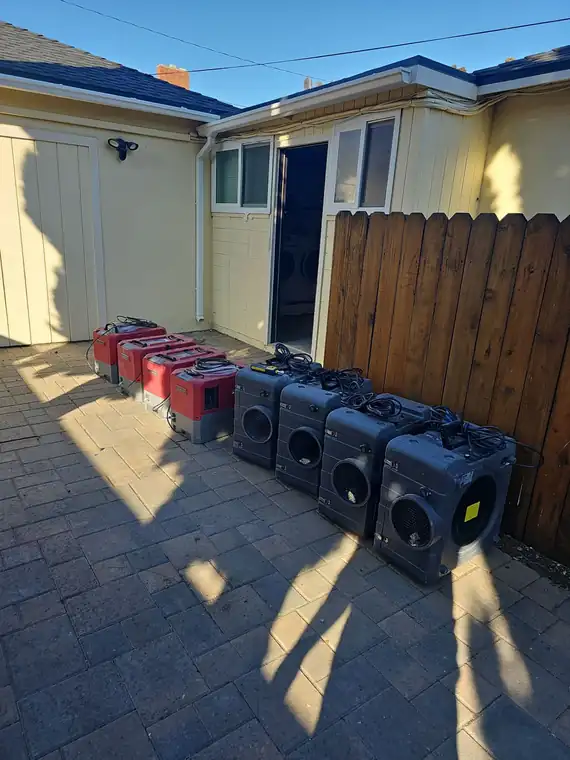
The clean-water version looks like this. Two air movers, which are the flat fans aimed along the wall, and one dehumidifier, running three or four days. A moisture meter reading taken every morning. Sign off comes when the wall that got wet reads the same as a wall that never did.
Then the debris has to go somewhere. Bags, a 20-yard dumpster, what the landfill charges by weight, and usually the contents as well: the toys off the floor, the boxes in the bottom of the closet, the bottom shelf of the pantry.
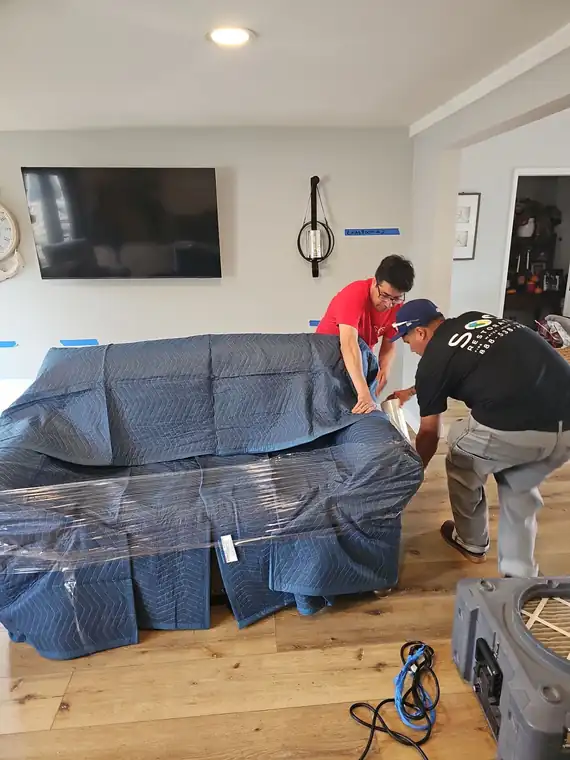
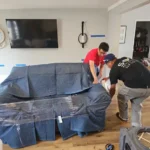
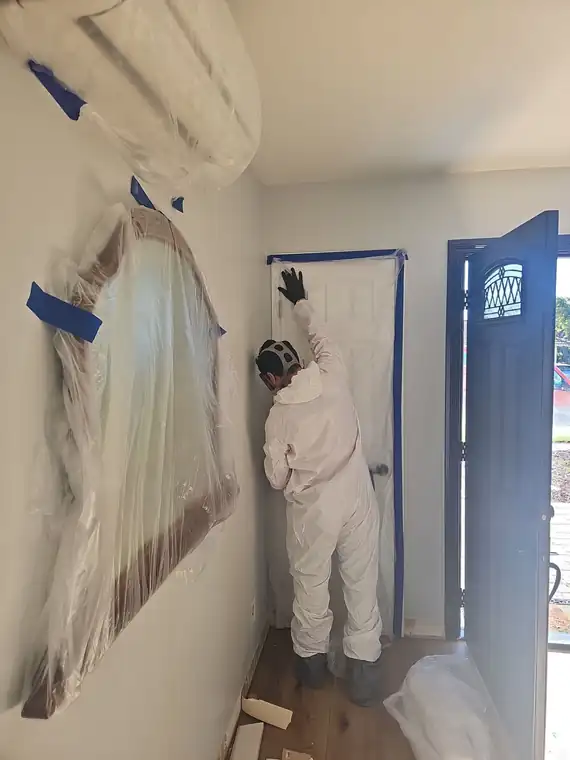
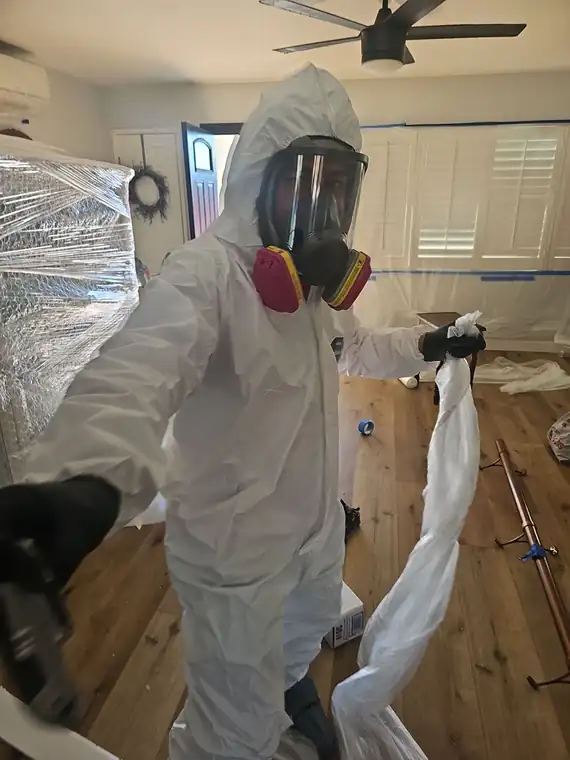
Then the plastic. Heavy sheeting taped floor to ceiling to close the work area off, a machine pulling air out of that room and blowing it through a window so the dust never reaches the rest of the house, and a route out to the truck that does not run through your living room.
Same 200 square feet of wet carpet, two ways. Category 1: replace the pad, keep the carpet, keep the drywall, dry the room. Category 3: the carpet, the pad, the bottom two feet of drywall and the insulation behind it all go in the dumpster, and the drying only starts once that is out.
Is class the same thing as category?
No, and both numbers turn up on the same estimate. Category is what is in the water. Class is how much of the house got wet and how grudgingly it will give the water back. A low class is a little wet material in a room of hard surfaces. A high class is water sitting inside plaster, hardwood or concrete, which surrender it slowly. A bad category with an easy class can land above the reverse, which is why two houses with the same size puddle end up holding invoices that look nothing alike.
Does an older Long Beach house cost more to tear out?
If your house went up before 1950, the plaster, the joint compound and the old floor tile all get treated as asbestos until a lab says otherwise, and that testing lands on the demolition side of the bill. Roughly a third of the housing in this city is that old. Category 3 is the category that means demolition, and demolition in an old house is where the air district wants a survey done first. The questions page has the threshold and the exemption. For your schedule it means a category 3 job in a pre-1950 house does not start the day you call.
None of this tells you what your own loss will cost, and anybody who gives you that figure over the phone without seeing it is guessing. What it does tell you is which questions the estimate in your hand should already answer. If the water came up out of a drain, the work is a different animal end to end, and sewage cleanup in Long Beach is where that story starts. If what you are really holding is a page of line items you do not recognize, the other guides here take them apart one at a time.
What to photograph before anything moves
Can We Stay in the House During the Work?
What does O&P mean on my damage estimate?
If you are standing in it right now and cannot tell what you are standing in, call (657) 660-4185 and ask; somebody in Long Beach picks up at any hour, and sorting out the category is the first thing that happens.