
The pipe let go and the water is still coming
Shut the water off at the valve nearest the break, keep out of any water that is touching electricity, and get whatever is sitting on the floor up off it. That is the first hour after a pipe bursts in a Long Beach house. Everything else, the drying and the paperwork and the phone calls, waits until the water stops.
Where is my water shutoff, and which one do I turn?
Start with the valve closest to whatever broke, not with the one out at the sidewalk.
Under the sink there is an angle stop on the wall for each supply line, hot and cold. An angle stop is that small oval-handled valve you have looked at a hundred times and never touched. Behind the toilet there is one on the left. Some are quarter-turn, some you spin four or five times, and they are the fastest thing in the house to close. On a water heater it is the valve on the cold line going into the top of the tank. If the failure is at one of those fixtures you are done in fifteen seconds and you never have to go looking for anything else.
Old stops seize. If yours will not move by hand, do not lean on it hard enough to snap the stem off the body, because a snapped stop is a bigger open pipe than the one you started with. Go up a level instead.
The main sits outside on the wall the water line comes in on, down low, usually within a few feet of the hose bib, which is the outdoor faucet you screw a garden hose onto. Sometimes it hides behind a little access panel, or a shrub nobody has trimmed in a decade.
If your floors are wood over a crawl space instead of concrete, the main may be down under the house, which is a miserable place to be crawling for the first time at midnight. That is a lot of homes here. Something like thirty-four thousand of them went up before 1940, and pre-war in this city usually means a raised foundation.
Failing all of that, there is a meter box out in the parkway, the strip of grass between the sidewalk and the curb. The valve on the house side of the meter is the one on your side of the line, and it takes a meter key or a wrench.
Go find it now, while nothing is wrong. Tag it with something you can read in the dark.
If you rent, or the building is a condo, the valve you need may not be yours to touch. The stops under the sink and behind the toilet are usually the only valves inside your own walls, and the building main is behind a locked utility door or down at a bank of meters in the garage. Close what you can reach, then wake the manager, and do that tonight rather than in the morning. In a stacked building the water is already in somebody else’s ceiling, and who ends up paying for that is an argument you do not have to win at 1am. The claim paperwork keeps until daylight too.
Is it safe to walk into the water?
It is not safe to walk into standing water until you know what that water is touching. Water coming through a ceiling light fixture is the clearest version of the problem: the fixture is now a bucket wired to a live circuit, and the water running down the wall underneath it is running over outlets. Water spreading across a floor toward the plug strip behind the television is the same thing with a longer fuse. Kill the circuit from a dry place, standing on dry floor, one hand in your pocket, before you step in.
If the panel itself is wet, or you would have to stand in the water to reach it, that is the point where an ordinary bad night becomes the kind you leave the house for. Do not reach it. An electrician or the utility can kill it from outside without anybody stepping into the water.
Do not count on the breaker to save you either. The outlets with the little test and reset buttons on the face, the ground-fault ones, were not required at kitchen counters until 1987. If the outlets by your sink do not have those buttons, nothing on that circuit trips before you do.
The bulge in the ceiling is water, not drywall
A ceiling holding water sags before it fails, and drywall does not sag like that on its own. Stay out from under it. If you want to relieve it into a bucket, do it from the doorway with a small hole at the low edge of the bulge, at arm’s length, and accept that you are going to get wet. In an older house the ceiling may be lath and plaster, wood slats with plaster pushed through them, which is far heavier than drywall and comes down in slabs instead of pieces. There I would close the door and leave it.


What do I move first?
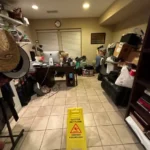
Move the cardboard first, then anything else that drinks water or will stain whatever it is sitting on. A box on a wet floor wicks several inches up its own sides while you are still looking for the valve, then folds, and what is inside it is what people actually grieve about a week later.
Then, in rough order:
- Rugs off hardwood, before the dye moves into the finish.
- Wood and metal furniture legs off wet carpet, or a square of foil under each one. Rust and stain bleed out of a leg overnight and never come back out of the pad.
- Cords, power strips, and anything with a battery in it, up onto a counter.
- The bottom drawer of the kitchen cabinets, emptied. The toe-kick under it, that recessed strip of board at the base of the cabinets where your feet go, is already holding water, and nobody will see it for three days.
- Whatever is irreplaceable, out of the room entirely, even the dry things.
Furniture you cannot lift, leave where it is. A soaked sofa is heavy enough to hurt you.
What should I leave alone?
Leave your walls, your ceiling, and the shop vacuum in the garage alone.
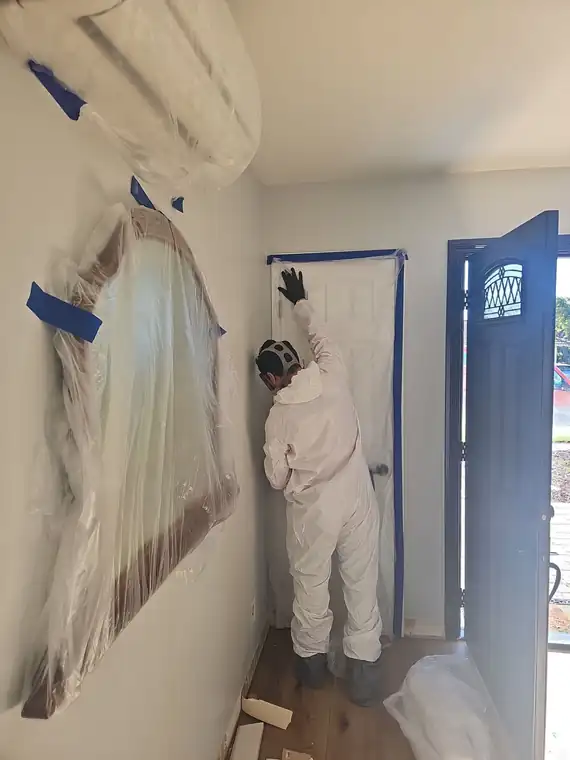
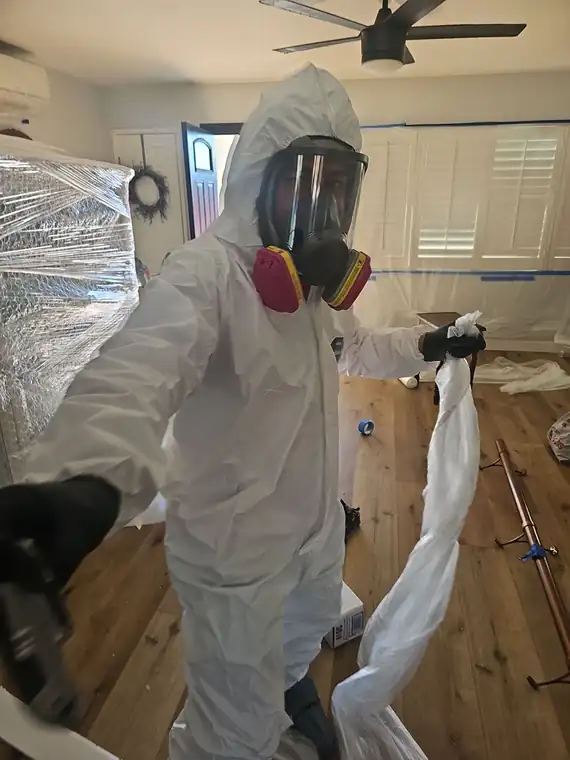
The urge at hour one is to start opening things up to see how bad it is, and here that urge is worth resisting, because of what these houses are made of. Close to four in five homes in Long Beach were built in 1979 or earlier. In a house of that vintage the plaster, the joint compound, the floor tile, and the black mastic under the tile are presumed to contain asbestos until somebody tests them, and cutting into that dry is how a water problem picks up a second set of rules and a second bill.
That same age bracket is the line the federal lead-paint rule draws, which is the other reason not to start scraping a swollen baseboard tonight.
Two more, in the same spirit:
- Do not run the air conditioning or the heater to help it dry. If the ducts took water, and in a slab house they usually run overhead while in an older raised house they may be under the floor, you have just moved wet air through the whole building.
- Do not put a household vacuum on standing water unless the label says it is rated for wet pickup. On a dry vacuum the motor sits in the airstream and the water goes straight to it.
And do not turn the water back on to check whether it is still leaking. It is.
Do I have to call someone tonight, or can this wait until morning?
Whether it can wait depends on how far the water traveled and what it went underneath. The size of the puddle you can see is not the measurement.
Here is the cheap answer, because it is often the right one. A glass of water on tile, caught right away, wiped up, with a fan on it, is not a job for anybody. Open the room up in the afternoon, leave the fan running, and look again in two days. If the grout is still dark, or the baseboard behind the spot has gone dark, then it went somewhere you cannot see.
What changes the answer is water that got into or under something you cannot reach: the pad beneath the carpet, the hollow behind a baseboard, the seams of a laminate floor, the underside of the subfloor. Those hold water for days while the surface you can touch feels dry to the hand.
And you do not have days. Carpet pad that is still wet on the third morning does not dry out, it goes to the curb. A baseboard found on Friday comes off and goes back on. The same baseboard found on Monday takes the bottom foot of drywall with it.
One local thing catches people out. Opening the windows does not reliably help in this city, which is the opposite of what everybody tells you. At five on an August morning the air out by the airport is sitting above eighty percent humidity, wetter than the room you are trying to dry, and it does not thin out until the middle of the afternoon. So open up at midday and shut it again at night.
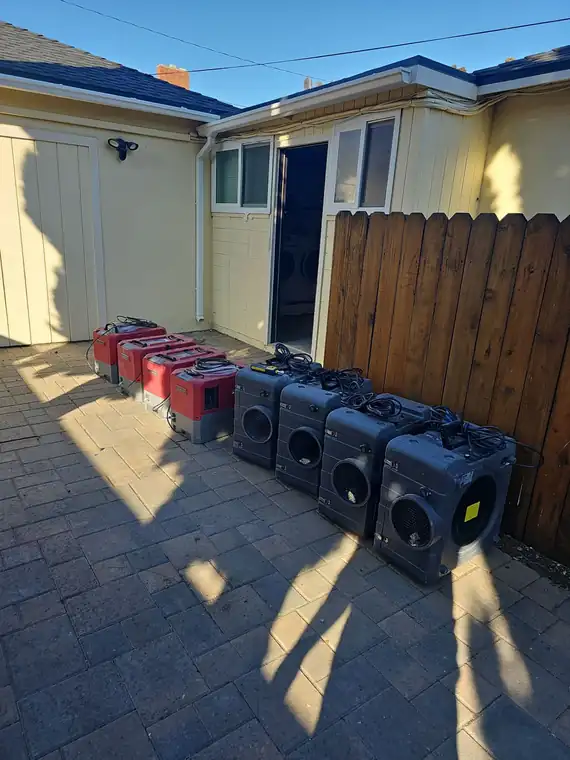
It is also why drying a room properly is not a window and a box fan. It is plastic over the doorway, three or four air movers, the low flat blowers that sit on the floor and push air along the wall, and one LGR dehumidifier draining into the sink. LGR stands for low grain refrigerant, which only means it keeps pulling water out of air that already feels dry.
What nobody can tell you at hour one is whether your particular wall dries or comes out. That is a number, not an opinion. A moisture meter with two pins that press into the wood, pushed into the same marked spot every morning, and read against a wall on the dry side of the same house so you know what normal looks like in your own place. Ask to see the readings.
If the water stayed and the fans are not winning, what the next three days actually look like is a longer answer than this page can carry.
What should I photograph, and what should I write down?
Write down two times: when you found the water, and when it stopped.
Photograph the source before you shut it off, if you can do that without standing somewhere stupid. The one frame nobody ever has is the pipe or the hose or the valve failing with water still in it. After that: the room from the doorway, the floor from standing height, the wet line on the wall, the serial plate on the appliance, the inside of the cabinet under the sink. There is more to that than fits here, and it has a guide of its own.
Everything that comes after tonight, the drying and the estimate and the check that arrives smaller than the estimate, is taken one question at a time in the rest of these guides.
Three Days of Fans and It Is Still Wet
Does homeowners insurance cover mold?
Water From the Unit Upstairs: Who Pays?
If the water is still on the floor and you would rather not guess at any of this on your own, SOS Restoration answers in Long Beach at any hour of the night on (657) 660-4185.