
The fire was next door. Nothing in your place burned, and everything in it smells.
Your place never caught fire and it still smells like one, because smoke goes where the air was already going: the shared attic, the hallway, your own vents. What you are left with is soot on surfaces and odor down inside soft things. SOS Restoration cleans smoke and soot in Long Beach at (657) 660-4185.
Can smoke get into my apartment if my unit never caught fire?
Yes, and in a building where you share a wall with somebody, that is the normal outcome rather than the unlucky one. Over a row of units the attic is usually one long open space with nothing sealing off one address from the next. A fire in unit 4 empties up into that space, runs the length of it over units 1 through 8, and settles down onto the top plate of every wall it crosses, the flat board a wall is capped with where it meets the ceiling.
The rest of the way in is holes nobody thinks about. Some of them leak a little at a time: the boxed-in space around the drain stack, that vertical pipe running floor to floor; the bathroom fan duct that ties two units together; the outlet and switch boxes; the cut in the ceiling around every recessed light. Three of them move real volume.
- the gap under your entry door, which is how hallway smoke gets in when a propped stairwell door pushes air down the corridor
- your own heating and air, if it was running, because it pulled smoke off the hallway or the attic and blew it into every room you own
- your windows, if smoke rolled out of theirs and the wind put it back through yours
If your windows face the burned unit, assume smoke came in that way. The breeze here comes off the water most afternoons, so whoever sat downwind of the fire took an outdoor dose on top of the indoor one. Check the window tracks and the sills on that side first.
How do I tell whether this is a smell or actual residue?
Wipe a white cotton cloth along the top edge of a door casing and look at the cloth. Nobody dusts up there, so it holds whatever fell out of the air. Do the same on the return grille, the big vent that sucks air back into your heating system, on top of the kitchen cabinets, and on the ceiling an inch or two out from a recessed light, where warm air lands first.
Four clean cloths and nothing settled in here. The smell is in your fabric: curtains, couch, clothes, bed.
Gray or black on the cloth means soot got in and landed. A yellow or tan film that smears when you press on it means something oily burned: plastics, wiring insulation, a mattress. That kind of residue is acidic, and it eats. It goes after chrome, the finish on a range hood, and the circuit boards inside anything that was plugged in while the air was dirty.
Pull the filter out of your furnace or air handler, the box with the blower in it, and lay it flat on the floor in daylight. A filter that went gray on the intake side inside a week is telling you the system carried smoke around your unit while you were out. Then pop off a vent and shine a phone light down the duct.
What can nobody tell from the doorway?
Whether soot got into the wall cavities and the insides of the ducts. A wall looks the same from your side whether the space behind it is clean or loaded. It takes a two-inch hole cut up high and a borescope, a little camera on a bendable wire, pushed in to look around. That is a fifteen-minute job for whoever you call, and it belongs before anybody quotes you a price for sealing.
Can I clean it myself, or does this need a crew?
Plenty of next-door smoke events are a laundry problem and a filter problem, nothing more. Light smell, clean cloth test, one or two rooms touched: wash every soft thing in the place, curtains and couch covers included, change the air filter, wipe the hard surfaces, and open the unit up on a dry day.
Dry first, wet second. Soot is a dry particle sitting on top of the paint, and a wet rag turns it into a stain that is now part of the wall. Use a dry chemical sponge, the rubbery block any paint store sells, with no water and no cleaner on it: pull it one direction, turn it to a clean face every few passes. The degreaser comes out afterward, in the kitchen, where the film on the cabinets was greasy before the fire ever started.
Pick your day for the windows. Air off the water is damp most mornings, and an open window only takes something out of the room when the outside is drier than the inside. Long Beach gets about 49 days a year when the humidity drops to 20 percent or under, and they bunch up around November and February.
Before any of that, check for water. A fire two doors down usually means hose water, and hose water runs under a shared wall into a subfloor you cannot see. Pull the carpet back in the corner nearest the burned unit and put your hand flat on the pad.
What tips it out of do-it-yourself territory:
- film you can see in rooms at the far end of the unit, a long way from the fire
- a filter or a return vent that went gray, which puts the problem inside the ductwork where a rag does not reach
- the sticky dark residue a slow smoldering fire leaves, the kind that smears under your thumb and takes solvent to move
- electronics and appliances that sat in it, which can power on fine today and corrode themselves quietly over the next six months
If anybody in the household has a breathing condition, ask their doctor before you spend a night in there.
What should I photograph before anything gets cleaned?
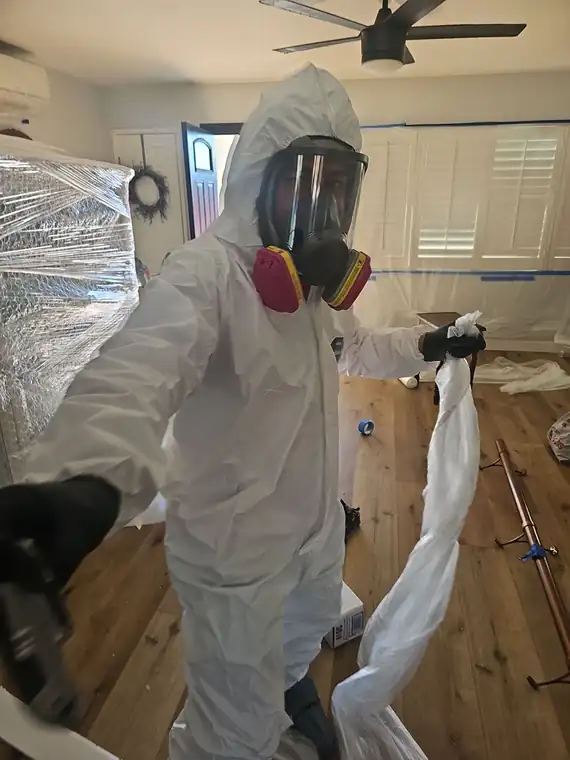
Shoot every room from the doorway before you move one object, then go in close for the details. The wide frame proves where things were. The close-up proves what was on them. Both come before the first load of laundry, because the laundry takes out the evidence and the smell in the same cycle.
Worth capturing while it still looks bad:
- the cloth test itself, held against something white, with a coin in the frame so the size reads
- the air filter pulled out and laid flat, next to a clean one if you have one
- the return vent, the supply vents, and the ceiling around the lights
- inside the closets and the dresser drawers, because a claim for clothes lives or dies on whether anybody photographed the clothes
- the shared wall, and the door or window closest to the burned unit
Write the boring facts down that same night: the date and the hour, whether your windows were open, whether the heat or the air conditioning was running, where the burned unit sits relative to yours. Then ask the fire department for the incident number. It ties your paperwork to theirs and it costs nothing.
Then start a receipt pile. A smoke loss puts people out of a unit that never burned, and the spending that follows is small and constant: the motel night, the laundromat, the box of filters, the extra miles driving the kids to school from wherever you are sleeping now. That is exactly the paper everybody throws away. Keep it. A cost you cannot document is a cost you ate, and how extra living costs get handled inside a claim is worked through on the page about documenting an insurance claim. There is a longer version of the documentation habit in what to photograph before anything gets moved.
My unit never burned. Who is supposed to pay for this?
Your place never burned and you are still the one about to spend money, which is the part that makes people furious. Two policies usually touch a loss like this, and neither belongs to the household whose kitchen it started in. If you rent, your own renters policy is what covers your belongings and, on most forms, the cost of sleeping somewhere else while the unit is unlivable. The landlord’s policy covers the building, not your things.
If you own a condominium, the line between the association’s master policy and yours is drawn in the CC&Rs, the recorded rulebook every owner in the building bought into. Pull them and read the part about interior finishes: the paint, the cabinets, the flooring.
Fault is a third track, and it moves slowly. Whether the household where the fire started owes anybody money is a liability question, generally worked out between carriers and attorneys long after the cleaning is finished. It is not a reason to sit still now.
What nobody honest will tell you is whether your particular policy covers this. We have not read it, and neither has any other website answering this question.
Two things are worth knowing while you are still standing in the hallway. California’s standard fire policy language hands you two jobs of your own: tell the insurer in writing without dragging your feet, and keep the damage from getting worse while everybody argues about who pays. Smoke residue does the getting-worse part quietly and on its own, on the chrome and inside the electronics, so cleaning early is part of that duty rather than something that puts your claim at risk.
The second one people almost never hear: under California’s insurance regulations, no insurer may require that the property be repaired by a company it names. Who does the work is your choice. The same split between the building and your belongings, applied to water instead of smoke, is on the page about who pays when the water came from the unit upstairs.
Why does the smell come back a month later?
The smell has been living in the carpet pad and in the insulation over your ceiling, and nobody pulled either one out, because nothing in your unit burned. Warm them up and they breathe it back at you. The first hot afternoon does it. So does the first cold night the heater runs, which is why people who cleaned up in October are back on the phone in December.
The cleaning did not fail. The pad is still full.
Surfaces are the easy half, and after a fire next door they are often the only half anybody touches, because nothing visible in your place was destroyed. The pad stays, the smoke-loaded insulation stays, the ducts never get opened, and it all smells fine for about six weeks. Where the soft material cannot come out, the answer is a coat of pigmented shellac primer over the framing and the back side of whatever is staying, which is a lid on the smell rather than a perfume over it.
The test for it is crude and it ends arguments. Shut the place up, let it get warm, come back an hour later and walk in with your nose. If it hits you at the door, something soft in there is still holding smoke. What that work involves, soot removal, contents, ducts, sealing, is laid out on the fire and smoke damage page. Other questions people ask in the weeks after a loss are answered across the rest of these guides.
Water From the Unit Upstairs: Who Pays?
Three Days of Fans and It Is Still Wet
Does homeowners insurance cover mold?
If you are standing in a Long Beach apartment that never burned and can still taste the smoke at two in the morning, the phone is answered at that hour: Ronen or one of the two guys picks up, any night of the year.