
Does homeowners insurance cover mold?
Mold coverage usually follows the water that caused it. The standard homeowners policy excludes mold, then hands back one narrow exception: mold hidden inside walls, ceilings, or under floors after a pipe or an appliance let go suddenly. Your own Long Beach policy decides the rest.
Two neighbors with the same stain on the same ceiling can get two different answers, because the pages stapled onto each policy are different.
Why does my policy exclude mold and then cover it anyway?
Because the policy is trying to keep two different stories apart. Mold that grew because the house was damp is one story. Mold that grew because something broke is the other. The first is treated as your housekeeping. The second is the one you bought the policy for.
Both halves sit within a few lines of each other. The standard homeowners form, the model contract most carriers start from, excludes loss caused by mold, fungus, or wet rot. A few lines later it gives one piece back: mold hidden inside the walls or ceilings, beneath the floors or above the ceilings, when it came from an accidental discharge or overflow, which is the policy’s way of saying water or steam escaped from a plumbing system or a household appliance in your own house.
Read that second clause twice. Almost every disagreement about mold coverage happens inside it.
Your carrier may use a different edition of that form, or bolt changes onto it that move the line. Pull your own copy before you lean on any of this.
Does insurance cover mold from water damage?
Mold from water damage is usually covered when the water arrived suddenly and accidentally, and usually excluded when it seeped for weeks.
The mold question tends to be settled before anyone looks at the mold. What gets looked at is the water: what it did, and how fast it did it. A pipe, a water heater, an air conditioner, or a supply line inside an appliance that lets go without warning is written into the policy by name. Slow is the other side of the same page. Wear and tear, deterioration, rust, and dry rot are excluded, and that is the language a carrier reaches for when the damage built up over months instead of arriving in one event.
Sudden does not settle everything either. The same clause that pays for what the water ruined leaves out the thing the water came out of, so the hose that failed is treated differently from the floor it soaked. Flood, surface water, and sewage backing up through a drain sit outside the policy on their own terms, and mold appearing afterward does not pull that water back in.
Does homeowners insurance cover mold from a roof leak?
Usually not.
That one mold exception is written around plumbing and household appliances inside the house, and a roof is neither of those. A roof case usually turns on whether the roof failed in a storm or simply wore out, and wear, deterioration, and dry rot are excluded by name. A Long Beach roof that has been quietly wicking water into the attic across a couple of wet winters is a maintenance argument long before anybody gets as far as the mold.
The day you find it is the day the record starts. Photograph the ceiling stain first. Then the flashing above it, the metal that seals where the roof meets a wall or a chimney, and the valley, the seam where two slopes of roof run together. Then the underside of the roof deck, the boards the shingles are nailed to, if you can get into the attic safely. Then all of it again a week later, so the file carries two dates instead of one. There is a full guide to what to photograph before anything moves.
Why is there a separate, smaller limit for mold on my policy?
The mold coverage you are asking about was probably sold to you as an add-on, and add-ons come with their own ceiling.
Anything past the narrow hidden-water exception generally arrives through a fungi or wet rot endorsement: an extra page attached to your policy that buys back a slice of what the main policy took out. No California statute sets that number and no state publication names one, so the only way to learn what you carry is to ask your agent or your company what type and amount of mold coverage is on the policy. Any website that publishes a figure is describing somebody else’s contract.
So do not scope a job against a number you read online. Pull the declarations page, the summary at the front of the policy that lists what you actually bought, and look for four things:
- A limit named for “fungi,” “wet rot,” or “bacteria,” usually sitting apart from the number that covers the house itself and much smaller than it.
- Whether that same limit has to pay for the testing and the tear-out, meaning the drywall and baseboard that come out to reach the wet part, and not only the removal.
- Whether it resets for each incident or is all you get for the policy year.
- Any endorsement number printed on the declarations page that is missing from your copy of the policy. Ask for the missing pages in writing.
The tear-out is usually the line that eats the limit, and what the removal work actually involves is set out separately. The rest of that declarations page, line by line, is what the other guides take apart.
Will homeowners insurance cover mold testing?
Testing usually gets paid when the insurance company ordered it as part of its own investigation, or when its adjuster signed off before you spent the money. A sample you order on your own initiative is often treated as a cost the policy does not owe, unless the fungi endorsement names testing inside its limit, which is exactly why the bullet above tells you to look.
Ask in writing before you spend it. There is a second reason to slow down here: the EPA says sampling is generally unnecessary where you can already see the mold growing, and there is no federal or state standard to measure the result against anyway. The handful of situations where a mold test does earn what it costs is a question of its own.
Is mold remediation covered by a home warranty?
A home warranty is a service contract on systems and appliances. It is not property insurance, and the two answer different questions.
The warranty may deal with the water heater that failed. The wet subfloor, the baseboard, the drywall a foot up the wall, and whatever grew in the cavity behind it are a property question, and property questions belong with the homeowners carrier. Warranty contracts vary enough that reading yours is the only instruction worth giving. Put the question to both companies in writing before anything gets opened up.
What should I do right now to protect the claim?
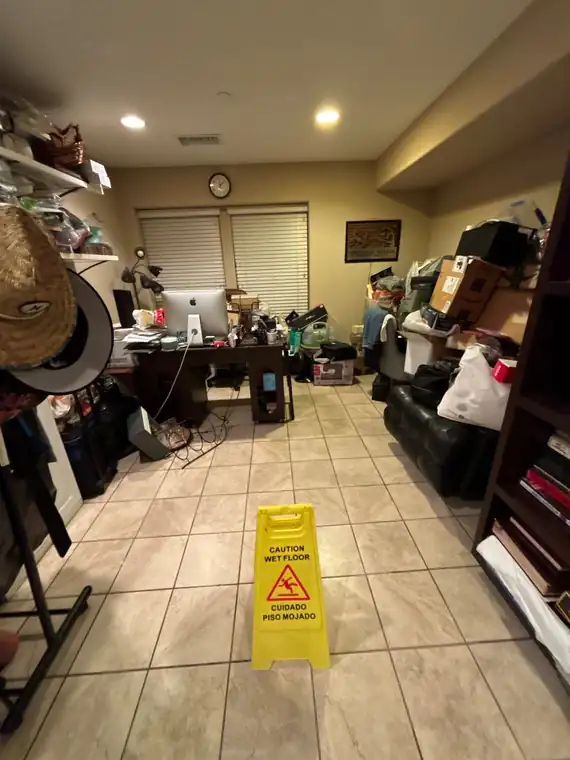
Dry it, document it, keep every receipt. Two of those three are duties written into the policy.
After a loss the policy puts three jobs on you: stop the damage spreading, make the reasonable repairs that stopping it takes, and keep an accurate record of what those repairs cost. Sitting on your hands has its own exclusion, for failing to use all reasonable means to save and preserve property. Nothing in that language sets a clock. Ignore any company that tells you a fixed number of hours decides your claim.
What the hours do decide is how much has to come out. On a Long Beach slab house, built straight onto concrete with nothing underneath it, a supply line that lets go behind the kitchen cabinets wets the subfloor and the bottom foot of drywall on both sides of that wall at once. The gap between finding it at 9pm and finding it at 9am is usually the difference between drying the cabinets where they stand and pulling the toe-kicks, the recessed panels at the bottom of the cabinet boxes, off to get air underneath. A 1920s bungalow on a raised foundation over in Belmont Heights fails the other way around: the water drops into the crawlspace under the floor where nobody looks, and the first sign is the smell in the hall.
Either way, a wall cavity that stays wet through a weekend is usually growing something by Monday, and a leak that has been running for weeks has already grown it. That is also why scrubbing at a patch you just found pushes spores into rooms that were fine. Drying runs on its own clock, well ahead of the paperwork, and how the drying itself gets done is set out separately.
Now the part that outranks everything above it. We have not read your policy, we are not a party to it, and no restoration company can tell you what your coverage is or how a claim will land. Your carrier has to answer questions about its own paperwork in writing. Public adjusters handle claims on a policyholder’s behalf for a fee and answer to the state separately, and a genuine fight over coverage is a lawyer’s question.
If you are further back than this page assumes, the walkthrough of how a water damage claim runs in Long Beach starts at the first phone call and gets into how the emergency invoice is treated when the settlement is added up.
What a Home Inspection Misses About Mold
Why the first insurance check is smaller
Why Category 3 Water Costs More to Clean
Whatever the policy turns out to say, the drying happens on its own clock, and SOS Restoration answers in Long Beach at any hour of the day or night on (657) 660-4185.