
The water came through your ceiling from the unit upstairs, and nobody will tell you who is paying for it.
Water from the unit above is coming through your ceiling. In a Long Beach condo, who pays for the water damage is settled by the CC&Rs, the rulebook recorded against your building, and by two separate insurance policies, the association’s and the unit owner’s. Whose pipe failed is a third question with its own answer.
Before any of that: if the ceiling is sagging or holding a bulge, get out from under it. The bulge is standing water sitting on drywall that is giving up, and it comes down all at once. The space above it, between your ceiling and their floor, is stuffed with framing and insulation and closed on both faces, so nothing in there dries on its own.
So who actually pays — my neighbor, the association, or me?
Who pays is whatever your building’s CC&Rs say it is. That document draws a line through the whole property: this side is yours to maintain, that side is common area, and here is who has to repair and replace each of them. Where the line sits was decided by whoever wrote your building’s declaration years ago, and it does not sit in the same place in a tower on Ocean as it does in a 1950s fourplex three blocks inland.
The document decides. Not the damage.
That is not really a procedural question, though. What you are afraid of is being handed a bill for a pipe you have never seen, in a wall you do not own, by the person who sleeps twelve feet above your bed.
Then there are the policies, and there really are two of them. Associations usually carry a master policy on the building. Unit owners usually carry their own, covering the inside of the unit and everything in it. One leak can put pieces of itself in both, plus a deductible that somebody has to absorb. Which piece lands where is a reading of your declarations page, the coverage summary your policy opens with, and a call to your carrier, and anyone who answers it without doing both is guessing with your money. You will also pass this neighbor in the elevator for years, which is the practical reason to get it settled on paper instead of in the hallway.
Does it matter whether it was my neighbor's fault?
Whose fault the leak was matters less than you would think, and it runs on a separate track from who pays to fix your ceiling. Repair responsibility comes out of the governing documents. Whether the owner upstairs personally owes you money, because he was careless or let a drip run for two weeks, is a negligence question, and negligence belongs to an attorney, not to a drying crew.
Here is what we cannot tell you: whether your building’s documents put this on the association, on the owner above you, or on you. We have not read your declaration, and neither has anybody else who is confidently telling you the answer. Ask the management company for it, along with any recorded amendments, and read the maintenance article and the insurance article first. They sit near the back and they run about four pages.
Where does the association's responsibility stop and my ceiling start?
The boundary usually sits inside the space between the two floors, and your recorded declaration is what says exactly where. On a ceiling leak the line tends to run through the framing, the insulation and their subfloor, the plywood layer under their flooring, rather than along the face of your drywall.
Which is worth knowing, because it is almost never one owner’s material that got wet. The water got out upstairs, from a braided supply hose or from the shower pan, the waterproof tray under their shower floor, then ran flat across the subfloor to the nearest opening and soaked the insulation and the framing in between, and came out through your ceiling and down the wall behind your kitchen cabinets. That is four or five different pieces of building, and the recorded line can run straight through the middle of them.
None of that is unusual. Two stacked units share one layer, and that layer belongs to both of you at once: your drywall on the underside, their subfloor on top, wet framing in the middle that neither of you can see or reach. The small piece of good news is that the management company has done this before, and there is probably a file on the last one.
I rent. Does any of this change for me?
Renting takes most of this off your plate, because you are not a party to the CC&Rs and the argument between the association and the owner upstairs is not yours to win. Your landlord’s policy covers the building you live in and nothing you own inside it. Your furniture, your clothes and a hotel bill if the unit becomes unlivable are what a renters policy is for, and if you do not carry one, that is the part nobody else is going to pay for you.
Whether your landlord owes you anything past that is habitability law, the rules about whether a place is legally fit to live in, and that is a tenant attorney’s ground rather than ours. This version of the question comes up more often downtown than the owner version does. In 90802, 79 percent of occupied units are rented.
Nobody has authorized anything and it is still dripping. What do I do tonight?
You do not need anybody’s authorization to protect your own things tonight. Catch what you can, get your furniture and boxes out from under the wet ceiling, and photograph them before you move them.
Whatever you spend tonight, keep the receipt on its own. The standard homeowners form puts a duty on the policyholder to do what is reasonable so the loss does not get bigger, and to keep an accurate record of what that costs. In a condo that record has to survive an argument, because the association’s carrier and your own will both end up looking at the same ceiling. Keep tonight’s receipts apart from next week’s, and photograph them before they go in a drawer.
The reason to move now is that two clocks are running at different speeds. A soaked cavity between two floors is the slowest part of the building to dry out, sealed on both faces with no air crossing it, and wet framing and insulation start growing things in days rather than weeks. Sorting out who pays takes longer than that. The gap between those two speeds is the whole reason somebody opens a ceiling before the question is settled, and how that drying is actually done is on our page about water damage restoration in Long Beach.
If the management company cannot get a crew out and the ceiling is still filling, somebody has to stop it tonight instead of in the morning. We answer at (657) 660-4185 at any hour, and so do other crews in Long Beach.
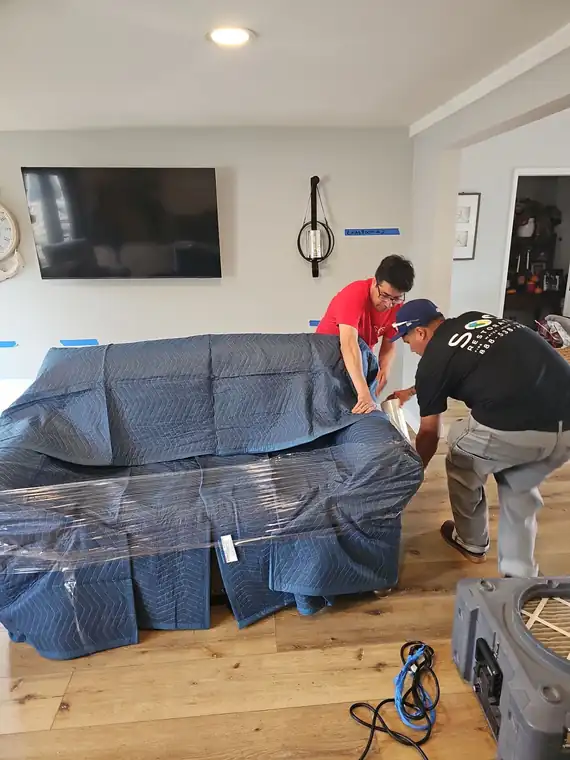
What should I photograph before anyone cuts into the ceiling?
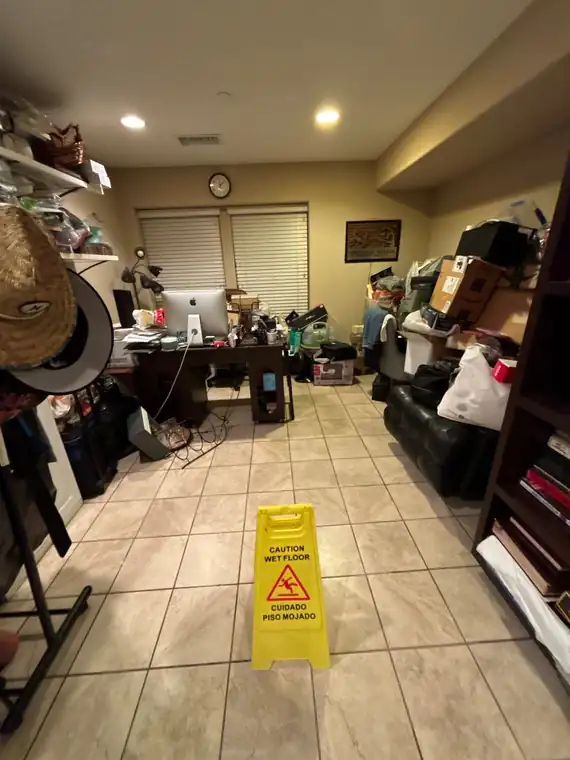
Photograph the ceiling before anyone touches it, the water on the floor, the inside of every cabinet underneath it, and every moisture reading a technician shows you. Then the shot you were about to skip, because that is usually the one that turns out to matter.
- The ceiling as it looks right now, framed wide enough to show which room and which wall, before one piece of drywall comes down.
- The source, if anyone ever lets you up there to see it: the failed hose, the shower pan, the angle stop under their sink, that little oval valve on the wall with the shutoff in the frame.
- The water on your floor and the line it left on the baseboard and on the toe kick, the board set back under the cabinets, because that line disappears the moment somebody mops.
- Inside the cabinets and inside the closet under the wet ceiling. That is where the contents half of this lives and it is the shot people always forget.
- Any moisture reading a technician shows you, photographed with the meter still held against the material and enough of the room visible to place it.
- Your ceiling again after they cut it open, with the wet insulation and the stained framing in the frame.
Then write down who you told and when, with a time on each: the management company, your carrier, and the owner upstairs if he answers the door. Two policies and a recorded declaration will eventually be pointed at the same ceiling, and the file with times in it is the one that gets read. The longer version of this is in what to photograph before anything gets moved, one of the Long Beach water damage guides.
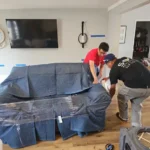

The building already sent its own restoration company. Do I have to use them?
It depends on who is paying for which part, and the two answers really are different.
For work the association is having done on its own property, it hires whoever its contract and its board settled on, and you are not the customer on that job. You can ask what they are drying and ask for the daily moisture readings. You cannot fire them.
For work running through your own policy, California limits how far your carrier can push you toward one particular company. The insurance claim page quotes the regulation. What matters here is how far it reaches: it binds insurance companies and nothing else. Your association is not an insurer, so do not walk into a board meeting quoting it at anybody.
Why the first check looks small, and what you can do about it, works the same here as on any other water loss. That part is laid out on our page about water damage insurance claims in Long Beach.
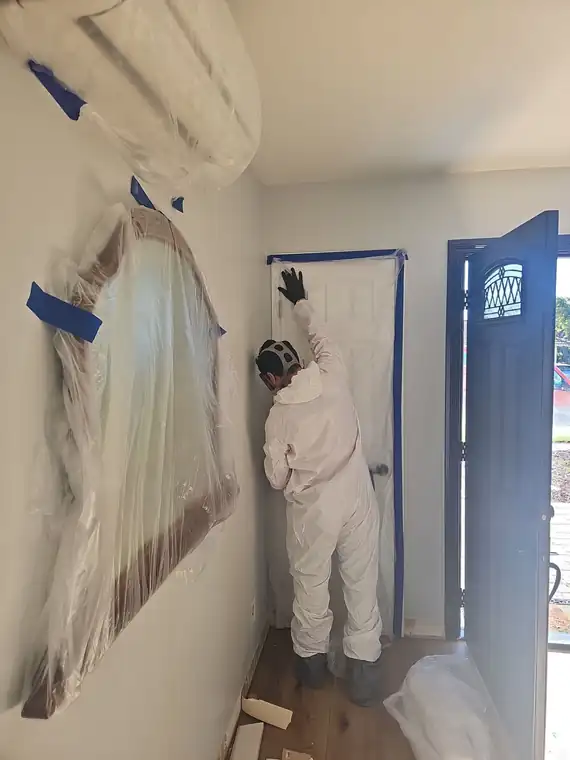
Why the first insurance check is smaller
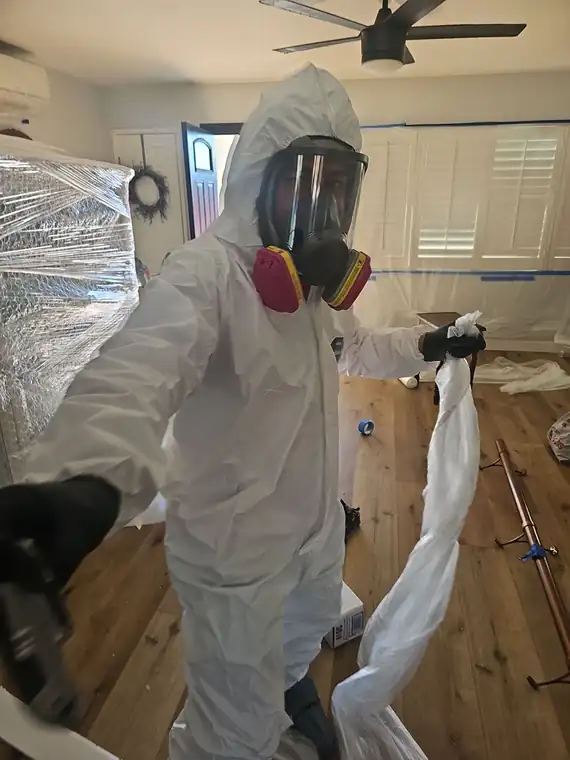
Why Category 3 Water Costs More to Clean
What a Home Inspection Misses About Mold
If the ceiling in your Long Beach condo is still dripping while everyone argues about the CC&Rs, call (657) 660-4185 and somebody will pick up, whatever hour it is.